Arsène Lupin, super-sleuth
Maurice Leblanc
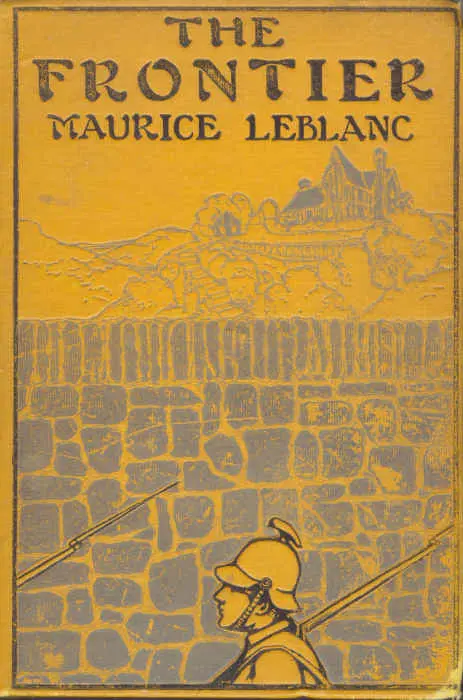
THE CLASSIC COLLECTION · 1912
"The Frontier" by Maurice Leblanc is a novel written in the early 20th century. The story revolves around the character of Morestal, a patriotic farmer and mayor, whose life is intricately connected to the tension between France and Germany, set against the backdrop of looming war. Through the lives of Morestal, his son Philippe, and the intertwining paths of other residents near the French-German border, the narrative grapples with themes of loyalty, national pride, and the personal costs of conflict. The opening of the book sets a tense atmosphere as Morestal and his wife discuss the ongoing disturbances along the French-German frontier, specifically the repeated damage to a boundary post, symbolizing deeper issues of national integrity and personal conflict stemming from past wars. We see Morestal's fierce pride in France and a palpable sense of foreboding as he reflects on the possibility of conflict re-emerging with Germany. The arrival of their son Philippe, a professor who has differing views, introduces an imminent clash of ideologies within the family, encapsulating the overarching struggle between old patriotic sentiments and newer, more progressive worldviews. As Philippe returns home with his wife Marthe, layers of personal history entwine with the national narrative, hinting at dramatic tensions both within the family and across the border.
Introduction adapted from the source catalogue; source summaries may be automatically generated.
Free to read · English · 57,388 words · No account needed
MAKE TIME FOR A GOOD BOOK
On by default. Untick to stop anonymous reading totals. Each page counts after 10 seconds in view. How this works.
Anonymous counting is on unless you have switched it off.
"Let them bring up as many guns as they please!... They can only take up positions which we command and which I have noted. A few good marksmen are enough to keep them from placing a battery."
And, turning to his son, he said to him, quite naturally, as though nothing had ever parted them:
"Are you coming, Philippe? We'll demolish them between us."
Captain Daspry interfered:
"Don't fire! We are not discovered yet. Wait till I give the order.... There'll be time enough later...."
Old Morestal had moved away.
Philippe walked resolutely towards the gate that led to the garden, to the open country. But he had not taken ten steps, when he stopped. He seemed to be vaguely suffering; and Marthe, who had not left his side, Marthe, anxious, full of mingled hope and apprehension, watched every phase of the tragic struggle:
"All the past is calling on you, Philippe; all the love for France that the past has bequeathed to you. Listen to its voice."
And, replying to every possible objection:
"Yes, I know, your intelligence rebels against it. But is one's intelligence everything?... Obey your instinct, Philippe.... It's your instinct that is right."
"No, no," he stammered, "one's instinct is never right...."
"It is right. But for that, you would be far away by now. But you can't go. Your whole being refuses to go. Your legs have not the strength for flight."
The Col du Diable was pouring forth troops and more troops, whose swarming masses showed along the slope. Others must be coming by the Albern Road; and, on every side, along every path and through every gap, the men of Germany were invading the soil of France.
The vanguard reached the high-road, at the end of the Etang-des-Moines.
There was a dull roll of the drum; and, suddenly, in the near silence, a hoarse voice barked out a German word of command.
Philippe started as though he had been struck.
And Marthe clung to him, pitilessly:
"Do you hear, Philippe? Do you understand? The German speech on French soil! Their language forced upon us!"
"Oh, no!" he said. "That can't be.... That will never be!"
"Why should it never be? Invasion comes first ... and then conquest ...
and subjection...."
Near them, the captain ordered:
"Let no one stir!"
Bullets spluttered against the walls, while the sounds of firing reverberated. A window-pane was smashed on the floor above. And more bullets broke fragments of stone from the coping of the parapet. The enemy, surprised at the disappearance of the French troops, were feeling their way before passing below that house, whose gloomy aspect must needs strike them as suspicious.
Your reading position is saved on this browser. Take it to another device with a library code. Reading pages adapt to text, rather than matching a printed edition.
Maurice Leblanc
Maurice Leblanc
Maurice Leblanc
Maurice Leblanc
BEHIND THE BOOK
This eBook is for the use of anyone anywhere in the United States and most other parts of the world at no cost and with almost no restrictions whatsoever. You may copy it, give it away or re-use it under the terms of the Project Gutenberg License included with this eBook or online at www.gutenberg.org. If you are not located in the United States, you will have to check the laws of the country where you are located before using this eBook. Read the source licence.
The original source file, including credits and licence, is retained by this library. Request an original-format copy at no charge. Please include the book title and Project Gutenberg identifier #28480.
KEEP YOUR CURIOSITY GOING
Cécile Tormay

Moritz Busch
Coulson Kernahan
John L. Ransom

Maurice Baring
Frances Wright