The type-writer girl
Grant Allen
THE CLASSIC COLLECTION · 1881
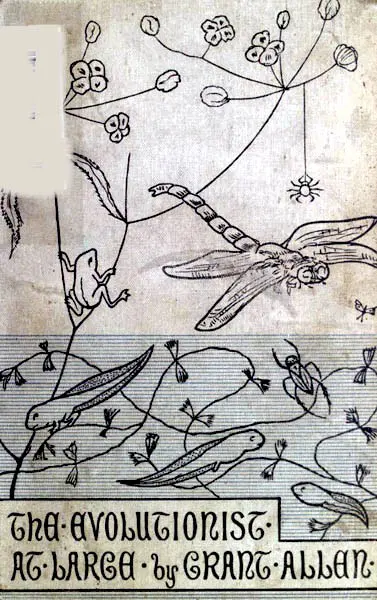
"The Evolutionist at Large" by Grant Allen is a collection of essays written in the late 19th century. This work seeks to engage non-scientific readers by simplifying the principles of evolution and illustrating the observable features of various plants and animals through a series of accessible explanations. Each essay explores a specific natural object, offering insights into its evolutionary significance and connections to the broader themes of natural history. At the start of the collection, the opening portion introduces the author’s personal reflections and poetic observations about nature, specifically focusing on a childhood connection to the flora of Canada. The preface sets the stage for the ensuing essays by outlining the author's intention to bridge the gap between complex scientific ideas and general understanding. This is followed by the first essay, which examines the intricate lives of ants and their reliance on olfactory senses, showcasing how different organisms perceive and interact with the world around them. The author emphasizes the idea that evolution not only shapes physical attributes but also influences sensory capabilities and behaviors, laying the groundwork for a deeper exploration of evolutionary concepts in subsequent essays.
Introduction adapted from the source catalogue; source summaries may be automatically generated.
Free to read · English · 47,571 words · No account needed
MAKE TIME FOR A GOOD BOOK
On by default. Untick to stop anonymous reading totals. Each page counts after 10 seconds in view. How this works.
Anonymous counting is on unless you have switched it off.
On the other hand, the second class consists of those birds which are exposed to the hostility of many wild animals, and more especially of man. These kinds, typified by the red grouse, partridges, quails, and guinea-fowls, are generally dingy in hue, with a tendency to pepper-and-salt in their plumage; and they usually display very little difference between the sexes, both cocks and hens being coloured and feathered much alike. In short, they are protectively designed, while the first class are attractive. Their plumage resembles as nearly as possible the ground on which they sit or the covert in which they skulk. They are thus enabled to escape the notice of their natural enemies, the birds of prey, from whose ravages they suffer far more in a state of nature than from any other cause. We may take the ptarmigans as the most typical example of this class of birds; for in summer their zigzagged black-and-brown attire harmonises admirably with the patches of faded heath and soil upon the mountain-side, as every sportsman well knows; while in the winter their pure white plumage can scarcely be distinguished from the snow in which they lie huddled and crouching during the colder months. Even in the brilliant species, Mr. Darwin and Mr. Wallace have pointed out that the ornamental colours and crest are never handed down to female descendants when the habits of nesting are such that the mothers would be exposed to danger by their conspicuousness during incubation. Speaking broadly, only those female birds which build in hollow trees or make covered nests have bright hues at all equal to those of the males. A female bird nesting in the open would be cut off if it showed any tendency to reproduce the brilliant colouring of its male relations.
Now the blackcock occupies to some extent an intermediate position between these two types of pheasant life, though it inclines on the whole to that first described. It is a polygamous bird, and it differs most conspicuously in plumage from its consort, the grey-hen, as may be seen from the very names by which they are each familiarly known. Yet, though the blackcock is handsome enough and shows evident marks of selective preference on the part of his ancestral hens, this preference has not exerted itself largely in the direction of bright colour, and that for two reasons. In the first place the blackcock does not feed upon brilliant foodstuffs, but upon small bog-berries, hard seeds, and young shoots of heather, and it is probable that an æsthetic taste for pure and dazzling hues is almost confined to those creatures which, like butterflies, hummingbirds, and parrots, seek their livelihood amongst beautiful fruits or flowers. In the second place, red, yellow, or orange ornaments would render the blackcock too conspicuous a mark for the hawk, the falcon, or the weapons of man; for we must remember that only those blackcocks survive from year to year and hand down their peculiarities to descendants which succeed in evading the talons of birds of prey or the small-shot of sportsmen. Feeding as they do on the open, they are not protected, like jungle-birds, by the shade of trees. Thus any bird which showed any marked tendency to develop brighter or more conspicuous plumage would almost infallibly fall a victim to one or other of his many foes; and however much his beauty might possibly charm his mates (supposing them for the moment to possess a taste for colour), he would have no chance of transmitting it to a future generation. Accordingly, the decoration of the blackcock is confined to glossy plumage and a few ornamental tail-feathers. The grey-hen herself still retains the dull and imitative colouring of the grouse race generally; and as for the cocks, even if a fair percentage of them is annually cut off through their comparative conspicuousness as marks, their loss is less felt than it would be in a monogamous community. Every spring the blackcock hold a sort of assembly or court of love, at which the pairing for the year takes place. The cocks resort to certain open and recognised spots, and there invite the grey-hens by their calls, a little duelling going on meanwhile. During these meetings they show off their beauty with great emulation, after the fashion with which we are all familiar in the case of the peacock; and when they have gained the approbation of their mates and maimed or driven away their rivals, they retire with their respective families. Unfortunately, like most polygamists, they make bad fathers, leaving the care of their young almost entirely to the hens. According to the veracious account of Artemus Ward, the great Brigham Young himself pathetically descanted upon the difficulty of extending his parental affections to 131 children. The imperious blackcock seems to labour under the same sentimental disadvantage.
Your reading position is saved on this browser. Take it to another device with a library code. Reading pages adapt to text, rather than matching a printed edition.
Grant Allen
Grant Allen
Grant Allen
Grant Allen
BEHIND THE BOOK
This eBook is for the use of anyone anywhere in the United States and most other parts of the world at no cost and with almost no restrictions whatsoever. You may copy it, give it away or re-use it under the terms of the Project Gutenberg License included with this eBook or online at www.gutenberg.org. If you are not located in the United States, you will have to check the laws of the country where you are located before using this eBook. Read the source licence.
The original source file, including credits and licence, is retained by this library. Request an original-format copy at no charge. Please include the book title and Project Gutenberg identifier #44820.
KEEP YOUR CURIOSITY GOING

David Patterson (Spirit) Hatch

David Patterson (Spirit) Hatch

David Patterson (Spirit) Hatch
Cécile Tormay

Moritz Busch
John L. Ransom