The type-writer girl
Grant Allen
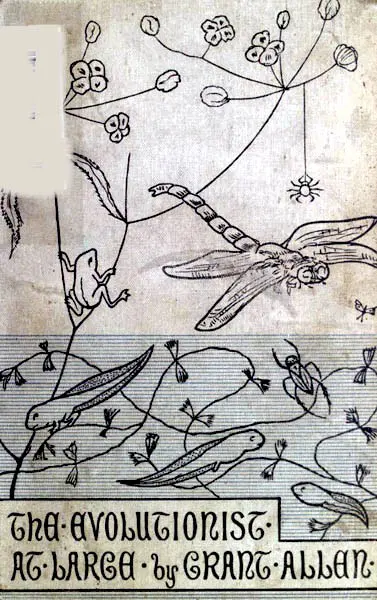
THE CLASSIC COLLECTION · 1881
"The Evolutionist at Large" by Grant Allen is a collection of essays written in the late 19th century. This work seeks to engage non-scientific readers by simplifying the principles of evolution and illustrating the observable features of various plants and animals through a series of accessible explanations. Each essay explores a specific natural object, offering insights into its evolutionary significance and connections to the broader themes of natural history. At the start of the collection, the opening portion introduces the author’s personal reflections and poetic observations about nature, specifically focusing on a childhood connection to the flora of Canada. The preface sets the stage for the ensuing essays by outlining the author's intention to bridge the gap between complex scientific ideas and general understanding. This is followed by the first essay, which examines the intricate lives of ants and their reliance on olfactory senses, showcasing how different organisms perceive and interact with the world around them. The author emphasizes the idea that evolution not only shapes physical attributes but also influences sensory capabilities and behaviors, laying the groundwork for a deeper exploration of evolutionary concepts in subsequent essays.
Introduction adapted from the source catalogue; source summaries may be automatically generated.
Free to read · English · 47,571 words · No account needed
MAKE TIME FOR A GOOD BOOK
On by default. Untick to stop anonymous reading totals. Each page counts after 10 seconds in view. How this works.
Anonymous counting is on unless you have switched it off.
This is the worst year for butterflies that I can remember. Entomologists all over England are in despair at the total failure of the insect crop, and have taken to botanising, angling, and other bad habits, in default of means for pursuing their natural avocation as beetle-stickers. Last year's heavy rains killed all the mothers as they emerged from the chrysalis; and so only a few stray eggs have survived till this summer, when the butterflies they produce will all be needed to keep up next season's supply. Nevertheless, I have climbed the highest down in this part of the country to-day, and come out for an airing among the heather, in the vague hope that I may be lucky enough to catch a glimpse of one or two old lepidopterous favourites. I am not a butterfly-hunter myself. I have not the heart to drive pins through the pretty creatures' downy bodies, or to stifle them with reeking chemicals; though I recognise the necessity for a hardened class who will perform that useful office on behalf of science and society, just as I recognise the necessity for slaughtermen and knackers. But I prefer personally to lie on the ground at my ease and learn as much about the insect nature as I can discover from simple inspection of the living subject as it flits airily from bunch to bunch of bright-coloured flowers.
I suppose even that apocryphal person, the general reader, would be insulted at being told at this hour of the day that all bright-coloured flowers are fertilised by the visits of insects, whose attentions they are specially designed to solicit. Everybody has heard over and over again that roses, orchids, and columbines have acquired their honey to allure the friendly bee, their gaudy petals to advertise the honey, and their divers shapes to ensure the proper fertilisation by the correct type of insect. But everybody does not know how specifically certain blossoms have laid themselves out for a particular species of fly, beetle, or tiny moth. Here on the higher downs, for instance, most flowers are exceptionally large and brilliant; while all Alpine climbers must have noticed that the most gorgeous masses of bloom in Switzerland occur just below the snow-line. The reason is, that such blossoms must be fertilised by butterflies alone. Bees, their great rivals in honey-sucking, frequent only the lower meadows and slopes, where flowers are many and small: they seldom venture far from the hive or the nest among the high peaks and chilly nooks where we find those great patches of blue gentian or purple anemone, which hang like monstrous breadths of tapestry upon the mountain sides. This heather here, now fully opening in the warmer sun of the southern counties--it is still but in the bud among the Scotch hills, I doubt not--specially lays itself out for the bumblebee, and its masses form about his highest pasture-grounds; but the butterflies--insect vagrants that they are--have no fixed home, and they therefore stray far above the level at which bee-blossoms altogether cease to grow. Now, the butterfly differs greatly from the bee in his mode of honey-hunting; he does not bustle about in a business-like manner from one buttercup or dead-nettle to its nearest fellow; but he flits joyously, like a sauntering straggler that he is, from a great patch of colour here to another great patch at a distance, whose gleam happens to strike his roving eye by its size and brilliancy. Hence, as that indefatigable observer, Dr. Hermann Müller, has noticed, all Alpine or hill-top flowers have very large and conspicuous blossoms, generally grouped together in big clusters so as to catch a passing glance of the butterfly's eye. As soon as the insect spies such a cluster, the colour seems to act as a stimulant to his broad wings, just as the candle-light does to those of his cousin the moth. Off he sails at once, as if by automatic action, towards the distant patch, and there both robs the plant of its honey and at the same time carries to it on his legs and head fertilising pollen from the last of its congeners which he favoured with a call. For of course both bees and butterflies stick on the whole to a single species at a time; or else the flowers would only get uselessly hybridised instead of being impregnated with pollen from other plants of their own kind. For this purpose it is that most plants lay themselves out to secure the attention of only two or three varieties among their insect allies, while they make their nectaries either too deep or too shallow for the convenience of all other kinds. Nature, though eager for cross-fertilisation, abhors 'miscegenation' with all the bitterness of an American politician.
Your reading position is saved on this browser. Take it to another device with a library code. Reading pages adapt to text, rather than matching a printed edition.
Grant Allen
Grant Allen
Grant Allen
Grant Allen
BEHIND THE BOOK
This eBook is for the use of anyone anywhere in the United States and most other parts of the world at no cost and with almost no restrictions whatsoever. You may copy it, give it away or re-use it under the terms of the Project Gutenberg License included with this eBook or online at www.gutenberg.org. If you are not located in the United States, you will have to check the laws of the country where you are located before using this eBook. Read the source licence.
The original source file, including credits and licence, is retained by this library. Request an original-format copy at no charge. Please include the book title and Project Gutenberg identifier #44820.
KEEP YOUR CURIOSITY GOING

David Patterson (Spirit) Hatch

David Patterson (Spirit) Hatch

David Patterson (Spirit) Hatch
Cécile Tormay

Moritz Busch
John L. Ransom