The type-writer girl
Grant Allen
THE CLASSIC COLLECTION · 1881
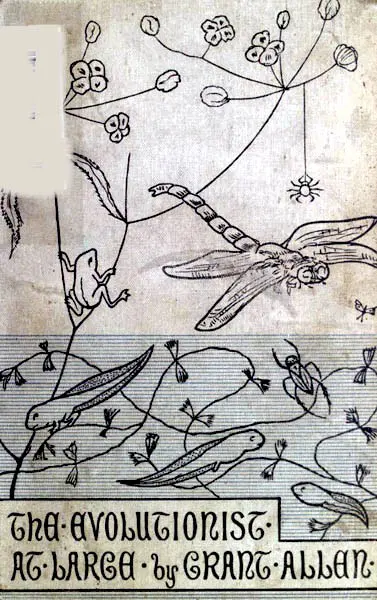
"The Evolutionist at Large" by Grant Allen is a collection of essays written in the late 19th century. This work seeks to engage non-scientific readers by simplifying the principles of evolution and illustrating the observable features of various plants and animals through a series of accessible explanations. Each essay explores a specific natural object, offering insights into its evolutionary significance and connections to the broader themes of natural history. At the start of the collection, the opening portion introduces the author’s personal reflections and poetic observations about nature, specifically focusing on a childhood connection to the flora of Canada. The preface sets the stage for the ensuing essays by outlining the author's intention to bridge the gap between complex scientific ideas and general understanding. This is followed by the first essay, which examines the intricate lives of ants and their reliance on olfactory senses, showcasing how different organisms perceive and interact with the world around them. The author emphasizes the idea that evolution not only shapes physical attributes but also influences sensory capabilities and behaviors, laying the groundwork for a deeper exploration of evolutionary concepts in subsequent essays.
Introduction adapted from the source catalogue; source summaries may be automatically generated.
Free to read · English · 47,571 words · No account needed
MAKE TIME FOR A GOOD BOOK
On by default. Untick to stop anonymous reading totals. Each page counts after 10 seconds in view. How this works.
Anonymous counting is on unless you have switched it off.
It is a piece of the common vanity of anglers to suppose that they know something about speckled trout. A fox might almost as well pretend that he was intimately acquainted with the domestic habits of poultry, or an Iroquois describe the customs of the Algonquins from observations made upon the specimens who had come under his scalping-knife. I will allow that anglers are well versed in the necessity for fishing up-stream rather than in the opposite direction; and I grant that they have attained an empirical knowledge of the æsthetic preferences of trout in the matter of blue duns and red palmers; but that as a body they are familiar with the speckled trout at home I deny. If you wish to learn all about the race in its own life you must abjure rod and line, and creep quietly to the side of the pools in an unfished brooklet, like this on whose bank I am now seated; and then, if you have taken care not to let your shadow fall upon the water, you may sit and watch the live fish themselves for an hour together, as they bask lazily in the sunlight, or rise now and then at cloudy moments with a sudden dart at a May-fly who is trying in vain to lay her eggs unmolested on the surface of the stream. The trout in my little beck are fortunately too small even for poachers to care for tickling them: so I am able entirely to preserve them as objects for philosophical contemplation, without any danger of their being scared away from their accustomed haunts by intrusive anglers.
Trout always have a recognised home of their own, inhabited by a pretty fixed number of individuals. But if you catch the two sole denizens of a particular scour, you will find another pair installed in their place to-morrow. Young fry seem always ready to fill up the vacancies caused by the involuntary retirement of their elders. Their size depends almost entirely upon the quantity of food they can get; for an adult fish may weigh anything at any time of his life, and there is no limit to the dimensions they may theoretically attain. Mr. Herbert Spencer, who is an angler as well as a philosopher, well observes that where the trout are many they are generally small; and where they are large they are generally few. In the mill-stream down the valley they measure only six inches, though you may fill a basket easily enough on a cloudy day; but in the canal reservoir, where there are only half-a-dozen fish altogether, a magnificent eight-pounder has been taken more than once. In this way we can understand the origin of the great lake trout, which weigh sometimes forty pounds. They are common trout which have taken to living in broader waters, where large food is far more abundant, but where shoals of small fish would starve. The peculiarities thus impressed upon them have been handed down to their descendants, till at length they have become sufficiently marked to justify us in regarding them as a separate species. But it is difficult to say what makes a species in animals so very variable as fish. There are, in fact, no less than twelve kinds of trout wholly peculiar to the British Islands, and some of these are found in very restricted areas. Thus, the Loch Stennis trout inhabits only the tarns of Orkney; the Galway sea trout lives nowhere but along the west coast of Ireland; the gillaroo never strays out of the Irish loughs; the Killin charr is confined to a single sheet of water in Mayo; and other species belong exclusively to the Llanberis lakes, to Lough Melvin, or to a few mountain pools of Wales and Scotland. So great is the variety that may be produced by small changes of food and habitat. Even the salmon himself is only a river trout who has acquired the habit of going down to the sea, where he gets immensely increased quantities of food (for all the trout kind are almost omnivorous), and grows big in proportion. But he still retains many marks of his early existence as a river fish. In the first place, every salmon is hatched from the egg in fresh water, and grows up a mere trout. The young parr, as the salmon is called in this stage of its growth, is actually (as far as physiology goes) a mature fish, and is capable of producing milt, or male spawn, which long caused it to be looked upon as a separate species. It really represents, however, the early form of the salmon, before he took to his annual excursion to the sea. The ancestral fish, only a hundredth fraction in weight of his huge descendant, must have somehow acquired the habit of going seaward--possibly from a drying up of his native stream in seasons of drought. In the sea, he found himself suddenly supplied with an unwonted store of food, and grew, like all his kind under similar circumstances, to an extraordinary size. Thus he attains, as it were, to a second and final maturity. But salmon cannot lay their eggs in the sea; or at least, if they did, the young parr would starve for want of their proper food, or else be choked by the salt water, to which the old fish have acclimatised themselves. Accordingly, with the return of the spawning season there comes back an instinctive desire to seek once more the native fresh water. So the salmon return up stream to spawn, and the young are hatched in the kind of surroundings which best suit their tender gills. This instinctive longing for the old home may probably have arisen during an intermediate stage, when the developing species still haunted only the brackish water near the river mouths; and as those fish alone which returned to the head waters could preserve their race, it would soon grow hardened into a habit engrained in the nervous system, like the migration of birds or the clustering of swarming bees around their queen. In like manner the Jamaican land-crabs, which themselves live on the mountain-tops, come down every year to lay their eggs in the Caribbean; because, like all other crabs, they pass their first larval stage as swimming tadpoles, and afterwards take instinctively to the mountains, as the salmon takes to the sea. Such a habit could only have arisen by one generation after another venturing further and further inland, while always returning at the proper season to the native element for the deposition of the eggs.
Your reading position is saved on this browser. Take it to another device with a library code. Reading pages adapt to text, rather than matching a printed edition.
Grant Allen
Grant Allen
Grant Allen
Grant Allen
BEHIND THE BOOK
This eBook is for the use of anyone anywhere in the United States and most other parts of the world at no cost and with almost no restrictions whatsoever. You may copy it, give it away or re-use it under the terms of the Project Gutenberg License included with this eBook or online at www.gutenberg.org. If you are not located in the United States, you will have to check the laws of the country where you are located before using this eBook. Read the source licence.
The original source file, including credits and licence, is retained by this library. Request an original-format copy at no charge. Please include the book title and Project Gutenberg identifier #44820.
KEEP YOUR CURIOSITY GOING

David Patterson (Spirit) Hatch

David Patterson (Spirit) Hatch

David Patterson (Spirit) Hatch
Cécile Tormay

Moritz Busch
John L. Ransom