The type-writer girl
Grant Allen
THE CLASSIC COLLECTION · 1881
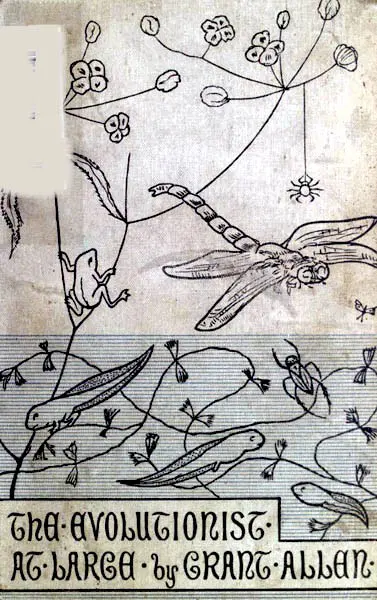
"The Evolutionist at Large" by Grant Allen is a collection of essays written in the late 19th century. This work seeks to engage non-scientific readers by simplifying the principles of evolution and illustrating the observable features of various plants and animals through a series of accessible explanations. Each essay explores a specific natural object, offering insights into its evolutionary significance and connections to the broader themes of natural history. At the start of the collection, the opening portion introduces the author’s personal reflections and poetic observations about nature, specifically focusing on a childhood connection to the flora of Canada. The preface sets the stage for the ensuing essays by outlining the author's intention to bridge the gap between complex scientific ideas and general understanding. This is followed by the first essay, which examines the intricate lives of ants and their reliance on olfactory senses, showcasing how different organisms perceive and interact with the world around them. The author emphasizes the idea that evolution not only shapes physical attributes but also influences sensory capabilities and behaviors, laying the groundwork for a deeper exploration of evolutionary concepts in subsequent essays.
Introduction adapted from the source catalogue; source summaries may be automatically generated.
Free to read · English · 47,571 words · No account needed
MAKE TIME FOR A GOOD BOOK
On by default. Untick to stop anonymous reading totals. Each page counts after 10 seconds in view. How this works.
Anonymous counting is on unless you have switched it off.
Behind the old mill, whose overshot wheel, backed by a wall thickly covered with the young creeping fronds of hart's-tongue ferns, forms such a picturesque foreground for the view of our little valley, the mill-stream expands into a small shallow pond, overhung at its edges by thick-set hazel-bushes and clambering honeysuckle. Of course it is only dammed back by a mud wall, with sluices for the miller's water-power; but it has a certain rustic simplicity of its own, which makes it beautiful to our eyes for all that, in spite of its utilitarian origin. At the bottom of this shallow pond you may now see a miracle daily taking place, which but for its commonness we should regard as an almost incredible marvel. You may there behold evolution actually illustrating the transformation of life under your very eyes: you may watch a low type of gill-breathing gristly-boned fish developing into the highest form of lung-breathing terrestrial amphibian. Nay, more--you may almost discover the earliest known ancestor of the whole vertebrate kind, the first cousin of that once famous ascidian larva, passing through all the upward stages of existence which finally lead it to assume the shape of a relatively perfect four-legged animal. For the pond is swarming with fat black tadpoles, which are just at this moment losing their tails and developing their legs, on the way to becoming fully formed frogs.
The tadpole and the ascidian larva divide between them the honour of preserving for us in all its native simplicity the primitive aspect of the vertebrate type. Beasts, birds, reptiles, and fishes have all descended from an animal whose shape closely resembled that of these wriggling little black creatures which dart up and down like imps through the clear water, and raise a cloud of mud above their heads each time that they bury themselves comfortably in the soft mud of the bottom. But while the birds and beasts, on the one hand, have gone on bettering themselves out of all knowledge, and while the ascidian, on the other hand, in his adult form has dropped back into an obscure and sedentary life--sans eyes, sans teeth, sans taste, sans everything--the tadpole alone, at least during its early days, remains true to the ancestral traditions of the vertebrate family. When first it emerges from its egg it represents the very most rudimentary animal with a backbone known to our scientific teachers. It has a big hammer-looking head, and a set of branching outside gills, and a short distinct body, and a long semi-transparent tail. Its backbone is a mere gristly channel, in which lies its spinal cord. As it grows, it resembles in every particular the ascidian larva, with which, indeed, Kowalewsky and Professor Ray Lankester have demonstrated its essential identity. But since a great many people seem wrongly to imagine that Professor Lankester's opinion on this matter is in some way at variance with Mr. Darwin's and Dr. Haeckel's, it may be well to consider what the degeneracy of the ascidian really means. The fact is, both larval forms--that of the frog and that of the ascidian--completely agree in the position of their brains, their gill-slits, their very rudimentary backbones, and their spinal cords. Moreover, we ourselves and the tadpole agree with the ascidian in a further most important point, which no invertebrate animal shares with us; and that is that our eyes grow out of our brains, instead of being part of our skin, as in insects and cuttle-fish. This would seem à priori a most inconvenient place for an eye--inside the brain; but then, as Professor Lankester cleverly suggests, our common original ancestor, the very earliest vertebrate of all, must have been a transparent creature, and therefore comparatively indifferent as to the part of his body in which his eye happened to be placed. In after ages, however, as vertebrates generally got to have thicker skulls and tougher skins, the eye-bearing part of the brain had to grow outward, and so reach the light on the surface of the body: a thing which actually happens to all birds, beasts, and reptiles in the course of their embryonic development. So that in this respect the ascidian larva is nearer to the original type than the tadpole or any other existing animal.
Your reading position is saved on this browser. Take it to another device with a library code. Reading pages adapt to text, rather than matching a printed edition.
Grant Allen
Grant Allen
Grant Allen
Grant Allen
BEHIND THE BOOK
This eBook is for the use of anyone anywhere in the United States and most other parts of the world at no cost and with almost no restrictions whatsoever. You may copy it, give it away or re-use it under the terms of the Project Gutenberg License included with this eBook or online at www.gutenberg.org. If you are not located in the United States, you will have to check the laws of the country where you are located before using this eBook. Read the source licence.
The original source file, including credits and licence, is retained by this library. Request an original-format copy at no charge. Please include the book title and Project Gutenberg identifier #44820.
KEEP YOUR CURIOSITY GOING

David Patterson (Spirit) Hatch

David Patterson (Spirit) Hatch

David Patterson (Spirit) Hatch
Cécile Tormay

Moritz Busch
John L. Ransom