The type-writer girl
Grant Allen
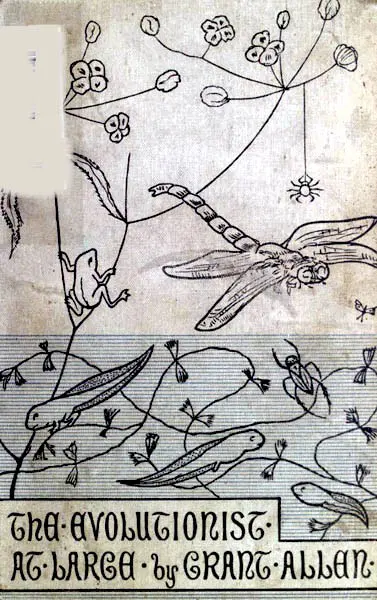
THE CLASSIC COLLECTION · 1881
"The Evolutionist at Large" by Grant Allen is a collection of essays written in the late 19th century. This work seeks to engage non-scientific readers by simplifying the principles of evolution and illustrating the observable features of various plants and animals through a series of accessible explanations. Each essay explores a specific natural object, offering insights into its evolutionary significance and connections to the broader themes of natural history. At the start of the collection, the opening portion introduces the author’s personal reflections and poetic observations about nature, specifically focusing on a childhood connection to the flora of Canada. The preface sets the stage for the ensuing essays by outlining the author's intention to bridge the gap between complex scientific ideas and general understanding. This is followed by the first essay, which examines the intricate lives of ants and their reliance on olfactory senses, showcasing how different organisms perceive and interact with the world around them. The author emphasizes the idea that evolution not only shapes physical attributes but also influences sensory capabilities and behaviors, laying the groundwork for a deeper exploration of evolutionary concepts in subsequent essays.
Introduction adapted from the source catalogue; source summaries may be automatically generated.
Free to read · English · 47,571 words · No account needed
MAKE TIME FOR A GOOD BOOK
On by default. Untick to stop anonymous reading totals. Each page counts after 10 seconds in view. How this works.
Anonymous counting is on unless you have switched it off.
How the dodder acquired this curious mode of life it is not difficult to see. By descent it is a bind-weed, or wild convolvulus, and its blossoms are in the main miniature convolvulus blossoms still. Now, all bind-weeds, as everybody knows, are climbing plants, which twine themselves round stouter stems for mere physical support This is in itself a half-parasitic habit, because it enables the plant to dispense with the trouble of making a thick and solid stem for its own use. But just suppose that any bind-weed, instead of merely twining, were to put forth here and there little tendrils, something like those of the ivy, which managed somehow to grow into the bark of the host, and so naturally graft themselves to its tissues. In that case the plant would derive nutriment from the stouter stem with no expense to itself, and it might naturally be expected to grow strong and healthy, and hand down its peculiarities to its descendants. As the leaves would thus be rendered needless, they would first become very much reduced in size, and would finally disappear altogether, according to the universal custom of unnecessary organs. So we should get at length a leafless plant, with numerous flowers and seeds, just like the dodder. Parasites, in fact, whether animal or vegetable, always end by becoming mere reproductive sacs, mechanisms for the simple elaboration of eggs or seeds. This is just what has happened to the dodder before me.
The other queer plant here is a broomrape. It consists of a tall, somewhat faded-looking stem, upright instead of climbing, and covered with brown or purplish scales in the place of leaves. Its flowers resemble the scales in colour, and the dead-nettle in shape. It is, in fact, a parasitic dead-nettle, a trifle less degenerate as yet than the dodder. This broomrape has acquired somewhat the same habits as the other plant, only that it fixes itself on the roots of clover or broom, from which it sucks nutriment by its own root, as the dodder does by its stem-suckers. Of course it still retains in most particulars its original characteristics as a dead-nettle; it grows with their upright stem and their curiously shaped flowers, so specially adapted for fertilisation by insect visitors. But it has naturally lost its leaves, for which it has no further use, and it possesses no chlorophyll, as the mistletoe does. Yet it has not probably been parasitic for as long a time as the dodder, since it still retains a dwindling trace of its leaves in the shape of dry purply scales, something like those of young asparagus shoots. These leaves are now, in all likelihood, actually undergoing a gradual atrophy, and we may fairly expect that in the course of a few thousand years they will disappear altogether. At present, however, they remain very conspicuous by their colour, which is not green, owing to the absence of chlorophyll, but is due to the same pigment as that of the blossoms. This generally happens with parasites, or with that other curious sort of plants known as saprophytes, which live upon decaying living matter in the mould of forests. As they need no green leaves, but have often inherited leafy structures of some sort, in a more or less degenerate condition, from their self-supporting ancestors, they usually display most beautiful colours in their stems and scales, and several of them rank amongst our handsomest hot-house plants. Even the dodder has red stalks. Their only work in life being to elaborate the materials stolen from their host into the brilliant pigments used in the petals for attracting insect fertilisers, they pour this same dye into the stems and scales, which thus render them still more conspicuous to the insects' eyes. Moreover, as they use their whole material in producing flowers, many of these are very large and handsome; one huge Sumatran species has a blossom which measures three feet across. On the other hand, their seeds are usually small and very numerous. Thousands of seeds must fall on unsuitable places, spring up, and waste all their tiny store of nourishment, find no host at hand on which to fasten themselves, and so die down for want of food. It is only by producing a few thousand young plants for every one destined ultimately to survive that dodders and broomrapes manage to preserve their types at all.
Your reading position is saved on this browser. Take it to another device with a library code. Reading pages adapt to text, rather than matching a printed edition.
Grant Allen
Grant Allen
Grant Allen
Grant Allen
BEHIND THE BOOK
This eBook is for the use of anyone anywhere in the United States and most other parts of the world at no cost and with almost no restrictions whatsoever. You may copy it, give it away or re-use it under the terms of the Project Gutenberg License included with this eBook or online at www.gutenberg.org. If you are not located in the United States, you will have to check the laws of the country where you are located before using this eBook. Read the source licence.
The original source file, including credits and licence, is retained by this library. Request an original-format copy at no charge. Please include the book title and Project Gutenberg identifier #44820.
KEEP YOUR CURIOSITY GOING

David Patterson (Spirit) Hatch

David Patterson (Spirit) Hatch

David Patterson (Spirit) Hatch
Cécile Tormay

Moritz Busch
John L. Ransom