The type-writer girl
Grant Allen
THE CLASSIC COLLECTION · 1881
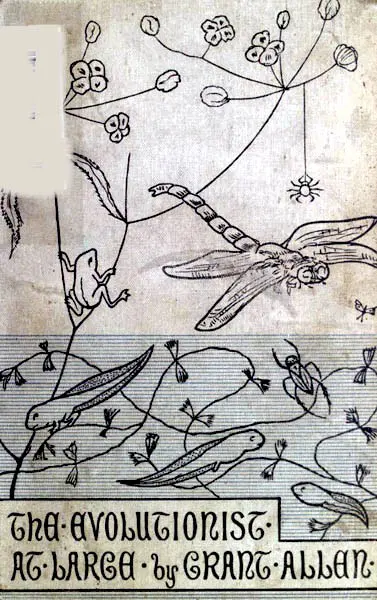
"The Evolutionist at Large" by Grant Allen is a collection of essays written in the late 19th century. This work seeks to engage non-scientific readers by simplifying the principles of evolution and illustrating the observable features of various plants and animals through a series of accessible explanations. Each essay explores a specific natural object, offering insights into its evolutionary significance and connections to the broader themes of natural history. At the start of the collection, the opening portion introduces the author’s personal reflections and poetic observations about nature, specifically focusing on a childhood connection to the flora of Canada. The preface sets the stage for the ensuing essays by outlining the author's intention to bridge the gap between complex scientific ideas and general understanding. This is followed by the first essay, which examines the intricate lives of ants and their reliance on olfactory senses, showcasing how different organisms perceive and interact with the world around them. The author emphasizes the idea that evolution not only shapes physical attributes but also influences sensory capabilities and behaviors, laying the groundwork for a deeper exploration of evolutionary concepts in subsequent essays.
Introduction adapted from the source catalogue; source summaries may be automatically generated.
Free to read · English · 47,571 words · No account needed
MAKE TIME FOR A GOOD BOOK
On by default. Untick to stop anonymous reading totals. Each page counts after 10 seconds in view. How this works.
Anonymous counting is on unless you have switched it off.
The base of the cliffs consists entirely of a very soft and plastic blue lias mud. This mud contains large numbers of fossils, chiefly chambered shells, but mixed with not a few relics of the great swimming and flying lizards that swarmed among the shallow flats or low islands of the lias sea. When the blue mud was slowly accumulating in the hollows of the ancient bottom, these huge saurians formed practically the highest race of animals then existing upon earth. There were, it is true, a few primæval kangaroo-mice and wombats among the rank brushwood of the mainland; and there may even have been a species or two of reptilian birds, with murderous-looking teeth and long lizard-like tails--descendants of those problematical creatures which printed their footmarks on the American trias, and ancestors of the later toothed bird whose tail-feathers have been naturally lithographed for us on the Solenhofen slate. But in spite of such rare precursors of higher modern types, the saurian was in fact the real lord of earth in the lias ocean.
For him did his high sun flame, and his river billowing ran, And he felt himself in his pride to be nature's crowning race.
We have adopted an easy and slovenly way of dividing all rocks into primary, secondary, and tertiary, which veils from us the real chronological relations of evolving life in the different periods. The lias is ranked by geologists among the earliest secondary formations: but if we were to distribute all the sedimentary rocks into ten great epochs, each representing about equal duration in time, the lias would really fall in the tenth and latest of all. So very misleading to the ordinary mind is our accepted geological nomenclature. Nay, even commonplace geologists themselves often overlook the real implications of many facts and figures which they have learned to quote glibly enough in a certain off-hand way. Let me just briefly reconstruct the chief features of this scarcely recognised world's chronology as I sit on this piece of fallen chalk at the foot of the mouldering cliff, where the stream from the meadow above brought down the newest landslip during the hard frosts of last December. First of all, there is the vast lapse of time represented by the Laurentian rocks of Canada. These Laurentian rocks, the oldest in the world, are at least 30,000 feet in thickness, and it must be allowed that it takes a reasonable number of years to accumulate such a mass of solid limestone or clay as that at the bottom of even the widest primæval ocean. In these rocks there are no fossils, except a single very doubtful member of the very lowest animal type. But there are indirect traces of life in the shape of limestone probably derived from shells, and of black lead probably derived from plants. All these early deposits have been terribly twisted and contorted by subsequent convulsions of the earth, and most of them have been melted down by volcanic action; so that we can tell very little about their original state. Thus the history of life opens for us, like most other histories, with a period of uncertainty: its origin is lost in the distant vistas of time. Still, we know that there was such an early period; and from the thickness of the rocks which represent it we may conjecture that it spread over three out of the ten great æons into which I have roughly divided geological time. Next comes the period known as the Cambrian, and to it we may similarly assign about two and a half æons on like grounds. The Cambrian epoch begins with a fair sprinkling of the lower animals and plants, presumably developed during the preceding age; but it shows no remains of fish or any other vertebrates. To the Silurian, Devonian, and Carboniferous periods we may roughly allow an æon and a fraction each: while to the whole group of secondary and tertiary strata, comprising almost all the best-known English formations--red marl, lias, oolite, greensand, chalk, eocene, miocene, pliocene, and drift--we can only give a single æon to be divided between them. Such facts will sufficiently suggest how comparatively modern are all these rocks when viewed by the light of an absolute chronology. Now, the first fishes do not occur till the Silurian--that is to say, in or about the seventh æon after the beginning of geological time. The first mammals are found in the trias, at the beginning of the tenth æon. And the first known bird only makes its appearance in the oolite, about half-way through that latest period. This will show that there was plenty of time for their development in the earlier ages. True, we must reckon the interval between ourselves and the date of this blue mud at many millions of years; but then we must reckon the interval between the lias and the earliest Cambrian strata at some six times as much, and between the lias and the lowest Laurentian beds at nearly ten times as much. Just the same sort of lessening perspective exists in geology as in ordinary history. Most people look upon the age before the Norman Conquest as a mere brief episode of the English annals; yet six whole centuries elapsed between the landing of the real or mythical Hengst at Ebbsfleet and the landing of William the Conqueror at Hastings; while under eight centuries elapsed between the time of William the Conqueror and the accession of Queen Victoria. But, just as most English histories give far more space to the three centuries since Elizabeth than to the eleven centuries which preceded them, so most books on geology give far more space to the single æon (embracing the secondary and tertiary periods) which comes nearest our own time, than to the nine æons which spread from the Laurentian to the Carboniferous epoch. In the earliest period, records either geological or historical are wholly wanting; in the later periods they become both more numerous and more varied in proportion as they approach nearer and nearer to our own time.
Your reading position is saved on this browser. Take it to another device with a library code. Reading pages adapt to text, rather than matching a printed edition.
Grant Allen
Grant Allen
Grant Allen
Grant Allen
BEHIND THE BOOK
This eBook is for the use of anyone anywhere in the United States and most other parts of the world at no cost and with almost no restrictions whatsoever. You may copy it, give it away or re-use it under the terms of the Project Gutenberg License included with this eBook or online at www.gutenberg.org. If you are not located in the United States, you will have to check the laws of the country where you are located before using this eBook. Read the source licence.
The original source file, including credits and licence, is retained by this library. Request an original-format copy at no charge. Please include the book title and Project Gutenberg identifier #44820.
KEEP YOUR CURIOSITY GOING

David Patterson (Spirit) Hatch

David Patterson (Spirit) Hatch

David Patterson (Spirit) Hatch
Cécile Tormay

Moritz Busch
John L. Ransom