THE CLASSIC COLLECTION✦The miracle of Saint AnthonyCLASSIC FREE BOOKS
The miracle of Saint Anthony
Maurice Maeterlinck
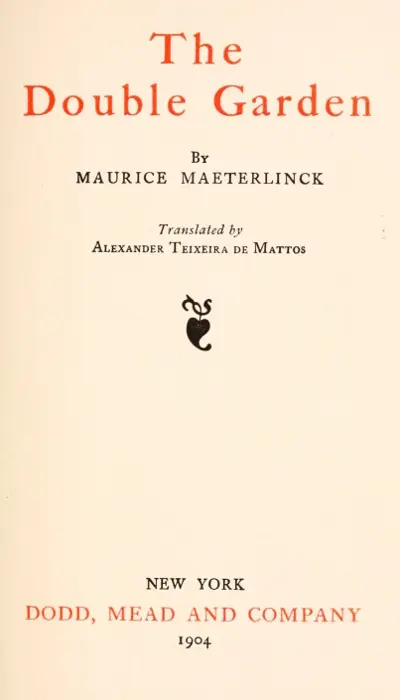
THE CLASSIC COLLECTION · 1902
"The Double Garden" by Maurice Maeterlinck is a collection of essays written in the early 20th century. The book reflects on various themes related to the intricacies of life, love, and the relationship between humans and nature. Notable among these explorations is the bond shared between humans and dogs, with the essay beginning with an emotional tribute to a little bulldog named Pelléas, serving as a lens through which the author examines loyalty, existence, and the nature of companionship. The opening of the work details the short life of Pelléas, emphasizing his innocent curiosity and the complex world he must navigate. As he explores new surroundings, the author evokes a deep sense of empathy, illustrating the dog's struggles to understand the human realm and its myriad rules and expectations. The essay touches upon themes of duty, instinct, and the inherent connection between man and beast, raising poignant questions about love, loss, and the fleeting nature of life. The narrative sets a reflective tone that underlines the book's overarching contemplation of existence and relationship dynamics.
Introduction adapted from the source catalogue; source summaries may be automatically generated.
Free to read · English · 44,350 words · No account needed
MAKE TIME FOR A GOOD BOOK
On by default. Untick to stop anonymous reading totals. Each page counts after 10 seconds in view. How this works.
Anonymous counting is on unless you have switched it off.
Around the tables crowd the faithful. Each of them carries within himself hopes, belief, different and invisible tragedies and comedies. This, I think, is the spot in which more nervous force and more human passions are accumulated and absolutely squandered than in any other in the world. This is the ill-omened spot where the peerless and, perhaps, divine substance of substances, which, in every other place, works pregnant miracles, prodigies of strength, of beauty and of love, this is the fatal spot where the flower of the soul, the most precious fluid on the planet, leaks away into nothingness!... No more criminal waste can be conceived. This unprofitable force, which knows neither whither to go nor what work to do, which finds no door nor window, no direct object nor manner of transmission, hovers over the table like a mortal shadow, falls back upon itself and creates a particular atmosphere, a sort of sweating silence which somehow suggests the fever of true silence. In this unwholesome stillness, the voice of Fate's little book-keeper snuffles out the sacred formula:
"Faites vos jeux, messieurs, faites vos jeux!"
That is to say, make to the hidden god the sacrifice which he demands before he shows himself. Then, somewhere from the crowd, a hand bright with certainty places imperiously the fruit of a year's work on numbers that cannot fail. Other adorers, more cunning, more circumspect, less confident, compound with luck, distribute their chances, compute illusive probabilities and, having studied the mood and peculiarities of the genius of the table, lay complex and knowing traps for it. Others, again, hand over a considerable portion of their happiness or their life, at random, to the caprice of numbers.
But now the second formula resounds:
"Rien ne va plus!"
That is to say, the god is about to speak! At this moment, an eye that could pierce the easy veil of appearances would distinctly see scattered on the plain green cloth (if not actually, then at least potentially; for a single stake is rare, and he who plays of his superfluity to-day will risk his all to-morrow) a corn-field ripening in the sun a thousand miles away; or, again, in other squares, a meadow, a wood, a moonlit country-house, a shop in some little market-town, a staff of book-keepers and accountants bending over ledgers in their gloomy offices, peasants labouring in the rain, hundreds of work-girls slaving from morn to night in deadly factories, miners in the mines, sailors on their ship; the jewels of debauchery, love or glory; a prison, a dockyard; joy, misery, injustice, cruelty, avarice; crimes, privations, tears. All this lies there, very peacefully, in those little heaps of smiling gold, in those flimsy scraps of paper which ordain disasters which even a life-time would be powerless ever to efface. The slightest timid and hesitating movements of these yellow counters and blue notes will rebound and swell out in the distance, in the real world, in the streets, in the plains, in the trees, in men's blood and in their hearts. They will demolish the house that saw the parents die, carry off the old man's chair, give a new squire to the astonished village, close a workshop, take away the bread from the children of a hamlet, divert the course of a river, stay or break a life and, through an infinity of time and space, burst the links of an uninterrupted chain of cause and effect. But none of these resounding truths utters an indiscreet whisper here. There are here more sleeping Furies than on the purple steps of the palace of the Atridæ; but their cries of waking and of pain lie hidden at the bottom of men's hearts. Nothing betrays, nothing foretells that there are definite ills hovering over those present and choosing their victims. Only, the eyes stare a little, while hands shiftily finger a pencil, a bit of paper. Not an unaccustomed word or gesture. Clammy expectation sits motionless. For this is the place of voiceless pantomime, of stifled fighting, of unblinking despair, of tragedy masked in silence, of dumb destiny sinking in an atmosphere of lies that swallows up every sound.
Your reading position is saved on this browser. Take it to another device with a library code. Reading pages adapt to text, rather than matching a printed edition.
Maurice Maeterlinck

Maurice Maeterlinck

Maurice Maeterlinck

Maurice Maeterlinck
BEHIND THE BOOK
This eBook is for the use of anyone anywhere in the United States and most other parts of the world at no cost and with almost no restrictions whatsoever. You may copy it, give it away or re-use it under the terms of the Project Gutenberg License included with this eBook or online at www.gutenberg.org. If you are not located in the United States, you will have to check the laws of the country where you are located before using this eBook. Read the source licence.
The original source file, including credits and licence, is retained by this library. Request an original-format copy at no charge. Please include the book title and Project Gutenberg identifier #48504.
KEEP YOUR CURIOSITY GOING

David Patterson (Spirit) Hatch

David Patterson (Spirit) Hatch

David Patterson (Spirit) Hatch

Ralph Waldo Emerson

Maurice Baring

Oscar Wilde & James McNeill Whistler