THE CLASSIC COLLECTION✦The miracle of Saint AnthonyCLASSIC FREE BOOKS
The miracle of Saint Anthony
Maurice Maeterlinck
THE CLASSIC COLLECTION · 1902
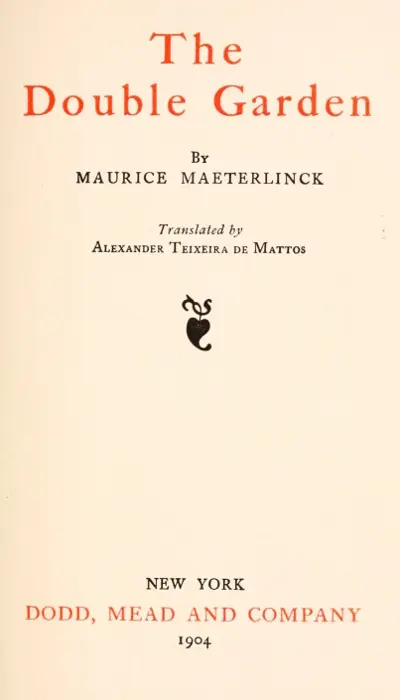
"The Double Garden" by Maurice Maeterlinck is a collection of essays written in the early 20th century. The book reflects on various themes related to the intricacies of life, love, and the relationship between humans and nature. Notable among these explorations is the bond shared between humans and dogs, with the essay beginning with an emotional tribute to a little bulldog named Pelléas, serving as a lens through which the author examines loyalty, existence, and the nature of companionship. The opening of the work details the short life of Pelléas, emphasizing his innocent curiosity and the complex world he must navigate. As he explores new surroundings, the author evokes a deep sense of empathy, illustrating the dog's struggles to understand the human realm and its myriad rules and expectations. The essay touches upon themes of duty, instinct, and the inherent connection between man and beast, raising poignant questions about love, loss, and the fleeting nature of life. The narrative sets a reflective tone that underlines the book's overarching contemplation of existence and relationship dynamics.
Introduction adapted from the source catalogue; source summaries may be automatically generated.
Free to read · English · 44,350 words · No account needed
MAKE TIME FOR A GOOD BOOK
On by default. Untick to stop anonymous reading totals. Each page counts after 10 seconds in view. How this works.
Anonymous counting is on unless you have switched it off.
Meanwhile, this space--the abode of our ignorance--which, after the disappearance of the religious ideas, had appeared frightfully empty, is gradually becoming peopled with vague, but enormous figures. Each time that one of these new forms uprises, the boundless extent in which it comes to move increases in proportions that are boundless in their turn; for the limits of boundlessness evolve in our imagination without ceasing. Assuredly, the gods who conceived certain positive religions were sometimes very great. The Jewish and Christian God, for instance, declared Himself incommensurable, containing all things, and His first attributes were eternity and infinity. But the infinite is an abstract and tenebrous notion which assumes life and is explained only by the displacing of frontiers which we thrust back further and further into the finite. It constitutes a formless extent of which we can acquire a consciousness only with the aid of a few phenomena that start up on points more or less distant from the centre of our imagination. It is efficacious only through the multiplicity of the, so to speak, tangible and positive faces of the unknown which it reveals to us in its depths. It does not become comprehensible and perceptible to us until it shows animation and movement and kindles on the several horizons of space questions more and more distant, more and more foreign to all our uncertainties. For our life to take part in its life, the infinite must question us incessantly and incessantly place us in the presence of the infinity of our ignorance, which is the only visible garment beneath which it allows us to conjecture the infinity of its existence.
Now the most incommensurable gods hardly put questions similar to those which are endlessly put to us by that which their adorers call the void, which is, in reality, nature. They were content to reign in a dead space, without events and without images, consequently without points of reference for our imagination, and having only an immutable and immobile influence over our thoughts and feelings. Thus, our sense of the finite, which is the source of all higher activity, became atrophied within us. Our intelligence, in order to live on the confines of itself, where it accomplishes its loftiest mission, our thought, in order to fill the whole space of our brain, needs to be continually excited by fresh recallings of the unknown. So soon as it ceases to be daily summoned to the extremity of its own strength by some new fact--and there are hardly any new facts in the reign of the gods--it falls asleep, contracts, gives way and sinks into decay. One thing alone is capable of dilating equally, in all their parts, all the lobes of our head, and that is the active idea which we conceive of the riddle in the midst of which we have our being. Is there danger of error in declaring that never was the activity of this idea comparable with that of to-day? Never before, neither at the time when the Hindoo, Jewish or Christian theology flourished, nor in the days when Greek or German metaphysics were engaging all the forces of human genius, was our conception of the universe enlivened, enriched and broadened by proofs so unexpected, so laden with mystery, so energetic, so real. Until now, it was fed on indirect nourishment, so to speak, or rather it fed illusively on itself. It inflated itself with its own breath, sprinkled itself with its own waters, and very little came to it from without. To-day, the universe itself is beginning to penetrate into the conception which we form of it. The diet of our thought is changed. That which it takes comes from outside itself and adds to its substance. It borrows instead of lending. It no longer sheds around itself the reflection of its own greatness, but absorbs the greatness around it. Until now, we had been prosing, with the aid of our infirm logic or our idle imagination, on the subject of the riddle; to-day, issuing from our too inward abode, we are trying to enter into relations with the riddle itself. It questions us, and we stammer as best we may. We put questions to it, and, in reply, it unmasks, at moments, a luminous and boundless perspective in the immense circle of darkness amid which we move. We were, it might be said, like blind men who should imagine the outer world from inside a shut room. Now, we are those same blind men whom an ever-silent guide leads by turns into the forest, across the plain, on the mountain and beside the sea. Their eyes have not yet opened; but their shaking and eager hands are able to feel the trees, to rumple the spikes of corn, to gather a flower or a fruit, to marvel at the ridge of a rock or to mingle with the cool waves, while their ears learn to distinguish, without needing to understand, the thousand real songs of the sun and the shade, the wind and the rain, the leaves and the waters.
Your reading position is saved on this browser. Take it to another device with a library code. Reading pages adapt to text, rather than matching a printed edition.
Maurice Maeterlinck

Maurice Maeterlinck

Maurice Maeterlinck

Maurice Maeterlinck
BEHIND THE BOOK
This eBook is for the use of anyone anywhere in the United States and most other parts of the world at no cost and with almost no restrictions whatsoever. You may copy it, give it away or re-use it under the terms of the Project Gutenberg License included with this eBook or online at www.gutenberg.org. If you are not located in the United States, you will have to check the laws of the country where you are located before using this eBook. Read the source licence.
The original source file, including credits and licence, is retained by this library. Request an original-format copy at no charge. Please include the book title and Project Gutenberg identifier #48504.
KEEP YOUR CURIOSITY GOING

David Patterson (Spirit) Hatch

David Patterson (Spirit) Hatch

David Patterson (Spirit) Hatch

Ralph Waldo Emerson

Maurice Baring

Oscar Wilde & James McNeill Whistler