THE CLASSIC COLLECTION✦The miracle of Saint AnthonyCLASSIC FREE BOOKS
The miracle of Saint Anthony
Maurice Maeterlinck
THE CLASSIC COLLECTION · 1902
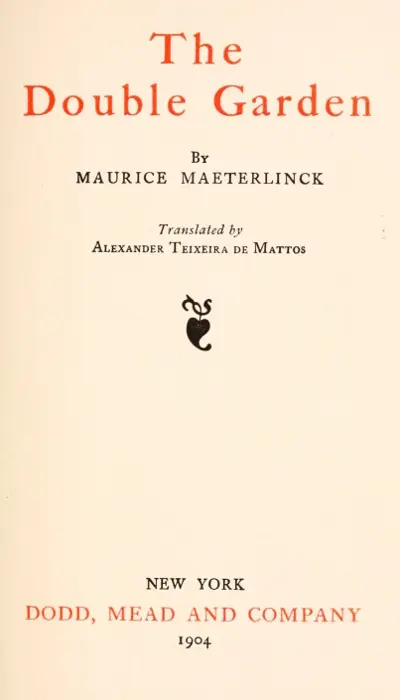
"The Double Garden" by Maurice Maeterlinck is a collection of essays written in the early 20th century. The book reflects on various themes related to the intricacies of life, love, and the relationship between humans and nature. Notable among these explorations is the bond shared between humans and dogs, with the essay beginning with an emotional tribute to a little bulldog named Pelléas, serving as a lens through which the author examines loyalty, existence, and the nature of companionship. The opening of the work details the short life of Pelléas, emphasizing his innocent curiosity and the complex world he must navigate. As he explores new surroundings, the author evokes a deep sense of empathy, illustrating the dog's struggles to understand the human realm and its myriad rules and expectations. The essay touches upon themes of duty, instinct, and the inherent connection between man and beast, raising poignant questions about love, loss, and the fleeting nature of life. The narrative sets a reflective tone that underlines the book's overarching contemplation of existence and relationship dynamics.
Introduction adapted from the source catalogue; source summaries may be automatically generated.
Free to read · English · 44,350 words · No account needed
MAKE TIME FOR A GOOD BOOK
On by default. Untick to stop anonymous reading totals. Each page counts after 10 seconds in view. How this works.
Anonymous counting is on unless you have switched it off.
"When a man's virtues are depicted for us, they are represented in the effort of action; but those which are admired in a woman always infer a model as motionless as a beautiful statue in a marble gallery. She is an inconsistent image, a tissue of vices quiescent, of inert qualities, of slumbering epithets, of passive movements, of negative forces. She is chaste because she has no senses, she is kind because she does harm to none, she is just because she does not act, she is patient and resigned because she is devoid of energy, she is indulgent because none offends her or forgiving because she has not the courage to resist, she is charitable because she allows herself to be stripped or because her charity deprives her of nothing, she is faithful, she is loyal, she is submissive, she is devoted because all these virtues can live in emptiness and can blossom on a dead woman's body. But what shall happen if the image takes life and comes forth from her retreat to enter upon an existence in which all that does not take part in the movement that surrounds it becomes a pitiful or dangerous wreck? Is it still a virtue to keep faithful to an ill-chosen or morally extinguished love, or to remain subject to an unintelligent or unjust master? Is to refrain from harming enough to make one kind, to refrain from lying enough to make one true? There is the morality of those who keep to the banks of the great river and the morality of those who ascend the stream. There is the morality of sleep and that of action, the morality of shadow and that of light; and the virtues of the first, which may be described as concave virtues, must needs arise, stand up and become virtues in relief, if they are to remain virtues in the second. The matter and the lines perhaps remain identical, but the values are exactly reversed. Patience, mildness, submissiveness, confidence, renunciation, resignation, devotion, sacrifice, all fruits of passive goodness, become, if we remove them, such as they are, into the stern outer life, no more than weakness, servility, indifference, unconsciousness, indolence, unconstraint, folly or cowardice and must, in order to keep at the necessary level the source of goodness from which they spring, be able to develop into energy, firmness, obstinacy, prudence, indignation and revolt. Loyalty, which has scarce anything to fear so long as it does not stir, must be careful lest it be duped and surrender its arms to the enemy. Chastity, which sat waiting with eyes closed and hands folded, has the right to change into passion, which shall decide and settle destiny. And the same consecutively with all the virtues which have a name as with those which are as yet unnamed. Next, it is a problem to know which is preferable, active or passive life, that which mingles with men and events or that which shuns them. Is there a moral law that imposes the one or the other, or has each the right to make his choice according to his tastes, his character, his aptitudes? Is it better or worse that the active or the passive virtues should stand in the foreground? It may, I think, be declared that the former always imply the second, but that the converse is not true. Thus, the woman of whom I speak is the more capable of devotion and sacrifice in that she has the strength to ward off their overwhelming necessity longer than any others. She will not cultivate sadness or suffering vaguely, as a means of expiation or purification; but she is able to accept and go in search of them with ingenuous ardour in order to save those whom she loves a small affliction or a great sorrow which she feels herself strong enough to face alone and to overcome in silence in her secret heart. How often have I not seen her force back tears ready to gush forth under unjust reproaches, while her lips, on which flickered a fevered smile, held back, with almost invisible courage, the word which would have justified her, but which would have crushed him who misjudged her. For, like all just and good beings, she had naturally to undergo the petty injustice and the petty wickedness of those who hover indeterminately between good and evil and who hasten to abuse the indulgence or forgiveness too frequently obtained. There you have that which, better than any slack and weeping acquiescence, shows an ardent and potent reserve of love.
Your reading position is saved on this browser. Take it to another device with a library code. Reading pages adapt to text, rather than matching a printed edition.
Maurice Maeterlinck

Maurice Maeterlinck

Maurice Maeterlinck

Maurice Maeterlinck
BEHIND THE BOOK
This eBook is for the use of anyone anywhere in the United States and most other parts of the world at no cost and with almost no restrictions whatsoever. You may copy it, give it away or re-use it under the terms of the Project Gutenberg License included with this eBook or online at www.gutenberg.org. If you are not located in the United States, you will have to check the laws of the country where you are located before using this eBook. Read the source licence.
The original source file, including credits and licence, is retained by this library. Request an original-format copy at no charge. Please include the book title and Project Gutenberg identifier #48504.
KEEP YOUR CURIOSITY GOING

David Patterson (Spirit) Hatch

David Patterson (Spirit) Hatch

David Patterson (Spirit) Hatch

Ralph Waldo Emerson

Maurice Baring

Oscar Wilde & James McNeill Whistler