THE CLASSIC COLLECTION✦Lost DiariesCLASSIC FREE BOOKS
Lost Diaries
Maurice Baring
THE CLASSIC COLLECTION · 1905
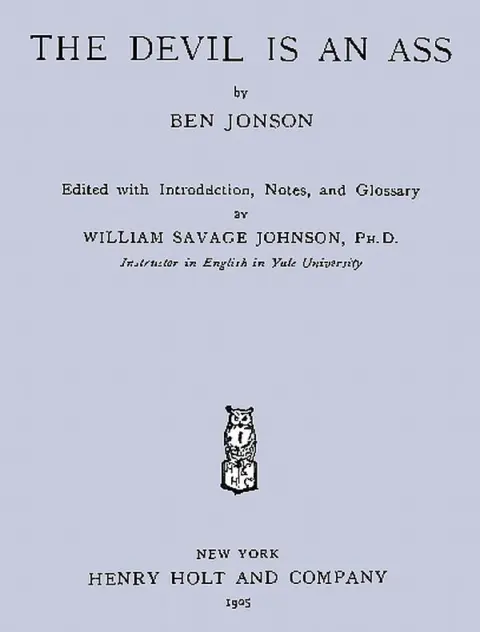
"The Devil is an Ass" by Ben Jonson is a Jacobean comedy first performed in 1616. When a minor devil named Pug begs to visit Earth, Satan warns him that London's vices have grown too sophisticated for a simple demon. Sent to plague the foolish Fabian Fitzdottrel, Pug finds himself hopelessly outmatched by cunning swindlers and charming gallants who converge on his master. As confidence men spin elaborate schemes and pursue Fitzdottrel's virtuous wife, the hapless devil discovers that human corruption far exceeds anything Hell has to offer.
Introduction adapted from the source catalogue; source summaries may be automatically generated.
Free to read · English · 107,369 words · No account needed
MAKE TIME FOR A GOOD BOOK
On by default. Untick to stop anonymous reading totals. Each page counts after 10 seconds in view. How this works.
Anonymous counting is on unless you have switched it off.
Till she be the reason, why,
All the world for love may die.
=2. 6. 72 These sister-swelling brests.= ‘This is an elegant and poetical rendering of the sororiantes mammae of the Latins, which Festus thus explains: Sororiare puellarum mammae dicuntur, cum primum tumescunt.’--G.
=2. 6. 76 SN.= ‘Liberties very similar to these were, in the poet’s time, permitted by ladies, who would have started at being told that they had foregone all pretensions to delicacy.’--G.
The same sort of familiarity is hinted at in Stubbes, Anatomy of Abuses (Part 1, p. 78). Furnivall quotes Histriomastix (Simpson’s School of Shak. 2. 50) and Vindication of Top Knots, Bagford Collection, 1. 124, in illustration of the subject. Gosson’s Pleasant Quippes (1595) speaks of ‘these naked paps, the Devils ginnes.’ Cf. also Cyn. Rev., Wks. 2. 266, and Case is A., Wks. 6. 330. It seems to have been a favorite subject of attack at the hands of both Puritans and dramatists.
=2. 6. 76 Downe to this valley.= Jonson uses a similar
figure in Cyn. Rev., Wks. 2. 240 and in Charis
(see note 2. 6. 57).
=2. 6. 78 these crisped groues.= So Milton, Comus, 984: ‘Along the crisped shades and bowers.’ Herrick, Hesper., Cerem. Candlemas-Eve: ‘The crisped yew.’
=2. 6. 85 well torn’d.= Jonson’s usual spelling. See Timber, ed. Schelling, 64. 33; 76. 22. etc.
=2. 6. 85 Billyard ball.= Billiards appears to have been an out-of-door game until the sixteenth century. It was probably introduced into England from France. See J. A. Picton, N. & Q.. 5. 5. 283. Jonson uses this figure again in Celeb. Charis 9. 19-20.
=2. 6. 92 when I said, a glasse could speake=, etc. Cf.
1. 6. 80 f.
=2. 6. 100 And from her arched browes=, etc. Swinburne says of this line: ‘The wheeziest of barrel-organs, the most broken-winded of bagpipes, grinds or snorts out sweeter music than that.’--Study of Ben Jonson, p. 104.
=2. 6. 104 Have you seene.= Sir John Suckling (ed. 1874, p.
79) imitates this stanza:
Hast thou seen the down in the air
When wanton blasts have tossed it?
Or the ship on the sea,
When ruder winds have crossed it?
Hast thou marked the crocodile’s weeping,
Or the fox’s sleeping?
Or hast viewed the peacock in his pride,
Or the dove by his bride
When he courts for his lechery?
O, so fickle, O, so vain, O, so false, so false is she!
=2. 6. 104 a bright Lilly grow.= The figures of the lily, the snow, and the swan’s down have already been used in The Fox, Wks. 3. 195. The source of that passage is evidently Martial, Epig. 1. 115:
Loto candidior puella cygno,
Argento, nive, lilio, ligustro.
In this place Jonson seems to have more particularly in mind Epig.
5. 37:
Puella senibus dulcior mibi cygnis ...
Cui nec lapillos praeferas Erythraeos, ...
Nivesque primas liliumque non tactum.
Your reading position is saved on this browser. Take it to another device with a library code. Reading pages adapt to text, rather than matching a printed edition.
BEHIND THE BOOK
This eBook is for the use of anyone anywhere in the United States and most other parts of the world at no cost and with almost no restrictions whatsoever. You may copy it, give it away or re-use it under the terms of the Project Gutenberg License included with this eBook or online at www.gutenberg.org. If you are not located in the United States, you will have to check the laws of the country where you are located before using this eBook. Read the source licence.
The original source file, including credits and licence, is retained by this library. Request an original-format copy at no charge. Please include the book title and Project Gutenberg identifier #50150.
KEEP YOUR CURIOSITY GOING
Maurice Baring
W. B. (William Butler) Yeats
Edward Martyn

John Brougham & Charlotte Brontë
Marguerite Merington
Leonid Andreyev