THE CLASSIC COLLECTION✦Lost DiariesCLASSIC FREE BOOKS
Lost Diaries
Maurice Baring
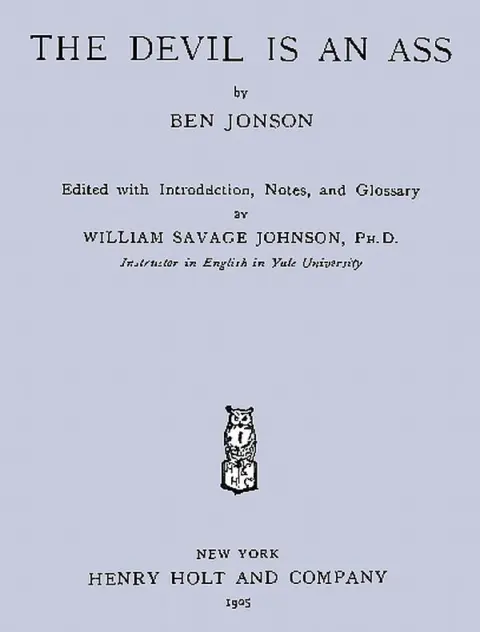
THE CLASSIC COLLECTION · 1905
"The Devil is an Ass" by Ben Jonson is a Jacobean comedy first performed in 1616. When a minor devil named Pug begs to visit Earth, Satan warns him that London's vices have grown too sophisticated for a simple demon. Sent to plague the foolish Fabian Fitzdottrel, Pug finds himself hopelessly outmatched by cunning swindlers and charming gallants who converge on his master. As confidence men spin elaborate schemes and pursue Fitzdottrel's virtuous wife, the hapless devil discovers that human corruption far exceeds anything Hell has to offer.
Introduction adapted from the source catalogue; source summaries may be automatically generated.
Free to read · English · 107,369 words · No account needed
MAKE TIME FOR A GOOD BOOK
On by default. Untick to stop anonymous reading totals. Each page counts after 10 seconds in view. How this works.
Anonymous counting is on unless you have switched it off.
=2. 7. 2, 3 that Wit of man will doe’t.= There is evidently an ellipsis of some sort before that (cf. Abbott, §284). Perhaps ‘provided’ is to be understood.
=2. 7. 4 She shall no more be buz’d at.= The metaphor is carried out in the words that follow, sweet meates 5, hum 6, flye-blowne 7. ‘Fly-blown’ was a rather common term of opprobrium. Cf. Dekker, Satiromastix, Wks. 1. 195: ‘Shal distaste euery vnsalted line, in their fly-blowne Comedies.’ Jonson is very fond of this metaphor, and presses it beyond all endurance in New Inn, Act 2. Sc. 2, Wks. 5. 344, 5, etc.
=2. 7. 13 I am resolu’d on’t, Sir.= See variants. Gifford points out the quibble on the word resolved. See Gloss.
=2. 7. 17 O! I could shoote mine eyes at him.= Cf. Fox,
Wks. 3. 305: ‘That I could shoot mine eyes at him, like
gun-stones!’
=2. 7. 22.= See variants. The the is probably absorbed by
the preceding dental. Cf. 5. 7. 9.
=2. 7. 33 fine pac’d huishers.= See note 4. 4. 201.
=2. 7. 38 turn’d my good affection.= ‘Not diverted or changed its course; but, as appears from what follows, soured it. The word is used in a similar sense by Shakespeare:
Has friendship such a faint and milky heart,
It turns in less than two nights!
Timon, 3. 2.’--G.
=2. 8. 9, 10 That was your bed-fellow.= Ingine, perhaps in anticipation of Fitzdottrel’s advancement, employs a term usually applied to the nobility. Cf. K. Henry V. 2. 2. 8:
Nay, but the man that was his bedfellow, Whom he had cloy’d and grac’d with princely favors.
Steevens in a note on the passage points out that the familiar appellation of bedfellow, which appears strange to us, was common among the ancient nobility.’ He quotes from A Knack to know a Knave, 1594; Look about you, 1600; Cynthia’s Revenge, 1613; etc., where the expression is used in the sense of ‘intimate companion’ and applied to nobles. Jonson uses the term chamberfellow in Underwoods, Wks. 8. 353.
=2. 8. 20 An Academy.= With this passage compare U. 62,
Wks. 8. 412:
--There is up of late
The Academy, where the gallants meet--
What! to make legs? yes, and to smell most sweet:
All that they do at plays. O but first here
They learn and study; and then practice there.
Jonson again refers to ‘the Academies’ (apparently schools of deportment or dancing schools) in 3. 5. 33.
=2. 8. 33 Oracle-Foreman.= See note 1. 2. 2.
=2. 8. 59 any thing takes this dottrel.= See note 2. 2. 49-50.
=2. 8. 64 Dicke Robinson.= Collier says: ‘This player may have been an original actor in some of Shakespeare’s later dramas, and he just outlived the complete and final suppression of the stage.’ His death and the date at which it occurred have been matters of dispute.
Your reading position is saved on this browser. Take it to another device with a library code. Reading pages adapt to text, rather than matching a printed edition.
BEHIND THE BOOK
This eBook is for the use of anyone anywhere in the United States and most other parts of the world at no cost and with almost no restrictions whatsoever. You may copy it, give it away or re-use it under the terms of the Project Gutenberg License included with this eBook or online at www.gutenberg.org. If you are not located in the United States, you will have to check the laws of the country where you are located before using this eBook. Read the source licence.
The original source file, including credits and licence, is retained by this library. Request an original-format copy at no charge. Please include the book title and Project Gutenberg identifier #50150.
KEEP YOUR CURIOSITY GOING
Maurice Baring
W. B. (William Butler) Yeats
Edward Martyn

John Brougham & Charlotte Brontë
Marguerite Merington
Leonid Andreyev