THE CLASSIC COLLECTION✦Lost DiariesCLASSIC FREE BOOKS
Lost Diaries
Maurice Baring
THE CLASSIC COLLECTION · 1905
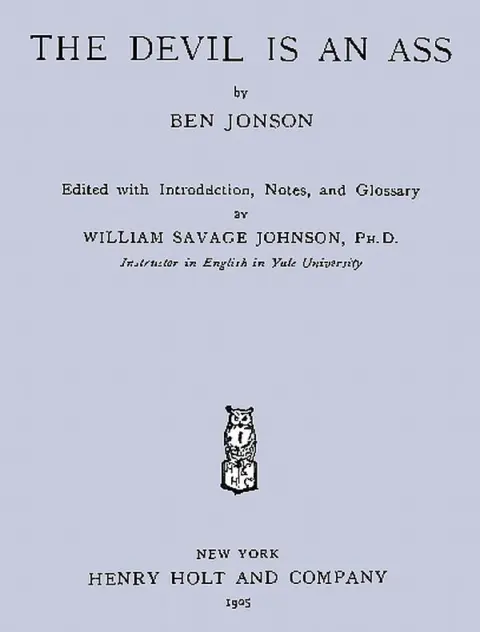
"The Devil is an Ass" by Ben Jonson is a Jacobean comedy first performed in 1616. When a minor devil named Pug begs to visit Earth, Satan warns him that London's vices have grown too sophisticated for a simple demon. Sent to plague the foolish Fabian Fitzdottrel, Pug finds himself hopelessly outmatched by cunning swindlers and charming gallants who converge on his master. As confidence men spin elaborate schemes and pursue Fitzdottrel's virtuous wife, the hapless devil discovers that human corruption far exceeds anything Hell has to offer.
Introduction adapted from the source catalogue; source summaries may be automatically generated.
Free to read · English · 107,369 words · No account needed
MAKE TIME FOR A GOOD BOOK
On by default. Untick to stop anonymous reading totals. Each page counts after 10 seconds in view. How this works.
Anonymous counting is on unless you have switched it off.
=2. 1. 1 Sir, money’s a whore=, etc. Coleridge, Notes, p. 280. emends: ‘Money, sir, money’s a’, &c. Cunningham, on the other hand, thinks that ‘the 9-syllable arrangement is quite in Jonson’s manner, and that it forces an emphasis upon every word especially effective at the beginning of an act.’ See variants.
Money is again designated as a whore in the Staple of News 4. 1: ‘Saucy Jack, away: Pecunia is a whore.’ In the same play Pennyboy, the usurer, is called a ‘money-bawd.’ Dekker (Non-dram. Wks. 2. 137) speaks of keeping a bawdy-house for Lady Pecunia. The figure is a common one.
=2. 1 .3 Via.= This exclamation is quite common among the dramatists and is explained by Nares as derived from the Italian exclamation via! ‘away, on!’ with a quibble on the literal of L. via, a way. The Century Dictionary agrees substantially with this derivation. Abundant examples of its use are given by the authorities quoted, to which may be added Merry Devil of Edmonton 1. 2. 5, and Marston, Dutch Courtezan, Wks. 2. 20:
O, yes, come, via!--away, boy--on!
=2. 1. 5 With Aqua-vitae.= Perhaps used with especial reference to line 1, where he has just called money a bawd Compare:
O, ay, as a bawd with aqua-vitae.
--Marston, The Malcontent, Wks. 1. 294.
‘Her face is full of those red pimples with drinking Aquauite,
the common drinke of all bawdes.’--Dekker, Whore of Babylon,
Wks. 2. 246.
=2. 1. 17. See variants.= Line 15 shows that the original
reading is correct.
=2. 1. 19 it shall be good in law.= See note 1. 2. 22.
=2. 1. 20 Wood-cock.= A cant term for a simpleton or dupe.
=2. 1. 21 th’ Exchange.= This was the first Royal Exchange, founded by Sir Thomas Gresham in 1566, opened by Queen Elizabeth in 1570-1, and destroyed in the great fire of 1666 (Wh-C.). Howes (1631) says that it was ‘plenteously stored with all kinds of rich wares and fine commodities,’ and Paul Hentzner (p. 40) speaks of it with enthusiasm.
It was a favorite lounging-place, especially in the evening. Wheatley quotes Hayman, Quodlibet, 1628, p. 6:
Though little coin thy purseless pockets line,
Yet with great company thou’rt taken up;
For often with Duke Humfray thou dost dine,
And often with Sir Thomas Gresham sup.
‘We are told in London and Country Carbonadoed, 1632, that at the exchange there were usually more coaches attendant than at church doors.’ Cf. also Bart. Fair, Wks. 4. 357: ‘I challenge all Cheapside to shew such another: Moor-fields, Pimlico-path, Or the Exchange, in a summer evening.’ Also Ev. Man in, Wks. 1. 39.
=2. 1. 30 do you doubt his eares?= Ingine’s speech is capable of a double interpretation. Pug has already spoken of the ‘liberal ears’ of his asinine master.
=2. 1. 41 a string of’s purse.= Purses, of course, used to be hung at the girdle. A thief was called a cut-purse. See the amusing scene in Bart. Fair, Wks. 5. 406.
Your reading position is saved on this browser. Take it to another device with a library code. Reading pages adapt to text, rather than matching a printed edition.
BEHIND THE BOOK
This eBook is for the use of anyone anywhere in the United States and most other parts of the world at no cost and with almost no restrictions whatsoever. You may copy it, give it away or re-use it under the terms of the Project Gutenberg License included with this eBook or online at www.gutenberg.org. If you are not located in the United States, you will have to check the laws of the country where you are located before using this eBook. Read the source licence.
The original source file, including credits and licence, is retained by this library. Request an original-format copy at no charge. Please include the book title and Project Gutenberg identifier #50150.
KEEP YOUR CURIOSITY GOING
Maurice Baring
W. B. (William Butler) Yeats
Edward Martyn

John Brougham & Charlotte Brontë
Marguerite Merington
Leonid Andreyev