THE CLASSIC COLLECTION✦A dead man’s diaryCLASSIC FREE BOOKS
A dead man’s diary
Coulson Kernahan
THE CLASSIC COLLECTION · 1923
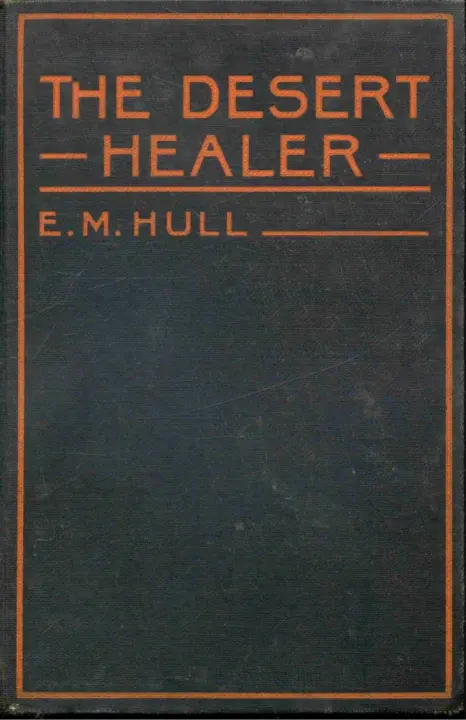
"The Desert Healer" by E. M. Hull is a novel written in the early 20th century. The story unfolds primarily in the vibrant yet harsh landscapes of Algeria, focusing on the characters' complex interactions against the backdrop of personal turmoil and cultural tensions. Central to the narrative is Gervas Carew, an enigmatic Englishman living in isolation in the desert who has a mysterious past, as well as Marny Geradine, a woman grappling with her own troubled marriage. At the start of the novel, we are introduced to the serene setting of the Little Atlas Mountains, where we meet William Chalmers, a doctor, and his wife, who discuss their planned departure from Algeria. They mention Carew, a reclusive figure with an intriguing background, hinting at the tragic elements of his story. As Mrs. Chalmers reveals her concerns for a young woman named Lady Geradine, we learn of the mysteries lurking around Carew, whose life is steeped in hardship and emotional scars from his past. The narrative quickly escalates when Marny unexpectedly finds herself in grave danger, prompting Carew to intervene and rescue her from a violent situation, setting the stage for their complicated relationship as they navigate the intricacies of their pasts and their feelings for one another. The opening establishes a rich world of emotional depth and conflict, drawing readers into the lives of its compelling characters.
Introduction adapted from the source catalogue; source summaries may be automatically generated.
Free to read · English · 86,816 words · No account needed
MAKE TIME FOR A GOOD BOOK
On by default. Untick to stop anonymous reading totals. Each page counts after 10 seconds in view. How this works.
Anonymous counting is on unless you have switched it off.
It was all like a dream, fantastic and unreal, but a dream that gave her more happiness than she had known for years. The swift gallop through the night, the cool wind blowing against her face, the easy movements of the horse between her knees, were all sheer joy to her. She had no wish to talk, even if the taciturn manner of the man beside her had not made speech difficult. She wanted nothing but the pleasure of the moment, the beauty of the moonlit scene and the charm of the wonderful solitude. For her Algeria had been Algiers, she had not been asked to accompany her husband on his occasional shooting expeditions, and she had wearied of the town and its immediate surroundings. She had longed to go further afield, to get right out into the desert, but she had been given no opportunity and she had long since learned to suppress inclinations that were ridiculed and never gratified. She craved for open spaces and the lonely places of the earth, and she had been chained to towns or crowded country houses and forced into a company whose society nauseated her; she had dreamt of nights like this, of the silence and peace of the wilderness, of solitary camps where she would sleep in happy dreamlessness under the radiant stars—and the nights that were her portion had been her chiefest torment. But this one night she could revel in her dream come true and rejoice in the freedom that might never again be hers. That she might have to pay, and perhaps pay hideously, for what had occurred did not matter, almost she did not care. She had suffered so much already that further suffering seemed almost inevitable and she would not spoil the rare joy of this wonderful ride by anticipating trouble. But even as she argued bravely with herself, she blanched at the possible consequences of the terrible adventure that had been no fault of her own. If when she reached the villa at Mustapha, Clyde had already returned! She clenched her teeth on her quivering lip. He had gone for a fortnight’s shooting and the fortnight would be up tomorrow—today, she remembered with a sudden glance of apprehension at the sky, where the pinky flush of dawn was already showing. He might be back now! And if he were—what would her punishment be, what would she have to endure from one who knew his strength and used it brutally, who was cruel and merciless by nature as if he, too, were an Arab. Her mind leapt to the man who had abducted her. When, at the close of an appalling day, she had been brought to the hut in the deserted village, when she had finally realised the sinister purpose intended against her, the ghastly fear that had come to her, the paralysing sense of helplessness she had felt as she struggled against the crushing arms that held her, the horror of the relentless face thrust close to hers quivering with lust and desire, was no new thing. So did Clyde look at her, so did she shrink and sicken when he touched her. Were all men alike—sensual brutes with no consideration or pity? One, at least, had shown himself to be different—and he was an Arab! She turned and looked at him curiously. By the light of the brilliant moon she studied the lean, tanned face, wondering at its grave austerity. And as her gaze lingered on the white seam of an old scar that ran diagonally across his cheek above the curve of his square-cut jaw, she remembered suddenly that the stern, sombre eyes that had looked into hers were blue. Were there, then, blue-eyed Arabs, as there were blue-eyed Afghans? Who was he? A personage of importance, obviously—the rich appointments of the camp to which he had taken her, proved it. The embroidered cloth burnous, the wide silk scarf swathed about the haick that shaded his face, the scarlet leather boots he wore was the dress of a Chief. One of the wealthy Sheiks from the far south, perhaps, coming into Algiers for the Governor’s annual ball. Whoever he was, he had saved her honour, had saved her from worse than death. And a sudden inexplicable desire came to her to explain to this strange, taciturn Arab the situation in which he had found her. She swung her horse nearer. “I oughtn’t to have ridden alone,” she began jerkily. “I know that, but I was quite close to Algiers—it seemed safe enough—and I had a reason for what I did. One has to—be alone—sometimes. I didn’t think there could be any danger. It all happened so suddenly—” she broke off, chilled with his silence, wondering how she had found courage to speak to him at all, for his frigid manner did not invite confidence. And his brief answer did not tend to put her more at ease.
Your reading position is saved on this browser. Take it to another device with a library code. Reading pages adapt to text, rather than matching a printed edition.
BEHIND THE BOOK
This eBook is for the use of anyone anywhere in the United States and most other parts of the world at no cost and with almost no restrictions whatsoever. You may copy it, give it away or re-use it under the terms of the Project Gutenberg License included with this eBook or online at www.gutenberg.org. If you are not located in the United States, you will have to check the laws of the country where you are located before using this eBook. Read the source licence.
The original source file, including credits and licence, is retained by this library. Request an original-format copy at no charge. Please include the book title and Project Gutenberg identifier #59199.
KEEP YOUR CURIOSITY GOING
Coulson Kernahan

Maurice Baring
Frances Wright
Cécile Tormay

Frederic Jesup Stimson

W. H. P. (William Henry Pope) Jarvis