THE CLASSIC COLLECTION✦Plays and controversiesCLASSIC FREE BOOKS
Plays and controversies
W. B. (William Butler) Yeats
THE CLASSIC COLLECTION · 1912
"The Cutting of an Agate" by William Butler Yeats is a collection of essays written in the early 20th century. The work primarily addresses themes related to Irish literature, theatre, and the cultural identity of Ireland, reflecting on the influence of myth and folklore in shaping artistic expression. Through discussions of prominent figures such as Cuchulain and the Fianna, Yeats delves into the unique narrative style of Irish storytelling, illuminating its lyrical qualities and emotional depth. The opening of this collection presents Yeats reflecting on the impact of Irish storytelling traditions and their relationship to the larger cultural landscape. He contrasts the robust and imaginative nature of Irish myths with the logical and historical narratives favored by other traditions, emphasizing the emotional resonance and communal spirit found in stories of legendary heroes like Cuchulain. Yeats draws upon his experiences and observations of the Irish theatre community, articulating a vision for a new artistic expression rooted in the richness of Irish folklore, while also critiquing contemporary literature and its disconnection from profound emotional truths. This opening sets the stage for a broader examination of how artistic forms can encapsulate cultural and historical identities, revealing insights that resonate with both the past and present.
Introduction adapted from the source catalogue; source summaries may be automatically generated.
Free to read · English · 46,290 words · No account needed
MAKE TIME FOR A GOOD BOOK
On by default. Untick to stop anonymous reading totals. Each page counts after 10 seconds in view. How this works.
Anonymous counting is on unless you have switched it off.
Once when I had been saying that though it seemed to me that a conventional descriptive passage encumbered the action at the moment of crisis, I liked The Shadow of the Glen better than Riders to the Sea, that is, for all the nobility of its end, its mood of Greek tragedy, too passive in suffering, and had quoted from Matthew Arnold's introduction to Empedocles on Etna, Synge answered, 'It is a curious thing that The Riders to the Sea succeeds with an English but not with an Irish audience, and The Shadow of the Glen, which is not liked by an English audience, is always liked in Ireland, though it is disliked there in theory.' Since then The Riders to the Sea has grown into great popularity in Dublin, partly because with the tactical instinct of an Irish mob, the demonstrators against The Playboy both in the press and in the theatre, where it began the evening, selected it for applause. It is now what Shelley's Cloud was for many years a comfort to those who do not like to deny altogether the genius they cannot understand. Yet I am certain that, in the long run, his grotesque plays with their lyric beauty, their violent laughter, The Playboy of the Western World most of all, will be loved for holding so much of the mind of Ireland. Synge has written of The Playboy, 'anyone who has lived in real intimacy with the Irish peasantry will know that the wildest sayings in this play are tame indeed compared with the fancies one may hear at any little hillside cottage of Geesala, or Carraroe, or Dingle Bay.' It is the strangest, the most beautiful expression in drama of that Irish fantasy, which overflowing through all Irish Literature that has come out of Ireland itself (compare the fantastic Irish account of the Battle of Clontarf with the sober Norse account) is the unbroken character of Irish genius. In modern days this genius has delighted in mischievous extravagance, like that of the Gaelic poet's curse upon his children, 'There are three things that I hate, the devil that is waiting for my soul, the worms that are waiting for my body, my children, who are waiting for my wealth and care neither for my body nor my soul: Oh, Christ hang all in the same noose!' I think those words were spoken with a delight in their vehemence that took out of anger half the bitterness with all the gloom. An old man on the Aran Islands told me the very tale on which The Playboy is founded, beginning with the words, 'If any gentleman has done a crime we'll hide him. There was a gentleman that killed his father, and I had him in my own house six months till he got away to America.' Despite the solemnity of his slow speech his eyes shone as the eyes must have shone in that Trinity College branch of the Gaelic League which began every meeting with prayers for the death of an old Fellow of College who disliked their movement, or as they certainly do when patriots are telling how short a time the prayers took to the killing of him. I have seen a crowd, when certain Dublin papers had wrought themselves into an imaginary loyalty, so possessed by what seemed the very genius of satiric fantasy, that one all but looked to find some feathered heel among the cobble stones. Part of the delight of crowd or individual is always that somebody will be angry, somebody take the sport for gloomy earnest. We are mocking at his solemnity, let us therefore so hide our malice that he may be more solemn still, and the laugh run higher yet. Why should we speak his language and so wake him from a dream of all those emotions which men feel because they should, and not because they must? Our minds, being sufficient to themselves, do not wish for victory but are content to elaborate our extravagance, if fortune aid, into wit or lyric beauty, and as for the rest 'There are nights when a king like Conchobar would spit upon his arm-ring and queens will stick out their tongues at the rising moon.' This habit of the mind has made Oscar Wilde and Mr. Bernard Shaw the most celebrated makers of comedy to our time, and if it has sounded plainer still in the conversation of the one, and in some few speeches of the other, that is but because they have not been able to turn out of their plays an alien trick of zeal picked up in struggling youth. Yet, in Synge's plays also, fantasy gives the form and not the thought, for the core is always as in all great art, an over-powering vision of certain virtues, and our capacity for sharing in that vision is the measure of our delight. Great art chills us at first by its coldness or its strangeness, by what seems capricious, and yet it is from these qualities it has authority, as though it had fed on locust and wild honey. The imaginative writer shows us the world as a painter does his picture, reversed in a looking-glass that we may see it, not as it seems to eyes habit has made dull, but as we were Adam and this the first morning; and when the new image becomes as little strange as the old we shall stay with him, because he has, besides, the strangeness, not strange to him, that made us share his vision, sincerity that makes us share his feeling.
Your reading position is saved on this browser. Take it to another device with a library code. Reading pages adapt to text, rather than matching a printed edition.
W. B. (William Butler) Yeats
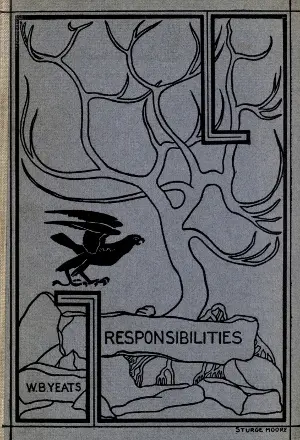
W. B. (William Butler) Yeats
W. B. (William Butler) Yeats
W. B. (William Butler) Yeats
BEHIND THE BOOK
This eBook is for the use of anyone anywhere in the United States and most other parts of the world at no cost and with almost no restrictions whatsoever. You may copy it, give it away or re-use it under the terms of the Project Gutenberg License included with this eBook or online at www.gutenberg.org. If you are not located in the United States, you will have to check the laws of the country where you are located before using this eBook. Read the source licence.
The original source file, including credits and licence, is retained by this library. Request an original-format copy at no charge. Please include the book title and Project Gutenberg identifier #33094.
KEEP YOUR CURIOSITY GOING

David Patterson (Spirit) Hatch

David Patterson (Spirit) Hatch

David Patterson (Spirit) Hatch
Cécile Tormay

Moritz Busch
John L. Ransom