THE CLASSIC COLLECTION✦Plays and controversiesCLASSIC FREE BOOKS
Plays and controversies
W. B. (William Butler) Yeats
THE CLASSIC COLLECTION · 1912
"The Cutting of an Agate" by William Butler Yeats is a collection of essays written in the early 20th century. The work primarily addresses themes related to Irish literature, theatre, and the cultural identity of Ireland, reflecting on the influence of myth and folklore in shaping artistic expression. Through discussions of prominent figures such as Cuchulain and the Fianna, Yeats delves into the unique narrative style of Irish storytelling, illuminating its lyrical qualities and emotional depth. The opening of this collection presents Yeats reflecting on the impact of Irish storytelling traditions and their relationship to the larger cultural landscape. He contrasts the robust and imaginative nature of Irish myths with the logical and historical narratives favored by other traditions, emphasizing the emotional resonance and communal spirit found in stories of legendary heroes like Cuchulain. Yeats draws upon his experiences and observations of the Irish theatre community, articulating a vision for a new artistic expression rooted in the richness of Irish folklore, while also critiquing contemporary literature and its disconnection from profound emotional truths. This opening sets the stage for a broader examination of how artistic forms can encapsulate cultural and historical identities, revealing insights that resonate with both the past and present.
Introduction adapted from the source catalogue; source summaries may be automatically generated.
Free to read · English · 46,290 words · No account needed
MAKE TIME FOR A GOOD BOOK
On by default. Untick to stop anonymous reading totals. Each page counts after 10 seconds in view. How this works.
Anonymous counting is on unless you have switched it off.
I have just been talking to a girl with a shrill monotonous voice and an abrupt way of moving. She is fresh from school, where they have taught her history and geography 'whereby a soul can be discerned,' but what is the value of an education, or even in the long run of a science, that does not begin with the personality, the habitual self, and illustrate all by that? Somebody should have taught her to speak for the most part on whatever note of her voice is most musical, and soften those harsh notes by speaking, not singing, to some stringed instrument, taking note after note and, as it were, caressing her words a little as if she loved the sound of them, and have taught her after this some beautiful pantomimic dance, till it had grown a habit to live for eye and ear. A wise theatre might make a training in strong and beautiful life the fashion, teaching before all else the heroic discipline of the looking-glass, for is not beauty, even as lasting love, one of the most difficult of the arts?
We artists have taken over-much to heart that old commandment about seeking after the Kingdom of Heaven. Verlaine told me that he had tried to translate 'In Memoriam,' but could not because Tennyson was 'too noble, too Anglais, and, when he should have been broken-hearted, had many reminiscences.' About that time I found in some English review an essay of his on Shakespeare. 'I had once a fine Shakespeare,' he wrote, or some such words, 'but I have it no longer. I write from memory.' One wondered in what vicissitude he had sold it, and for what money; and an image of the man rose in the imagination. To be his ordinary self as much as possible, not a scholar or even a reader, that was certainly his pose; and in the lecture he gave at Oxford he insisted 'that the poet should hide nothing of himself,' though he must speak it all with 'a care of that dignity which should manifest itself, if not in the perfection of form, at all events with an invisible, insensible, but effectual endeavour after this lofty and severe quality, I was about to say this virtue.' It was this feeling for his own personality, his delight in singing his own life, even more than that life itself, which made the generation I belong to compare him to Villon. It was not till after his death that I understood the meaning his words should have had for me, for while he lived I was interested in nothing but states of mind, lyrical moments, intellectual essences. I would not then have been as delighted as I am now by that guitar player, or as shocked as I am now by that girl whose movements have grown abrupt, and whose voice has grown harsh by the neglect of all but external activities. I had not learned what sweetness, what rhythmic movement, there is in those who have become the joy that is themselves. Without knowing it, I had come to care for nothing but impersonal beauty. I had set out on life with the thought of putting my very self into poetry, and had understood this as a representation of my own visions and an attempt to cut away the non-essential, but as I imagined the visions outside myself my imagination became full of decorative landscape and of still life. I thought of myself as something unmoving and silent living in the middle of my own mind and body, a grain of sand in Bloomsbury or in Connacht that Satan's watch fiends cannot find. Then one day I understood quite suddenly, as the way is, that I was seeking something unchanging and unmixed and always outside myself, a Stone or an Elixir that was always out of reach, and that I myself was the fleeting thing that held out its hand. The more I tried to make my art deliberately beautiful, the more did I follow the opposite of myself, for deliberate beauty is like a woman always desiring man's desire. Presently I found that I entered into myself and pictured myself and not some essence when I was not seeking beauty at all, but merely to lighten the mind of some burden of love or bitterness thrown upon it by the events of life. We are only permitted to desire life, and all the rest should be our complaints or our praise of that exacting mistress who can awake our lips into song with her kisses. But we must not give her all, we must deceive her a little at times, for, as Le Sage says in Diable Boiteux the false lovers who do not become melancholy or jealous with honest passion have the happiest mistresses and are rewarded the soonest and by the most beautiful. Our deceit will give us style, mastery, that dignity, that lofty and severe quality Verlaine spoke of. To put it otherwise, we should ascend out of common interests, the thoughts of the newspapers, of the marketplace, of men of science, but only so far as we can carry the normal, passionate, reasoning self, the personality as a whole. We must find some place upon the Tree of Life for the Phoenix nest, for the passion that is exaltation and the negation of the will, for the wings that are always upon fire, set high that the forked branches may keep it safe, yet low enough to be out of the little wind-tossed boughs, the quivering of the twigs.
Your reading position is saved on this browser. Take it to another device with a library code. Reading pages adapt to text, rather than matching a printed edition.
W. B. (William Butler) Yeats
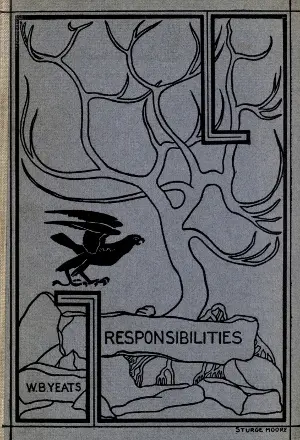
W. B. (William Butler) Yeats
W. B. (William Butler) Yeats
W. B. (William Butler) Yeats
BEHIND THE BOOK
This eBook is for the use of anyone anywhere in the United States and most other parts of the world at no cost and with almost no restrictions whatsoever. You may copy it, give it away or re-use it under the terms of the Project Gutenberg License included with this eBook or online at www.gutenberg.org. If you are not located in the United States, you will have to check the laws of the country where you are located before using this eBook. Read the source licence.
The original source file, including credits and licence, is retained by this library. Request an original-format copy at no charge. Please include the book title and Project Gutenberg identifier #33094.
KEEP YOUR CURIOSITY GOING

David Patterson (Spirit) Hatch

David Patterson (Spirit) Hatch

David Patterson (Spirit) Hatch
Cécile Tormay

Moritz Busch
John L. Ransom