
The wild duck
Henrik Ibsen
THE CLASSIC COLLECTION · 1894
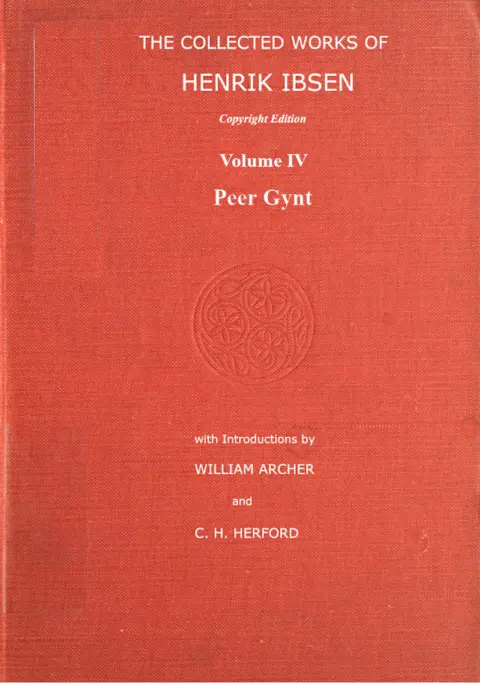
"The Collected Works of Henrik Ibsen, Vol. 04 (of 11)" by Henrik Ibsen is a collection of drama, specifically a dramatic poem titled "Peer Gynt," written during the mid-19th century. This work presents a combination of fantastical and satirical elements that follow the life and adventures of the titular character, Peer Gynt, a complex and imaginative young man from the Norwegian countryside who engages in numerous escapades and self-deceptions. The opening of "Peer Gynt" introduces the main character, Peer, and his tense relationship with his mother, Åse, who chastises him for his tendency to embellish stories and avoid responsibility. As Peer recounts a seemingly outlandish tale about his hunting exploits, his mother expresses disbelief and frustration, reflecting on their family's diminished circumstances. Their interaction sets the stage for Peer's character development, as he dreams of greatness while grappling with the disappointment of his current life. This lively exchange showcases Ibsen's characteristic blend of humor and pathos, establishing a rich foundation for the adventure and self-discovery that will unfold throughout the poem.
Introduction adapted from the source catalogue; source summaries may be automatically generated.
Free to read · English · 55,696 words · No account needed
MAKE TIME FOR A GOOD BOOK
On by default. Untick to stop anonymous reading totals. Each page counts after 10 seconds in view. How this works.
Anonymous counting is on unless you have switched it off.
MEMNON’S STATUE.
[Sings.]
From the demigod’s ashes there soar, youth-renewing,
Birds ever singing.
Zeus the Omniscient
Shaped them contending.
Owls of wisdom,
My birds, where do they slumber?
Thou must die if thou rede not
The song’s enigma!
How strange now,—I really fancied there came From the statue a sound. Music, this, of the Past. I heard the stone-accents now rising, now sinking.— I will register it, for the learned to ponder. [Notes in his pocket-book “The statue did sing. I heard the sound plainly, But didn’t quite follow the text of the song. The whole thing, of course, was hallucination.— Nothing else of importance observed to-day.” [Proceeds on his way.
Near the village of Gizeh. The great SPHINX carved out of the rock. In the distance the spires and minarets of Cairo.
PEER GYNT enters; he examines the SPHINX attentively, now through his eyeglass, now through his hollowed hand.
Now, where in the world have I met before Something half forgotten that’s like this hobgoblin? For met it I have, in the north or the south. Was it a person? And, if so, who? That Memnon, it afterwards crossed my mind, Was like the Old Man of the Dovrë, so called, Just as he sat there, stiff and stark, Planted on end on the stumps of pillars.— But this most curious mongrel here, This changeling, a lion and woman in one,— Does he come to me, too, from a fairy-tale, Or from a remembrance of something real? From a fairy-tale? Ho, I remember the fellow! Why, of course it’s the Boyg, that I smote on the skull,— That is, I dreamt it,—I lay in fever.— [Going closer. The self-same eyes, and the self-same lips;— Not quite so lumpish; a little more cunning; But the same, for the rest, in all essentials.— Ay, so that’s it, Boyg; so you’re like a lion When one sees you from behind and meets you in the day-time! Are you still good at riddling? Come, let us try. Now we shall see if you answer as last time! [Calls out towards the SPHINX. Hei, Boyg, who are you?
A VOICE.
[Behind the SPHINX.]
Ach, Sphinx, wer bist du?
What! Echo answers in German! How strange!
Wer bist du?
It speaks it quite fluently too!
That observation is new, and my own.
[Notes in his book.
“Echo in German. Dialect, Berlin.”
[BEGRIFFENFELDT comes out from behind the SPHINX.
A man!
Oh, then it was he that was chattering.
[Notes again.
“Arrived in the sequel at other results.”
BEGRIFFENFELDT.
[With all sorts of restless antics.]
Your reading position is saved on this browser. Take it to another device with a library code. Reading pages adapt to text, rather than matching a printed edition.
BEHIND THE BOOK
This eBook is for the use of anyone anywhere in the United States and most other parts of the world at no cost and with almost no restrictions whatsoever. You may copy it, give it away or re-use it under the terms of the Project Gutenberg License included with this eBook or online at www.gutenberg.org. If you are not located in the United States, you will have to check the laws of the country where you are located before using this eBook. Read the source licence.
The original source file, including credits and licence, is retained by this library. Request an original-format copy at no charge. Please include the book title and Project Gutenberg identifier #66239.
KEEP YOUR CURIOSITY GOING
Maurice Baring
W. B. (William Butler) Yeats
Edward Martyn

John Brougham & Charlotte Brontë
Marguerite Merington
Leonid Andreyev


