
The wild duck
Henrik Ibsen
THE CLASSIC COLLECTION · 1894
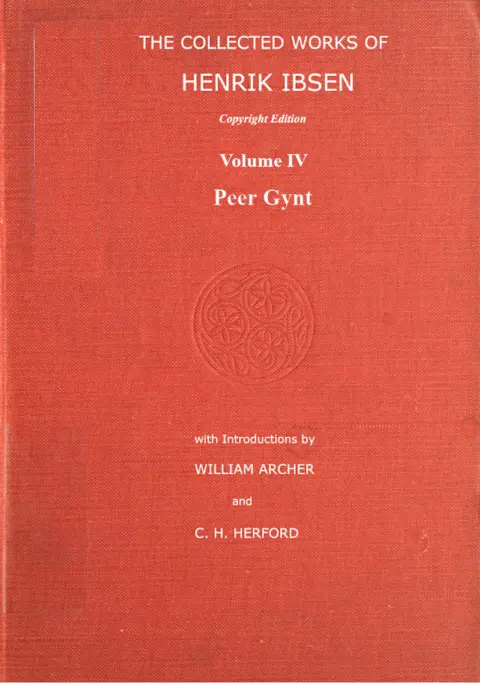
"The Collected Works of Henrik Ibsen, Vol. 04 (of 11)" by Henrik Ibsen is a collection of drama, specifically a dramatic poem titled "Peer Gynt," written during the mid-19th century. This work presents a combination of fantastical and satirical elements that follow the life and adventures of the titular character, Peer Gynt, a complex and imaginative young man from the Norwegian countryside who engages in numerous escapades and self-deceptions. The opening of "Peer Gynt" introduces the main character, Peer, and his tense relationship with his mother, Åse, who chastises him for his tendency to embellish stories and avoid responsibility. As Peer recounts a seemingly outlandish tale about his hunting exploits, his mother expresses disbelief and frustration, reflecting on their family's diminished circumstances. Their interaction sets the stage for Peer's character development, as he dreams of greatness while grappling with the disappointment of his current life. This lively exchange showcases Ibsen's characteristic blend of humor and pathos, establishing a rich foundation for the adventure and self-discovery that will unfold throughout the poem.
Introduction adapted from the source catalogue; source summaries may be automatically generated.
Free to read · English · 55,696 words · No account needed
MAKE TIME FOR A GOOD BOOK
On by default. Untick to stop anonymous reading totals. Each page counts after 10 seconds in view. How this works.
Anonymous counting is on unless you have switched it off.
[At a cross-road.]
Now comes the pinch, Peer, as never before! This Dovrish Enough has passed judgment upon you. The vessel’s a wreck; one must float with the spars. All else; but to go to the scrap-heap—no, no!
THE BUTTON-MOULDER.
[At the cross-road.]
Well now, Peer Gynt, have you found your voucher?
Is this, then, the cross-road? Well, that is short work!
I can see on your face, as it were on a sign-board, The gist of the paper before I have read it.
I got tired of the hunt;—one might lose one’s way——
Yes; and what does it lead to, after all?
True enough; in the wood, and by night as well——
There’s an old man, though, trudging. Shall we call him here?
No, let him go. He is drunk, my dear fellow!
But perhaps he might——
Hush; no—let him alone!
Well, shall we begin then?
One question—just one:
What is it, at bottom, this “being oneself”?
A singular question, most odd in the mouth
Of a man who but now——
Come, a straightforward answer.
To be oneself is: to slay oneself. But on you that answer is doubtless lost; And therefore we’ll say: to stand forth everywhere With Master’s intention displayed like a sign-board.
But suppose a man never has come to know
What Master meant with him?
He must divine it.
But how oft are divinings beside the mark,— Then one’s carried “ad undas”[138] in middle career.
That is certain, Peer Gynt; in default of divining The cloven-hoofed gentleman finds his best hook.
This matter’s excessively complicated.— See here! I no longer plead being myself;— It might not be easy to get it proven. That part of my case I must look on as lost. But just now, as I wandered alone o’er the heath, I felt my conscience-shoe pinching me; I said to myself: After all, you’re a sinner——
You seem bent on beginning all over again——
No, very far from it; a great one I mean;
Not only in deeds, but in words and desires.
I’ve lived a most damnable life abroad——
Perhaps; I must ask you to show me the schedule!
Well well, give me time; I will find out a parson, Confess with all speed, and then bring you his voucher.
Your reading position is saved on this browser. Take it to another device with a library code. Reading pages adapt to text, rather than matching a printed edition.
BEHIND THE BOOK
This eBook is for the use of anyone anywhere in the United States and most other parts of the world at no cost and with almost no restrictions whatsoever. You may copy it, give it away or re-use it under the terms of the Project Gutenberg License included with this eBook or online at www.gutenberg.org. If you are not located in the United States, you will have to check the laws of the country where you are located before using this eBook. Read the source licence.
The original source file, including credits and licence, is retained by this library. Request an original-format copy at no charge. Please include the book title and Project Gutenberg identifier #66239.
KEEP YOUR CURIOSITY GOING
Maurice Baring
W. B. (William Butler) Yeats
Edward Martyn

John Brougham & Charlotte Brontë
Marguerite Merington
Leonid Andreyev


