
The wild duck
Henrik Ibsen
THE CLASSIC COLLECTION · 1894
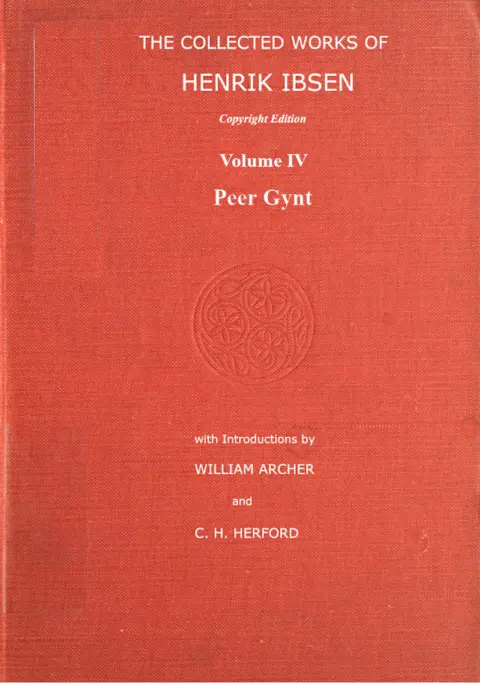
"The Collected Works of Henrik Ibsen, Vol. 04 (of 11)" by Henrik Ibsen is a collection of drama, specifically a dramatic poem titled "Peer Gynt," written during the mid-19th century. This work presents a combination of fantastical and satirical elements that follow the life and adventures of the titular character, Peer Gynt, a complex and imaginative young man from the Norwegian countryside who engages in numerous escapades and self-deceptions. The opening of "Peer Gynt" introduces the main character, Peer, and his tense relationship with his mother, Åse, who chastises him for his tendency to embellish stories and avoid responsibility. As Peer recounts a seemingly outlandish tale about his hunting exploits, his mother expresses disbelief and frustration, reflecting on their family's diminished circumstances. Their interaction sets the stage for Peer's character development, as he dreams of greatness while grappling with the disappointment of his current life. This lively exchange showcases Ibsen's characteristic blend of humor and pathos, establishing a rich foundation for the adventure and self-discovery that will unfold throughout the poem.
Introduction adapted from the source catalogue; source summaries may be automatically generated.
Free to read · English · 55,696 words · No account needed
MAKE TIME FOR A GOOD BOOK
On by default. Untick to stop anonymous reading totals. Each page counts after 10 seconds in view. How this works.
Anonymous counting is on unless you have switched it off.
Sunrise. The mountain-side in front of ÅSE’S sæter. The door is shut; all is silent and deserted.
PEER GYNT is lying asleep by the wall of the sæter.
PEER.
[Wakens, and looks about him with dull and heavy
eyes. He spits.]
What wouldn’t I give for a pickled herring!
[Spits again, and at the same moment catches sight of HELGA, who appears carrying a basket of food.
Ha, child, are you there? What is it you want?
It is Solveig——
PEER.
[Jumping up.]
Where is she?
Behind the sæter.
SOLVEIG.
[Unseen.]
If you come nearer, I’ll run away!
PEER.
[Stopping short.]
Perhaps you’re afraid I might take you in my arms?
For shame!
Do you know where I was last night?— Like a horse-fly the Dovrë-King’s daughter is after me.
Then it was well that the bells were set ringing.
Peer Gynt’s not the lad they can lure astray.—
What do you say?
HELGA.
[Crying.]
Oh, she’s running away!
[Running after her.
Wait!
PEER.
[Catches her by the arm.]
Look here, what I have in my pocket!
A silver button, child! You shall have it,—
Only speak for me!
Let me be; let me go!
There you have it.
Let go; there’s the basket of food.
God pity you if you don’t——
Uf, how you scare me!
PEER.
[Gently; letting her go.]
No, I only meant: beg her not to forget me!
[HELGA runs off.
Footnotes:
Footnote 43:
See note on page 35.
Footnote 44:
“Blir der Helg når en dig ser?” literally, “Does it become a holy-day (or holy-tide) when one sees you?”
Footnote 45:
A malevolent water-monster.
Footnote 46:
Sæter—a châlet, or small mountain farm, where the cattle are sent to pasture in the summer months.
Footnote 47:
See note, p. 29.
Footnote 48:
See Appendix.
Footnote 49:
Pronounce Vaal-fyeld.
Footnote 50:
Pronounce Broasë.
Footnote 51:
Kicking the rafters is a much-admired exploit in peasant
dancing. See note, page 30.
Footnote 52:
Literally, “Better than our reputation.”
Footnote 53:
“Ustyggelig stygt.” “Ustyggelig” seems to be what Mr. Lewis Carroll calls a portmanteau word, compounded of “usigelig” = unspeakable, and “styg” = ugly. The words might be rendered “beyond grimness grim.”
Footnote 54:
See Introduction and Appendix.
Footnote 55:
Rendered harmless by magical anointing.
Footnote 56:
“Atter og fram, det er lige langt;—
ud og ind, det er lige trangt!”
Footnote 57:
“Med lempe,” literally “by gentleness” or “easy-goingness.” “Quiescence” is somewhere near the idea.
Your reading position is saved on this browser. Take it to another device with a library code. Reading pages adapt to text, rather than matching a printed edition.
BEHIND THE BOOK
This eBook is for the use of anyone anywhere in the United States and most other parts of the world at no cost and with almost no restrictions whatsoever. You may copy it, give it away or re-use it under the terms of the Project Gutenberg License included with this eBook or online at www.gutenberg.org. If you are not located in the United States, you will have to check the laws of the country where you are located before using this eBook. Read the source licence.
The original source file, including credits and licence, is retained by this library. Request an original-format copy at no charge. Please include the book title and Project Gutenberg identifier #66239.
KEEP YOUR CURIOSITY GOING
Maurice Baring
W. B. (William Butler) Yeats
Edward Martyn

John Brougham & Charlotte Brontë
Marguerite Merington
Leonid Andreyev


