
The wild duck
Henrik Ibsen
THE CLASSIC COLLECTION · 1894
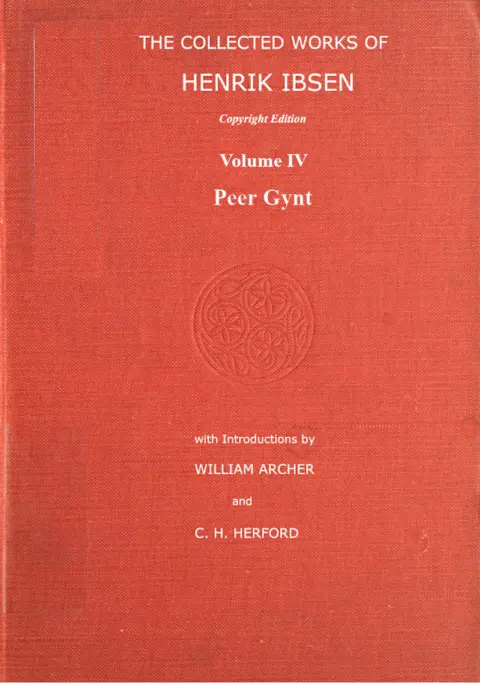
"The Collected Works of Henrik Ibsen, Vol. 04 (of 11)" by Henrik Ibsen is a collection of drama, specifically a dramatic poem titled "Peer Gynt," written during the mid-19th century. This work presents a combination of fantastical and satirical elements that follow the life and adventures of the titular character, Peer Gynt, a complex and imaginative young man from the Norwegian countryside who engages in numerous escapades and self-deceptions. The opening of "Peer Gynt" introduces the main character, Peer, and his tense relationship with his mother, Åse, who chastises him for his tendency to embellish stories and avoid responsibility. As Peer recounts a seemingly outlandish tale about his hunting exploits, his mother expresses disbelief and frustration, reflecting on their family's diminished circumstances. Their interaction sets the stage for Peer's character development, as he dreams of greatness while grappling with the disappointment of his current life. This lively exchange showcases Ibsen's characteristic blend of humor and pathos, establishing a rich foundation for the adventure and self-discovery that will unfold throughout the poem.
Introduction adapted from the source catalogue; source summaries may be automatically generated.
Free to read · English · 55,696 words · No account needed
MAKE TIME FOR A GOOD BOOK
On by default. Untick to stop anonymous reading totals. Each page counts after 10 seconds in view. How this works.
Anonymous counting is on unless you have switched it off.
Churchyard in a high lying mountain parish.
A funeral is going on. By the grave, the PRIEST and a gathering of people. The last verse of the psalm is being sung. PEER GYNT passes by on the road.
PEER.
[At the gate.]
Here’s a countryman going the way of all flesh.
God be thanked that it isn’t me.
[Enters the churchyard.
THE PRIEST.
[Speaking beside the grave.]
Now, when the soul has gone to meet its doom, And here the dust lies, like an empty pod,— Now, my dear friends, we’ll speak a word or two About this dead man’s pilgrimage on earth. He was not wealthy, neither was he wise, His voice was weak, his bearing was unmanly, He spoke his mind abashed and faltering, He scarce was master at his own fireside; He sidled into church, as though appealing For leave, like other men, to take his place. It was from Gudbrandsdale, you know, he came. When here he settled he was but a lad;— And you remember how, to the very last, He kept his right hand hidden in his pocket. That right hand in the pocket was the feature That chiefly stamped his image on the mind,— And therewithal his writhing, his abashed Shrinking from notice wheresoe’er he went. But, though he still pursued a path aloof, And ever seemed a stranger in our midst, You all know what he strove so hard to hide,— The hand he muffled had four fingers only.— I well remember, many years ago, One morning; there were sessions held at Lundë. ’Twas war-time, and the talk in every mouth Turned on the country’s sufferings and its fate. I stood there watching. At the table sat The Captain, ’twixt the Bailiff[115] and the sergeants; Lad after lad was measured up and down, Passed, and enrolled, and taken for a soldier. The room was full, and from the green outside, Where thronged the young folks, loud the laughter rang. A name was called, and forth another stepped, One pale as snow upon the glacier’s edge. They bade the youth advance; he reached the table; We saw his right hand swaddled in a clout;— He gasped, he swallowed, battling after words,— But, though the Captain urged him, found no voice. Ah yes, at last! Then with his cheek aflame, His tongue now failing him, now stammering fast He mumbled something of a scythe that slipped By chance, and shore his finger to the skin. Straightway a silence fell upon the room. Men bandied meaning glances; they made mouths; They stoned the boy with looks of silent scorn. He felt the hail-storm, but he saw it not. Then up the Captain stood, the grey old man; He spat, and pointed forth, and thundered “Go!” And the lad went. On both sides men fell back, Till through their midst he had to run the gauntlet. He reached the door; from there he took to flight;— Up, up he went,—through wood and over hillside, Up through the stone-screes, rough, precipitous. He had his home up there among the mountains.— It was some six months later he came here, With mother, and betrothed, and little child. He leased some ground upon the high hill-side, There where the waste lands trend away towards Lomb. He married the first moment that he could; He built a house; he broke the stubborn soil; He throve, as many a cultivated patch Bore witness, bravely clad in waving gold. At church he kept his right hand in his pocket,— But sure I am at home his fingers nine Toiled every whit as hard as others’ ten.— One spring the torrent washed it all away. Their lives were spared. Ruined and stripped of all, He set to work to make another clearing; And, ere the autumn, smoke again arose From a new, better-sheltered, mountain farm-house. Sheltered? From torrent—not from avalanche; Two years, and all beneath the snow lay buried. But still the avalanche could not daunt his spirit. He dug, and raked, and carted—cleared the ground— And the next winter, ere the snow-blasts came, A third time was his little homestead reared. Three sons he had, three bright and stirring boys; They must to school, and school was far away;— And they must clamber, where the hill-track failed, By narrow ledges past the headlong scree. What did he do? The eldest had to manage As best he might, and, where the path was worst, His father bound a rope round him to stay him;— The others on his back and arms he bore. Thus he toiled, year by year, till they were men. Now might he well have looked for some return. In the New World, three prosperous gentlemen Their school-going and their father have forgotten. He was short-sighted. Out beyond the circle Of those most near to him he nothing saw. To him seemed meaningless as cymbals’ tinkling Those words that to the heart should ring like steel. His race, his fatherland, all things high and shining, Stood ever, to his vision, veiled in mist. But he was humble, humble, was this man; And since that sessions-day his doom oppressed him, As surely as his cheeks were flushed with shame, And his four fingers hidden in his pocket.— Offender ’gainst his country’s laws? Ay, true! But there is one thing that the law outshineth Sure as the snow-white tent of Glittertind[116] Has clouds, like higher rows of peaks, above it. No patriot was he. Both for church and state A fruitless tree. But there, on the upland ridge, In the small circle where he saw his calling, There he was great, because he was himself. His inborn note rang true unto the end. His days were as a lute with muted strings. And therefore, peace be with thee, silent warrior, That fought the peasant’s little fight, and fell! It is not ours to search the heart and reins;— That is no task for dust, but for its ruler;— Yet dare I freely, firmly, speak my hope: He scarce stands crippled now before his God!
Your reading position is saved on this browser. Take it to another device with a library code. Reading pages adapt to text, rather than matching a printed edition.
BEHIND THE BOOK
This eBook is for the use of anyone anywhere in the United States and most other parts of the world at no cost and with almost no restrictions whatsoever. You may copy it, give it away or re-use it under the terms of the Project Gutenberg License included with this eBook or online at www.gutenberg.org. If you are not located in the United States, you will have to check the laws of the country where you are located before using this eBook. Read the source licence.
The original source file, including credits and licence, is retained by this library. Request an original-format copy at no charge. Please include the book title and Project Gutenberg identifier #66239.
KEEP YOUR CURIOSITY GOING
Maurice Baring
W. B. (William Butler) Yeats
Edward Martyn

John Brougham & Charlotte Brontë
Marguerite Merington
Leonid Andreyev


