
The wild duck
Henrik Ibsen
THE CLASSIC COLLECTION · 1894
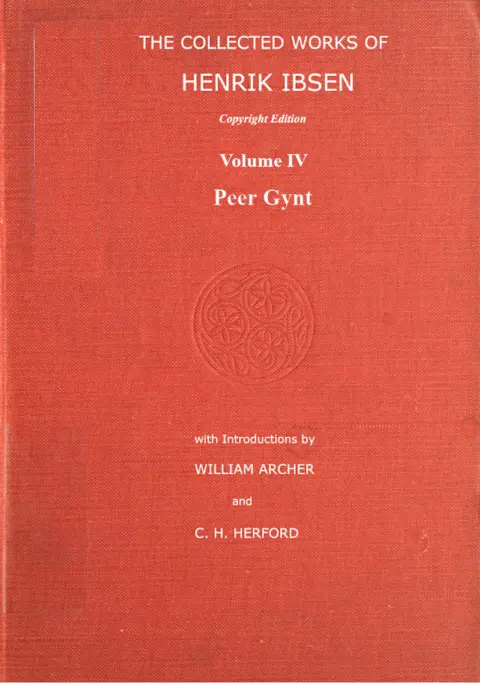
"The Collected Works of Henrik Ibsen, Vol. 04 (of 11)" by Henrik Ibsen is a collection of drama, specifically a dramatic poem titled "Peer Gynt," written during the mid-19th century. This work presents a combination of fantastical and satirical elements that follow the life and adventures of the titular character, Peer Gynt, a complex and imaginative young man from the Norwegian countryside who engages in numerous escapades and self-deceptions. The opening of "Peer Gynt" introduces the main character, Peer, and his tense relationship with his mother, Åse, who chastises him for his tendency to embellish stories and avoid responsibility. As Peer recounts a seemingly outlandish tale about his hunting exploits, his mother expresses disbelief and frustration, reflecting on their family's diminished circumstances. Their interaction sets the stage for Peer's character development, as he dreams of greatness while grappling with the disappointment of his current life. This lively exchange showcases Ibsen's characteristic blend of humor and pathos, establishing a rich foundation for the adventure and self-discovery that will unfold throughout the poem.
Introduction adapted from the source catalogue; source summaries may be automatically generated.
Free to read · English · 55,696 words · No account needed
MAKE TIME FOR A GOOD BOOK
On by default. Untick to stop anonymous reading totals. Each page counts after 10 seconds in view. How this works.
Anonymous counting is on unless you have switched it off.
THE SMITH.
[Flinging away his jacket.]
The jade shall be slaughtered!
SOLVEIG’S MOTHER.
[To SOLVEIG.]
There, you can see how that windbag is thought of.
ÅSE.
[Coming up with a stick in her hand.]
Is that son of mine here? Now he’s in for a drubbing!
Oh! how heartily I will dang him!
THE SMITH.
[Rolling up his shirt-sleeves.]
That switch is too light for a carcase like his.
The smith will dang him!
Bang him!
THE SMITH.
[Spits on his hands and nods to Åse.]
Hang him!
What? Hang my Peer? Ay, just try if you dare;— Åse and I,[42] we have teeth and claws!— Where is he? [Calls across the yard.] Peer!
THE BRIDEGROOM.
[Comes running up.]
Oh, God’s death on the cross!
Come father, come mother, and——!
What is the matter?
Just fancy, Peer Gynt——!
ÅSE.
[Screams.]
Have you taken his life?
No, but Peer Gynt——! Look, there on the hillside——!
With the bride.
ÅSE.
[Lets her stick sink.]
Oh, the beast!
THE SMITH.
[As if thunderstruck.]
Where the slope rises sheerest
He’s clambering upwards, by God, like a goat!
THE BRIDEGROOM.
[Crying.]
He’s shouldered her, mother, as I might a pig!
ÅSE.
[Shaking her fist up at him.]
Would God you might fall, and——! [Screams out in terror. Take care of your footing!
THE HEGSTAD FARMER.
[Comes in, bare-headed and white with rage.]
I’ll have his life for this bride-rape yet!
Oh no, God punish me if I let you!
Footnotes:
Footnote 22:
Pronounce Yendeen.
Footnote 23:
This is the poet’s own explanation of this difficult passage. “Hvirvlens vætter,” he writes, is equivalent to “Svimmelhedens ånder”—i.e., spirits of dizziness or vertigo.
Footnote 24:
See Appendix.
Footnote 25:
Literally “bushels.”
Footnote 26:
An ecclesiastical dignitary—something equivalent to a rural
dean.
Footnote 27:
“Jon med Skjæppen”—literally, “John with the Bushel”—a nickname given him in his days of prosperity, in allusion to his supposed bushels of money.
Footnote 28:
Pronounce Maass-Moo-en.
Footnote 29:
It is believed in some parts of Norway that “changelings” (elf-children left in the stead of those taken away by the fairies) can, by certain spells, be made to fly away up the chimney.
Footnote 30:
“Sendingsfolk,” literally, “folks with presents.” When the Norwegian peasants are bidden to a wedding-feast, they bring with them presents of eatables.
Footnote 31:
A somewhat violent peasant dance.
Footnote 32:
Foss (in the North of England “force”)—a waterfall.
Footnote 33:
A sort of master of ceremonies.
Footnote 34:
Your reading position is saved on this browser. Take it to another device with a library code. Reading pages adapt to text, rather than matching a printed edition.
BEHIND THE BOOK
This eBook is for the use of anyone anywhere in the United States and most other parts of the world at no cost and with almost no restrictions whatsoever. You may copy it, give it away or re-use it under the terms of the Project Gutenberg License included with this eBook or online at www.gutenberg.org. If you are not located in the United States, you will have to check the laws of the country where you are located before using this eBook. Read the source licence.
The original source file, including credits and licence, is retained by this library. Request an original-format copy at no charge. Please include the book title and Project Gutenberg identifier #66239.
KEEP YOUR CURIOSITY GOING
Maurice Baring
W. B. (William Butler) Yeats
Edward Martyn

John Brougham & Charlotte Brontë
Marguerite Merington
Leonid Andreyev


