
The wild duck
Henrik Ibsen
THE CLASSIC COLLECTION · 1894
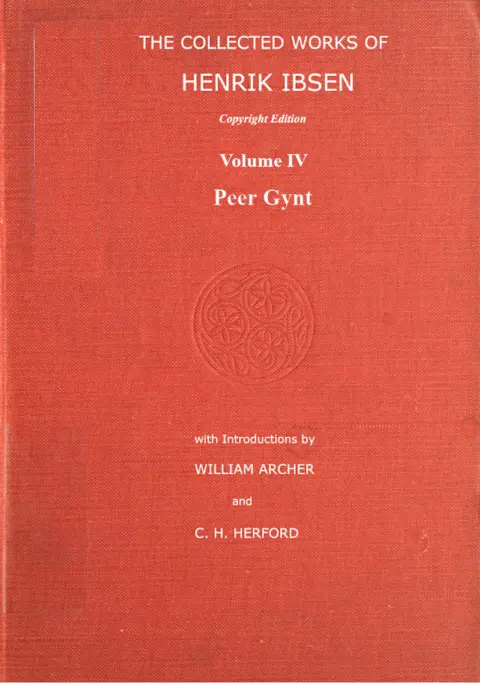
"The Collected Works of Henrik Ibsen, Vol. 04 (of 11)" by Henrik Ibsen is a collection of drama, specifically a dramatic poem titled "Peer Gynt," written during the mid-19th century. This work presents a combination of fantastical and satirical elements that follow the life and adventures of the titular character, Peer Gynt, a complex and imaginative young man from the Norwegian countryside who engages in numerous escapades and self-deceptions. The opening of "Peer Gynt" introduces the main character, Peer, and his tense relationship with his mother, Åse, who chastises him for his tendency to embellish stories and avoid responsibility. As Peer recounts a seemingly outlandish tale about his hunting exploits, his mother expresses disbelief and frustration, reflecting on their family's diminished circumstances. Their interaction sets the stage for Peer's character development, as he dreams of greatness while grappling with the disappointment of his current life. This lively exchange showcases Ibsen's characteristic blend of humor and pathos, establishing a rich foundation for the adventure and self-discovery that will unfold throughout the poem.
Introduction adapted from the source catalogue; source summaries may be automatically generated.
Free to read · English · 55,696 words · No account needed
MAKE TIME FOR A GOOD BOOK
On by default. Untick to stop anonymous reading totals. Each page counts after 10 seconds in view. How this works.
Anonymous counting is on unless you have switched it off.
With his destiny’s seal on his brow;
Been, as in God’s thought he first sprang forth!
Canst thou tell me? If not, I must get me home,—
Go down to the mist-shrouded regions.
SOLVEIG.
[Smiling.]
Oh, that riddle is easy.
Then tell what thou knowest!
Where was I, as myself, as the whole man, the true man?
Where was I, with God’s sigil upon my brow?
In my faith, in my hope, and in my love.[146]
PEER.
[Starts back.]
What sayest thou——? Peace! These are juggling words. Thou art mother thyself to the man that’s there.
Ay, that I am; but who is his father?
Surely he that forgives at the mother’s prayer.
PEER.
[A light shines in his face; he cries:]
My mother; my wife; oh, thou innocent woman!—
In thy love—oh, there hide me, hide me!
[Clings to her end hides his face in her lap. A long
silence. The sun rises.
SOLVEIG.
[Sings softly.]
Sleep thou, dearest boy of mine!
I will cradle thee, I will watch thee——
The boy has been sitting on his mother’s lap.
They two have been playing all the life-day long.
The boy has been resting at his mother’s breast All the life-day long. God’s blessing on my joy!
The boy has been lying close in to my heart
All the life-day long. He is weary now.
Sleep thou, dearest boy of mine!
I will cradle thee, I will watch thee.
THE BUTTON-MOULDER’S VOICE.
[Behind the house.]
At the last cross-road we will meet again, Peer; And then we’ll see whether——; I say no more.
SOLVEIG.
[Sings louder in the full daylight.]
I will cradle thee, I will watch thee;
Sleep and dream thou, dear my boy!
Footnotes:
Footnote 109:
Mountains and glaciers.
Footnote 110:
Mountains and glaciers.
Footnote 111:
So in original.
Footnote 112:
“Angst”—literally, “dread” or “terror”—probably means here something like “conviction of sin.” The influence of the Danish theologian, Sören Kierkegård, may be traced in this passage.
Footnote 113:
Literally, “Are set on screws.”
Footnote 114:
“Tolder,” the biblical “publican.”
Footnote 115:
See footnote, p. 95.
Footnote 116:
A mountain in the Jotunheim. The name means “glittering peak.”
Footnote 117:
“Den tid den sorg”—literally, “That time that sorrow” or
“care.”
Footnote 118:
Literally “the bushel.” See note, p. 11.
Footnote 119:
See Appendix.
Footnote 120:
See footnote, p. 114.
Footnote 121:
See footnote, p. 95.
Footnote 122:
“Digter”; means also “poet.”
Footnote 123:
See footnotes, pp. 29 and 30.
Footnote 124:
In the original, “Personlighed”—personality.
Footnote 125:
Your reading position is saved on this browser. Take it to another device with a library code. Reading pages adapt to text, rather than matching a printed edition.
BEHIND THE BOOK
This eBook is for the use of anyone anywhere in the United States and most other parts of the world at no cost and with almost no restrictions whatsoever. You may copy it, give it away or re-use it under the terms of the Project Gutenberg License included with this eBook or online at www.gutenberg.org. If you are not located in the United States, you will have to check the laws of the country where you are located before using this eBook. Read the source licence.
The original source file, including credits and licence, is retained by this library. Request an original-format copy at no charge. Please include the book title and Project Gutenberg identifier #66239.
KEEP YOUR CURIOSITY GOING
Maurice Baring
W. B. (William Butler) Yeats
Edward Martyn

John Brougham & Charlotte Brontë
Marguerite Merington
Leonid Andreyev


