THE CLASSIC COLLECTION✦My diaries, being a personal narrative of events 1888-1914, Part 2 (1900-1914)CLASSIC FREE BOOKS
My diaries, being a personal narrative of events 1888-1914, Part 2 (1900-1914)
Wilfrid Scawen Blunt
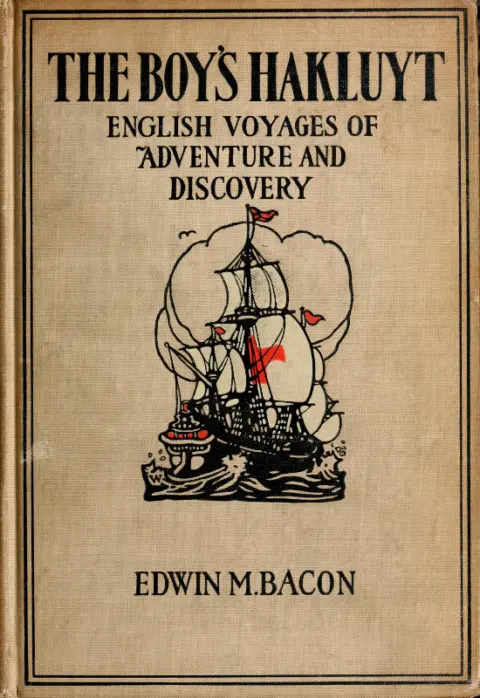
THE CLASSIC COLLECTION · 1908
"The Boy's Hakluyt: English Voyages of Adventure and Discovery" by Edwin M. Bacon is a historical account aimed at younger audiences, written in the early 20th century. The book explores the early English voyages of discovery and colonization, retelling the narratives compiled by Richard Hakluyt, a pivotal figure in promoting English maritime exploration in the late 16th century. It serves as an introduction to America's colonial history while celebrating the spirit of adventure and discovery shown by early explorers. At the start of the narrative, the text discusses the publication of Hakluyt's pamphlet "Divers Voyages," which emerged in 1582 and served to promote English colonization efforts in North America. The pamphlet sought to incite the interest and ambition of the English public by compiling accounts of earlier discoveries made by Englishmen and others, detailing the potential for trade and settlement in the New World. Hakluyt's influential work eventually laid the groundwork for subsequent expeditions, including those spearheaded by prominent explorers like Sir Humphrey Gilbert and Sir Walter Raleigh. This opening portion sets the stage for a comprehensive exploration of the achievements and failures associated with early English attempts to establish presence in the Americas.
Introduction adapted from the source catalogue; source summaries may be automatically generated.
Free to read · English · 103,906 words · No account needed
MAKE TIME FOR A GOOD BOOK
On by default. Untick to stop anonymous reading totals. Each page counts after 10 seconds in view. How this works.
Anonymous counting is on unless you have switched it off.
With unquenchable hopefulness Raleigh continued his quest for the Lost Colony to the close of Elizabeth’s reign, and abandoned it only when forced to do so by the attainder of James stripping him of his rights and liberty. By Elizabeth’s last year he had fitted out at his own charges five several expeditions solely for this purpose. While during this period, 1589–1603, his marvellous energies had been directed in many channels, he had remitted no efforts for the succour of his colonists. While performing many parts,—courtier, captain of the queen’s guard, statesman, member of parliament, mariner, sea-fighter, explorer, gold seeker,—and with varying fortunes, now falling under the queen’s displeasure, imprisoned in the Tower of London, again restored to her favour, engaged in dazzling adventure, American colonization was ever paramount in his thoughts.
And how crowded with extraordinary activities by this most versatile of the Elizabethan men these years were, the record of his greater achievements, mostly chronicled in the Principal Navigations, shows. What he had done up to the time of White’s abandonment of the search for the Lost Colony in 1590 we have seen. In 1591 he was the organizer of a fleet for service against Spain’s American possessions, and was appointed second in command under Lord Thomas Howard. But the queen refusing to let him go out, his cousin Sir Richard Grenville was appointed in his place; and with this expedition Sir Richard’s career closed, he being wounded to death when off the Azores, the last of August, in one of the most stubborn and desperate sea-fights of naval history. The next year, 1592, Raleigh promoted the privateering expedition under Frobisher and Burroughs which captured, among other prizes in the West Indies, the “Madre de Dios,” greatest of the Spanish treasure-ships then afloat. It was in this year, in July, that he was disgraced and sent to the Tower, but in October, when the privateers had returned with their rich prize, the queen, who had the largest share in this privateering venture, released him, since he alone could superintend the division of the plunder. In 1593 he matured a plan for a voyage to the “Empire of Guiana” and the fabled “El Dorado,” the “citie of gold,” in the unexplored northwestern part of South America, of which the natives had told Spanish travellers, with mines far excelling those of Peru. In 1594, in accordance with this plan, he sent out a preliminary expedition, under an experienced navigator, Captain Jacob Whiddon, to explore the coast contiguous to the great River Orinoco, and also the river with its tributaries, above which “El Dorado,” or “Manoa” as called by the Indians, was supposed to lie. In 1595 he sailed himself for Guiana at the head of a fleet of five ships and a company of one hundred officers, soldiers, and gentlemen adventurers. By a perilous voyage in small boats he succeeded in penetrating the Orinoco far up to the mouth of the Caroni, and the latter river to impassable falls, yet two hundred miles short, as it was reckoned, of the “citie of gold.” Upon his return to England in the summer, with some specimens of ore which he had picked up along the way, and the son of a local king as a pledge of friendship against his next coming, he prepared, maybe with Hakluyt’s assistance, a glowing account of this voyage, embellished with the tales that had been told him of the wonders of the region besides its richness in mines: among them, the “Amazons,” a warlike race of great women, and the “Ewaipanoma,” a headless nation, whose eyes were in their shoulders and their mouths in the middle of their breasts, and who wore “a long train of hair growing backward between the shoulders.” And when this story was printed, under the inviting title, “The Discouerie of the large, rich, and beautifull Empire of Guiana, with a relation of the great and golden citie of Manoa, which the Spaniards call El Dorado,” it was eagerly read and heightened his reputation. In 1596 he sent out Captain Laurence Keymis, a companion of his first voyage, with two well-equipped ships to renew the exploration of the Orinoco, especially with a view to planting an English colony in the region. Keymis returned in June with a report that confirmed Raleigh’s belief in its great mineral wealth. But at this juncture Raleigh was engrossed in a venture nearer home for checkmating Spain’s move of a second “Armada” against England. He was now united with Howard and the Earl of Essex in command of a fleet to attack Cadiz. With the ship “Warspite” he led the van in the great fight of June twenty-one which resulted in the destruction of the fleet intended for the descent upon England, and the capture of the city. Later, the same year, he despatched one of the smaller ships that had been in the Cadiz fight to Guiana, but this voyage had no important result. In 1597 he sailed as second in command with Essex in an expedition to strike another blow against Spain, and this was effectively done with the capture of Fayal. In 1598 his scheme of colonization in the fertile valley of the Orinoco had developed, and he planned to send out a colony. But for some reason not known the enterprise was abandoned. In 1600 he added to his several offices that of Governor of Jersey. In 1602 he despatched his fifth expedition for the relief of the “Virginia” colony.
Your reading position is saved on this browser. Take it to another device with a library code. Reading pages adapt to text, rather than matching a printed edition.
BEHIND THE BOOK
This eBook is for the use of anyone anywhere in the United States and most other parts of the world at no cost and with almost no restrictions whatsoever. You may copy it, give it away or re-use it under the terms of the Project Gutenberg License included with this eBook or online at www.gutenberg.org. If you are not located in the United States, you will have to check the laws of the country where you are located before using this eBook. Read the source licence.
The original source file, including credits and licence, is retained by this library. Request an original-format copy at no charge. Please include the book title and Project Gutenberg identifier #57917.
KEEP YOUR CURIOSITY GOING
Wilfrid Scawen Blunt
Wilfrid Scawen Blunt

E. W. (Edgar Watson) Howe
Cécile Tormay

Moritz Busch
John L. Ransom