THE CLASSIC COLLECTION✦My diaries, being a personal narrative of events 1888-1914, Part 2 (1900-1914)CLASSIC FREE BOOKS
My diaries, being a personal narrative of events 1888-1914, Part 2 (1900-1914)
Wilfrid Scawen Blunt
THE CLASSIC COLLECTION · 1908
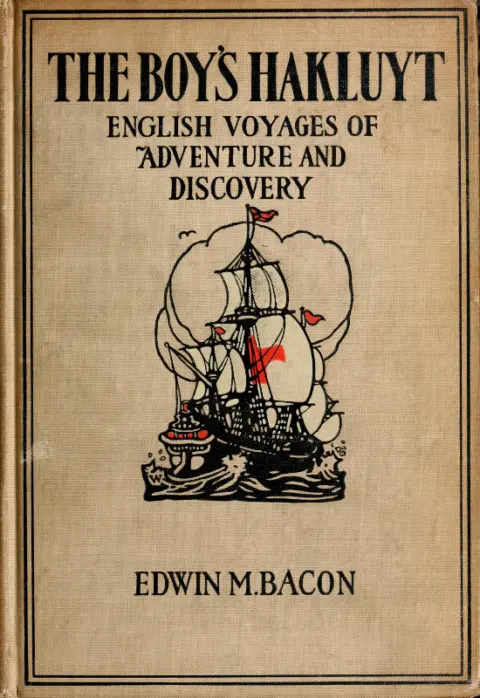
"The Boy's Hakluyt: English Voyages of Adventure and Discovery" by Edwin M. Bacon is a historical account aimed at younger audiences, written in the early 20th century. The book explores the early English voyages of discovery and colonization, retelling the narratives compiled by Richard Hakluyt, a pivotal figure in promoting English maritime exploration in the late 16th century. It serves as an introduction to America's colonial history while celebrating the spirit of adventure and discovery shown by early explorers. At the start of the narrative, the text discusses the publication of Hakluyt's pamphlet "Divers Voyages," which emerged in 1582 and served to promote English colonization efforts in North America. The pamphlet sought to incite the interest and ambition of the English public by compiling accounts of earlier discoveries made by Englishmen and others, detailing the potential for trade and settlement in the New World. Hakluyt's influential work eventually laid the groundwork for subsequent expeditions, including those spearheaded by prominent explorers like Sir Humphrey Gilbert and Sir Walter Raleigh. This opening portion sets the stage for a comprehensive exploration of the achievements and failures associated with early English attempts to establish presence in the Americas.
Introduction adapted from the source catalogue; source summaries may be automatically generated.
Free to read · English · 103,906 words · No account needed
MAKE TIME FOR A GOOD BOOK
On by default. Untick to stop anonymous reading totals. Each page counts after 10 seconds in view. How this works.
Anonymous counting is on unless you have switched it off.
They departed hence with their lighter load on the sixteenth of October. A month later they were “clear from the coast of the Indies and out of the channel and gulf of Bahama.” Afterward approaching the “cold country” many of the company “oppressed with famine” died, while those that were left “grew into such weaknesses” that they were scarcely able to manage the ship. Shortly new perils came upon them. “The winde alwayes ill for us to recover England, we determined to goe with Galicia in Spaine, with intent there to relieve our companie and other extreame wantes. And being arrived the last day of December in a place neere unto Vigo called Ponte Vedra, our men with excesse of fresh meate grew into miserable diseases, and died a great part of them. This matter was borne out as long as it might be, but in the end although there were none of our men suffered to goe a land, yet by accesse of the Spaniards our feeblenesse was knowen to them. Whereupon they ceased not to seeke by all meanes to betray us.” To escape this danger they made with all speed for Vigo. Here at last fortune favoured them. With the help of some English ships in this port and “twelve fresh men” they “repaired their wants” sufficiently to complete the voyage; and on the twenty-fifth of January, 1568/9 the “Minion” entered Mounts Bay, Cornwall, and the worn and shattered survivors were at home.
“If all the miseries and troublesome affaires of this sorowful voyage should be perfectly and throughly written,” Hawkins opined in closing his narration, “there should neede a painefull man with his pen, and as great a time as he had that wrote the lives and deathes of the Martyrs.”
The tribulations of the hundred and more men who were landed in the Gulf of Mexico to shift for themselves, and the marvellous adventures of those who lived through awful hardships, were related in large detail by three of them: Miles Philips, David Ingram, and Job Hartop. The tales of Philips and Hartop fill many of Hakluyt’s ample pages. Both supplement Hawkins’s official report of the San Juan d’Ulloa affair in small particulars. Philips told of miseries sustained by himself and companions among savage people; of their ultimate falling into the Spaniards’ hands; of how they were worked as slaves; how they were reviled as “English dogs and Lutheran heretics,” suffered the Inquisition, which was brought into “New Spain” while they were there, and were hardly used in the “religious houses”; and how some of them escaped after years of bondage. Philips also told of meeting in the city of Mexico the English hostages whom Hawkins had given at San Juan d’Ulloa. They were there prisoners in the viceroy’s house. After four months’ imprisonment they were sent to Spain, where, Philips had heard it “credibly reported,” many of them died “with the cruel handling of the Spaniards in the Inquisition house.” In Mexico, too, and at the viceroy’s house, Captain Barret, the captured master of the “Jesus,” was found. He also was afterward sent to Spain, and suffered the Inquisition; and at the last that Philips had heard, he was condemned to be burned, and with him another of Hawkins’s men named John Gilbert. Philips got back to England and told his story in 1582. Hartop was one of the gunners of the “Jesus.” The sum of his experiences covered twenty-three years, and included two years’ imprisonment in Mexico; a year in an Inquisition house in Spain; twelve years in the galleys; four years in the “everlasting prison remidilesse” with the “coat of St. Andrews cross on his back”; and three years a “drudge” to the treasurer of the king’s mint. Ingram’s experiences were the most marvellous of all, according to his narration, and the things that he saw, or imagined he saw, were amazing. He told of travelling with two companions afoot along the coast of North America, from the Gulf of Mexico to near Cape Breton. He averred that he “never continued in any one place above three or four days, saving in the city of Balma,” wherever that may have been, where he tarried about a week. He saw fair dwellings topped with “banquetting houses” built with “pillars of massy silver and crystal”; many strange peoples; wondrous beasts, elephants, a “monster beast twice as big as a horse,” another “bigger than a bear,” with neither head nor neck, the eyes and mouth in the breast; and many strange birds, “thrice as big as an eagle and beautiful to behold.” Hakluyt gave his story in the first edition of the Principal Navigations, but left it out of the later editions, because, as Purchas in his Pilgrimies afterward explained, of some of its “incredibilities”: the “reward of lying,” Purchas observes, “being not to be believed in truths.”
Your reading position is saved on this browser. Take it to another device with a library code. Reading pages adapt to text, rather than matching a printed edition.
BEHIND THE BOOK
This eBook is for the use of anyone anywhere in the United States and most other parts of the world at no cost and with almost no restrictions whatsoever. You may copy it, give it away or re-use it under the terms of the Project Gutenberg License included with this eBook or online at www.gutenberg.org. If you are not located in the United States, you will have to check the laws of the country where you are located before using this eBook. Read the source licence.
The original source file, including credits and licence, is retained by this library. Request an original-format copy at no charge. Please include the book title and Project Gutenberg identifier #57917.
KEEP YOUR CURIOSITY GOING
Wilfrid Scawen Blunt
Wilfrid Scawen Blunt

E. W. (Edgar Watson) Howe
Cécile Tormay

Moritz Busch
John L. Ransom