Stories of the Persian wars
Herodotus
THE CLASSIC COLLECTION · 1905
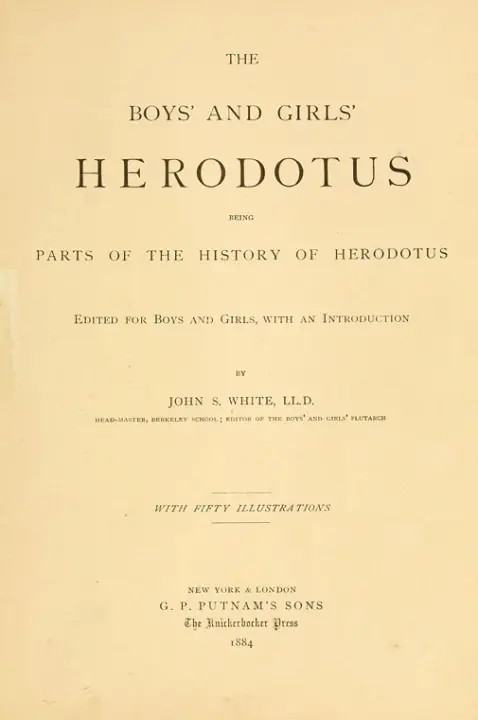
"The Boys' and Girls' Herodotus" by Herodotus is a historical account written in the late 19th century. This edition, edited for younger readers by John S. White, aims to make the classic writings of Herodotus accessible to boys and girls, blending historical facts with engaging storytelling. The work discusses the origins of historical events, particularly the conflicts between the Greeks and various nations, introduced through the lens of Herodotus's experiences and narrative style. At the start of the narrative, the scene is set in ancient Athens, near the end of the year 446 B.C., as the city faces political uncertainty. Herodotus is described as a famed historian sharing captivating tales before an audience, including a young Thucydides. The introduction highlights his intent to document the historical struggles between Greeks and barbarians, showcasing the origins of various conflicts, customs, and significant figures. The narrative establishes Herodotus’s honest and vivid storytelling approach that includes anecdotes, making it relatable and appealing to younger audiences. The opening chapters delve into the early effects of the conflict over respect and relationships that escalated into war, providing a foundation for the historical accounts that follow.
Introduction adapted from the source catalogue; source summaries may be automatically generated.
Free to read · English · 112,601 words · No account needed
MAKE TIME FOR A GOOD BOOK
On by default. Untick to stop anonymous reading totals. Each page counts after 10 seconds in view. How this works.
Anonymous counting is on unless you have switched it off.
After this, they said that this king descended alive into the place which the Greeks call Hades, and there played at dice with Ceres, and sometimes won, and other times lost; and that he came up again and brought with him as a present from her a napkin of gold. Any person to whom such things appear credible may adopt the accounts given by the Egyptians; it is my object, however, throughout the whole history, to write what I hear from each people. The Egyptians say that Ceres and Bacchus hold the chief sway in the infernal regions; and the Egyptians were also the first who asserted the doctrine that the soul of man is immortal, and that when the body perishes the soul enters into some other animal, constantly springing into existence; and when it has passed through the different kinds of terrestrial, marine, and aërial beings, it again enters into the body of a man that is born; and that this revolution is made in three thousand years.
Now, they told me that down to the reign of Rhampsinitus there was a perfect distribution of justice, and that all Egypt was in a high state of prosperity; but that after him Cheops, coming to reign over them, plunged into every kind of wickedness. For, having shut up all the temples, he first of all forbade them to offer sacrifice, and afterward ordered all the Egyptians to work for him; some, accordingly, were appointed to draw stones from the quarries in the Arabian mountain down to the Nile, others he ordered to receive the stones when transported in vessels across the river, and to drag them to the mountain called the Libyan. And they worked to the number of a hundred thousand men at a time, each party during three months. The time during which the people were thus harassed by toil lasted ten years on the road which they constructed, along which they drew the stones, a work, in my opinion, not much less than the pyramid: for its length is five stades, and its width ten orgyæ, and its height, where it is the highest, eight orgyæ; and it is of polished stone, with figures carved on it: ten years, then, were expended on this road, and in forming the subterraneous apartments on the hill, on which the pyramids stand, which he had made as a burial vault for himself, in an island, formed by draining a canal from the Nile. Twenty years were spent in erecting the pyramid itself: of this, which is square, each face is eight plethra, and the height is the same; it is composed of polished stones, and joined with the greatest exactness; none of the stones are less than thirty feet in length. This pyramid was built in the form of steps, which some call crosssæ, others bomides. When they had first built it in this manner, they raised the stones for covering the surface by machines made of short pieces of wood: having lifted them from the ground to the first range of steps, when the stone arrived there it was put on another machine that stood ready on the first range; from this it was drawn to the second range on another machine; for the machines were equal in number to the ranges of steps; or they removed the machine, which was only one, and portable, to each range in succession, whenever they wished to raise the stone higher; for I should relate it in both ways, as it was related to me. The highest parts of it were first finished, and last of all the parts on the ground. On the pyramid is shown an inscription, in Egyptian characters, how much was expended in radishes, onions, and garlic for the workmen; which the interpreter, as I well remember, reading the inscription, told me amounted to one thousand six hundred talents of silver. If this be really the case, how much more was probably expended in iron tools, in bread, and in clothes for the laborers, since they occupied in building the works the time which I mentioned, and no short time besides, as I think, in cutting and drawing the stones, and in forming the subterraneous excavation. It is related that Cheops in his cruelty subjected his daughter to every sort of disgrace, but she contrived to leave a monument of herself, and asked every one that she met to give her a stone toward the edifice she designed: of these stones they said the pyramid was built that stands in the middle of the three, before the great pyramid, each side of which is a plethron and a half in length. The Egyptians say that this Cheops reigned fifty years; and when he died, his brother Chephren succeeded to the kingdom; and he followed the same practices as the other, both in other respects, and in building a pyramid. This does not come up to the dimensions of his brother's, for I myself measured them; nor has it subterraneous chambers; nor does a channel from the Nile flow to it, as to the other; but this flows through an artificial aqueduct round an island within, in which they say the body of Cheops is laid. Having laid the first course of variegated Ethiopian stones, less in height than the other by forty feet, he built it near the large pyramid. They both stand on the same hill, which is about a hundred feet high. Chephren, they said, reigned fifty-six years. Thus one hundred and six years are reckoned, during which the Egyptians suffered all kinds of calamities, and for this length of time the temples were never opened. From the hatred they bear them the Egyptians are not very willing to mention their names; but call the pyramids after Philition, a shepherd, who at that time kept his cattle in those parts.
Your reading position is saved on this browser. Take it to another device with a library code. Reading pages adapt to text, rather than matching a printed edition.
BEHIND THE BOOK
This eBook is for the use of anyone anywhere in the United States and most other parts of the world at no cost and with almost no restrictions whatsoever. You may copy it, give it away or re-use it under the terms of the Project Gutenberg License included with this eBook or online at www.gutenberg.org. If you are not located in the United States, you will have to check the laws of the country where you are located before using this eBook. Read the source licence.
The original source file, including credits and licence, is retained by this library. Request an original-format copy at no charge. Please include the book title and Project Gutenberg identifier #55758.
KEEP YOUR CURIOSITY GOING
Cécile Tormay

Moritz Busch
John L. Ransom
Frances Wright
Cécile Tormay

Mabel Potter Daggett