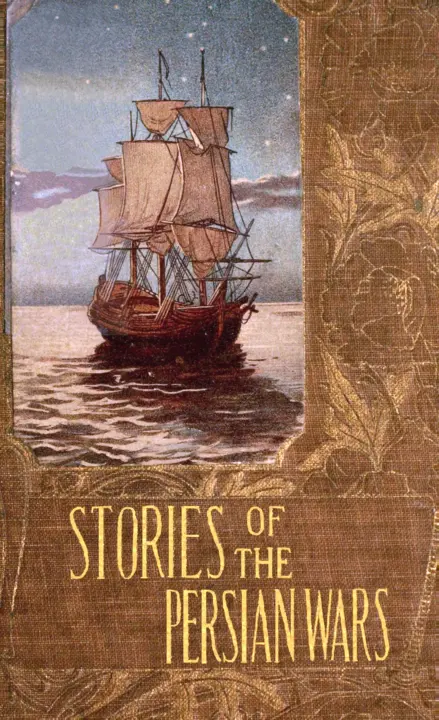
Stories of the Persian wars
Herodotus
THE CLASSIC COLLECTION · 1905
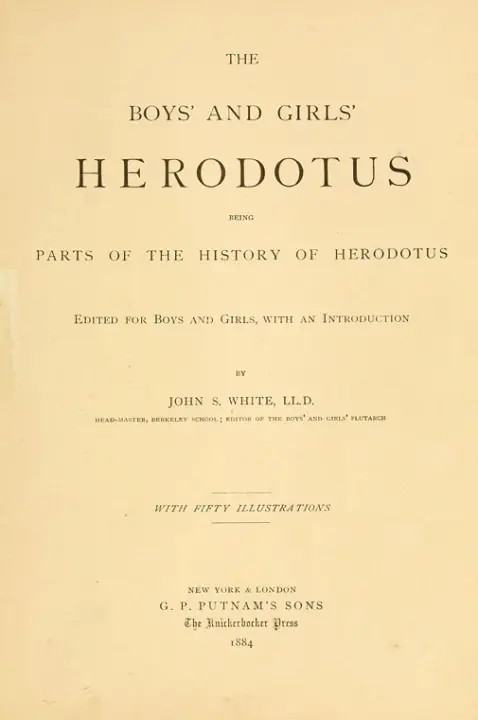
"The Boys' and Girls' Herodotus" by Herodotus is a historical account written in the late 19th century. This edition, edited for younger readers by John S. White, aims to make the classic writings of Herodotus accessible to boys and girls, blending historical facts with engaging storytelling. The work discusses the origins of historical events, particularly the conflicts between the Greeks and various nations, introduced through the lens of Herodotus's experiences and narrative style. At the start of the narrative, the scene is set in ancient Athens, near the end of the year 446 B.C., as the city faces political uncertainty. Herodotus is described as a famed historian sharing captivating tales before an audience, including a young Thucydides. The introduction highlights his intent to document the historical struggles between Greeks and barbarians, showcasing the origins of various conflicts, customs, and significant figures. The narrative establishes Herodotus’s honest and vivid storytelling approach that includes anecdotes, making it relatable and appealing to younger audiences. The opening chapters delve into the early effects of the conflict over respect and relationships that escalated into war, providing a foundation for the historical accounts that follow.
Introduction adapted from the source catalogue; source summaries may be automatically generated.
Free to read · English · 112,601 words · No account needed
MAKE TIME FOR A GOOD BOOK
On by default. Untick to stop anonymous reading totals. Each page counts after 10 seconds in view. How this works.
Anonymous counting is on unless you have switched it off.
Rhampsinitus succeeded Proteus in the kingdom: He left as a monument the portico of the temple of Vulcan, fronting to the west; and erected two statues before the portico, twenty-five cubits high. Of these, the one standing to the north the Egyptians call Summer; and that to the south, Winter: and the one that they call Summer, they worship and do honor to; but the one called Winter, they treat in a quite contrary way.
This king, they said, possessed a great quantity of money, such as no one of the succeeding kings was able to attain. Wishing to treasure up his wealth in safety, he built a chamber of stone, one of the walls of which adjoined the outside of the palace. But the builder, forming a plan against it, devised the following contrivance; he fitted one of the stones so that it might be easily taken out by two men, or even one. When the chamber was finished, the king laid up his treasures in it; in the course of time the builder, finding his end approaching, called his two sons to him, and described to them how he had provided when he was building the king's treasury that they might have abundant sustenance; and having clearly explained to them every thing relating to the removal of the stone, he gave them its dimensions, and told them, if they would observe his instructions, they would be stewards of the king's riches. He died, and the sons were not long in applying themselves to the work; coming by night to the palace, they found the stone in the building, easily removed it, and carried off a great quantity of treasure. When the king happened to open the chamber, he was astonished at seeing the vessels deficient in treasure; but was not able to accuse any one, as the seals were unbroken, and the chamber well secured. When on opening it two or three times, the treasures were always evidently diminished (for the thieves did not cease plundering), he adopted the following plan: he ordered traps to be made, and placed them round the vessels in which the treasures were. But when the thieves came as before, and one of them had entered, as soon as he went near a vessel, he was straightway caught in the trap; perceiving, therefore, in what a predicament he was, he immediately called to his brother, and told him what had happened, and bade him enter as quick as possible, and cut off his head, lest, if he was seen and recognized, he should ruin him also: the other thought that he spoke well, and did as he was advised; then, having fitted in the stone, he returned home, taking with him his brother's head. When day came, the king entered the chamber, and was astonished at seeing the body of the thief in the trap without the head, but the chamber secure, and without any means of entrance or exit. In this perplexity he contrived another plan: he hung up the body of the thief on a public wall, and having placed sentinels there, ordered them to seize and bring before him whomsoever they should see weeping or expressing commiseration at the spectacle. The mother was greatly grieved at the body being suspended, and coming to words with her surviving son, commanded him, by any means he could, to contrive how he might take down and bring away the corpse of his brother; and if he should neglect to do so, she threatened to go to the king, and inform him that he had the treasures. Having got some asses, and filled some skins with wine, he put them on the asses, and then drove them along; but when he came near the sentinels that guarded the suspended corpse, he drew out two or three of the necks of the skins that hung down, and loosened them; and, as the wine ran out, he beat his head, and cried out aloud, as if he knew not to which of the asses he should turn first. The sentinels, when they saw wine flowing in abundance, ran into the road, with vessels in their hands, caught the wine that was being spilt, thinking it all their own gain; but the man, feigning anger, railed bitterly against them all; however, as the sentinels soothed him, he at length pretended to be pacified; and at last drove his asses out of the road, and set them to rights again. When more conversation passed, and one of the sentinels joked with him and set him laughing, he gave them another of the skins; and they, just as they were, lay down and set to to drink, and invited him to stay and drink with them. He was persuaded, and remained with them; and as they treated him kindly during the drinking, he gave them another of the skins; and the sentinels, having taken very copious draughts, became royally drunk, and, overpowered by the wine, fell asleep on the spot. Then he took down the body of his brother, and having by way of insult shaved the right cheeks of all the sentinels, laid the corpse on the asses, and drove home, having performed his mother's injunctions. The king, upon being informed that the body of the thief had been stolen, was exceedingly indignant, but being unable by any means to find out the contriver of this artifice, he grew so astonished at the shrewdness and daring of the man, that at last, sending throughout all the cities, he caused a proclamation to be made, offering a free pardon, and promising great reward to the man, if he would discover himself. The thief, relying on this promise, went to the king's palace; and Rhampsinitus greatly admired him, and gave him his daughter in marriage, accounting him the most knowing of all men; for while the Egyptians were superior to all others, he was superior to the Egyptians.
Your reading position is saved on this browser. Take it to another device with a library code. Reading pages adapt to text, rather than matching a printed edition.
BEHIND THE BOOK
This eBook is for the use of anyone anywhere in the United States and most other parts of the world at no cost and with almost no restrictions whatsoever. You may copy it, give it away or re-use it under the terms of the Project Gutenberg License included with this eBook or online at www.gutenberg.org. If you are not located in the United States, you will have to check the laws of the country where you are located before using this eBook. Read the source licence.
The original source file, including credits and licence, is retained by this library. Request an original-format copy at no charge. Please include the book title and Project Gutenberg identifier #55758.
KEEP YOUR CURIOSITY GOING
Cécile Tormay

Moritz Busch
John L. Ransom
Frances Wright
Cécile Tormay

Mabel Potter Daggett