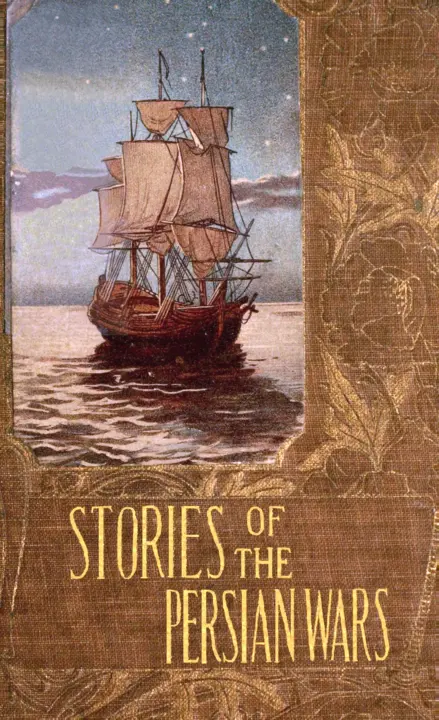
Stories of the Persian wars
Herodotus
THE CLASSIC COLLECTION · 1905
"The Boys' and Girls' Herodotus" by Herodotus is a historical account written in the late 19th century. This edition, edited for younger readers by John S. White, aims to make the classic writings of Herodotus accessible to boys and girls, blending historical facts with engaging storytelling. The work discusses the origins of historical events, particularly the conflicts between the Greeks and various nations, introduced through the lens of Herodotus's experiences and narrative style. At the start of the narrative, the scene is set in ancient Athens, near the end of the year 446 B.C., as the city faces political uncertainty. Herodotus is described as a famed historian sharing captivating tales before an audience, including a young Thucydides. The introduction highlights his intent to document the historical struggles between Greeks and barbarians, showcasing the origins of various conflicts, customs, and significant figures. The narrative establishes Herodotus’s honest and vivid storytelling approach that includes anecdotes, making it relatable and appealing to younger audiences. The opening chapters delve into the early effects of the conflict over respect and relationships that escalated into war, providing a foundation for the historical accounts that follow.
Introduction adapted from the source catalogue; source summaries may be automatically generated.
Free to read · English · 112,601 words · No account needed
MAKE TIME FOR A GOOD BOOK
On by default. Untick to stop anonymous reading totals. Each page counts after 10 seconds in view. How this works.
Anonymous counting is on unless you have switched it off.
My history hence proceeds to inquire who Cyrus was that overthrew the power of Crœsus, and how the Persians became masters of Asia. In which narration I shall follow those Persians, who do not wish to magnify the actions of Cyrus, but to relate the plain truth; though I am aware that there are three other ways of relating Cyrus's history. After the Assyrians had ruled over Upper Asia five hundred and twenty years, the Medes first began to revolt from them; and they it seems, in their struggle with the Assyrians for liberty, proved themselves brave men; and having shaken off the yoke, became free: afterward the other nations also did the same as the Medes. When all throughout the continent were independent, they were again reduced under a despotic government. There was among the Medes a man famous for wisdom, named Deioces, son of Phraortes. This Deioces, aiming at absolute power, had recourse to the following plan. The Medes were at that time distributed into villages, and Deioces, who was already highly esteemed in his own district, applied himself with great zeal to the exercise of justice; and this he did, since great lawlessness prevailed throughout the whole of Media, and he knew that injustice and justice are ever at variance. The Medes of the same village, observing his conduct, chose him for their judge; and he, constantly keeping the sovereign power in view, showed himself upright and just. By this conduct he acquired no slight praise from his fellow citizens, so much so that the inhabitants of other villages, hearing that Deioces was the only one who judged uprightly, having before met with unjust sentences, when they heard of him gladly came from all parts to Deioces, in order to submit their quarrels to his decision; and at last they would commit the decision to no one else. In the end, when the number of those who had recourse to him continually increased as men heard of the justice of his decisions, Deioces, seeing the whole devolved upon himself, would no longer occupy the seat where he used to sit to determine differences, and refused to act as judge any more, for it was of no advantage to him to neglect his own affairs, and spend the day in deciding the quarrels of others. Upon this, rapine and lawlessness growing far more frequent throughout the villages than before, the Medes called an assembly and consulted together about the present state of things, but, as I suspect, the partisans of Deioces spoke to the following purpose: "Since it is impossible for us to inhabit the country if we continue in our present condition, let us constitute a king over us, and so the country will be governed by good laws, and we ourselves shall be able to attend to our business, nor be any longer driven from our homes by lawlessness." By some such words they persuaded them to submit to a kingly government. Upon their immediately putting the question, whom they should appoint king, Deioces was unanimously preferred and commended: so that at last they agreed that he should be their king. But he required them to build him a palace suitable to the dignity of a king, and give him guards for security of his person. The Medes accordingly did so: and built him a strong and spacious palace in the part of the country that he selected, and permitted him to choose guards for his person out of all the Medes. Being thus possessed of the power, he compelled the Medes to build one city, and having carefully adorned that, to pay less attention to the others. As the Medes obeyed him in this also, he built lofty and strong walls, which now go under the name of Ecbatana,[4] one placed in a circle within the other; and this fortification was so contrived, that each circle was raised above the other by the height of the battlements only. The situation of the ground, rising by an easy ascent, was very favorable to the design. There were seven circles altogether, the king's palace and the treasury, situated within the innermost of them. The largest of these walls was about equal in circumference to the city of Athens; the battlements of the first circle were white, of the second black, of the third purple, of the fourth blue, of the fifth bright red. Thus the battlements of all circles were painted with different colors; but the two last had their battlements plated, the one with silver, the other with gold.[5]
Your reading position is saved on this browser. Take it to another device with a library code. Reading pages adapt to text, rather than matching a printed edition.
BEHIND THE BOOK
This eBook is for the use of anyone anywhere in the United States and most other parts of the world at no cost and with almost no restrictions whatsoever. You may copy it, give it away or re-use it under the terms of the Project Gutenberg License included with this eBook or online at www.gutenberg.org. If you are not located in the United States, you will have to check the laws of the country where you are located before using this eBook. Read the source licence.
The original source file, including credits and licence, is retained by this library. Request an original-format copy at no charge. Please include the book title and Project Gutenberg identifier #55758.
KEEP YOUR CURIOSITY GOING
Cécile Tormay

Moritz Busch
John L. Ransom
Frances Wright
Cécile Tormay

Mabel Potter Daggett