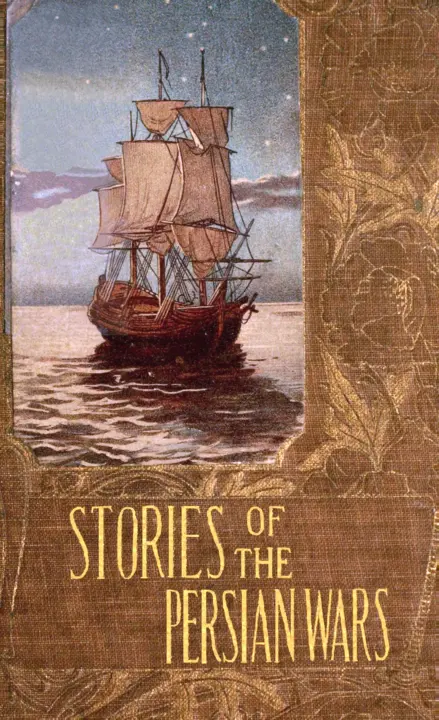
Stories of the Persian wars
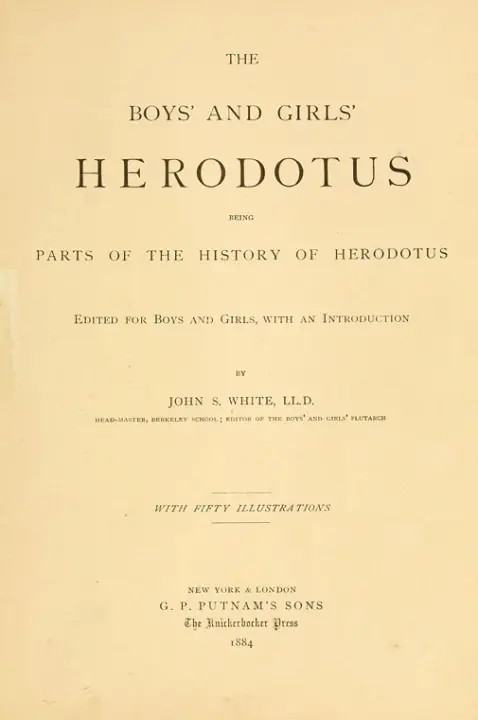
Herodotus
THE CLASSIC COLLECTION · 1905
"The Boys' and Girls' Herodotus" by Herodotus is a historical account written in the late 19th century. This edition, edited for younger readers by John S. White, aims to make the classic writings of Herodotus accessible to boys and girls, blending historical facts with engaging storytelling. The work discusses the origins of historical events, particularly the conflicts between the Greeks and various nations, introduced through the lens of Herodotus's experiences and narrative style. At the start of the narrative, the scene is set in ancient Athens, near the end of the year 446 B.C., as the city faces political uncertainty. Herodotus is described as a famed historian sharing captivating tales before an audience, including a young Thucydides. The introduction highlights his intent to document the historical struggles between Greeks and barbarians, showcasing the origins of various conflicts, customs, and significant figures. The narrative establishes Herodotus’s honest and vivid storytelling approach that includes anecdotes, making it relatable and appealing to younger audiences. The opening chapters delve into the early effects of the conflict over respect and relationships that escalated into war, providing a foundation for the historical accounts that follow.
Introduction adapted from the source catalogue; source summaries may be automatically generated.
Free to read · English · 112,601 words · No account needed
MAKE TIME FOR A GOOD BOOK
On by default. Untick to stop anonymous reading totals. Each page counts after 10 seconds in view. How this works.
Anonymous counting is on unless you have switched it off.
On the same day on which the defeat at Platæa occurred, another happened to take place at Mycale in Ionia. For while the Greeks were stationed at Delos, there came to them as ambassadors from Samos, Lampon, Athenagoras, and Hegesistratus, being sent by the Samians, unknown to the Persians. When they came to the generals, Hegesistratus urged that "if only the Ionians should see them, they would revolt from the Persians, and that the barbarians would not withstand them; or, if they should withstand them, the Greeks would not find any other such booty." Invoking, too, their common gods, he besought them to deliver Grecian men from servitude, and to repel the barbarian; and he said, "that this would be easy for them to do, for their ships sailed badly, and were not fit to fight with them; and, if they suspected at all that they were leading them on deceitfully, they were themselves ready to go on board their ships as hostages." The Samian stranger was so earnest in his entreaties, that Leotychides asked: "O Samian friend, what is your name?" "Hegesistratus," he answered; upon which, interrupting the rest of his discourse, Leotychides exclaimed: "I accept the "Hegesistratus,"[30] my Samian friend; only do you take care that before you sail away both you yourself and those who are with you, pledge your faith that the Samians will be zealous allies to us." The Samians immediately pledged their faith and made oath of confederacy with the Greeks. The others sailed home, but he ordered Hegesistratus to sail with the fleet, regarding his name as an omen. The Greeks tarried that day, and on the next sacrificed auspiciously, Deiphonus, son of Evenius, of Apollonia in the Ionian gulf, acting as diviner.
The following incident befel his father, Evenius. There are in this Apollonia sheep sacred to the sun, which by day feed near the river that flows from Mount Lacmon through the Apollonian territory into the sea, near the port of Oricus; but by night, chosen men, the most eminent of the citizens for wealth and birth, keep watch over them, each for a year: for the Apollonians set a high value upon these sheep, in consequence of some oracle. They are folded in a cavern at a distance from the city. There, once on a time, Evenius, being chosen, kept watch, and one night when he had fallen asleep during his watch, wolves entered the cave, and destroyed about sixty of the sheep. When he discovered what had happened, he mentioned it to no one, purposing to buy others, and put them in their place. This occurrence, however, did not escape the notice of the Apollonians; and as soon as they discovered it, they brought him to trial, and gave sentence that, for having fallen asleep during his watch, he should be deprived of sight. But after they had blinded Evenius, from that time forward neither did their sheep multiply, nor did the land yield its usual fruit. An admonition was given them at Dodona and Delphi, when they inquired of the prophets the cause of the present calamities "that they had unjustly deprived Evenius, the keeper of the sacred sheep, of his sight; for they themselves had sent the wolves, and would not cease avenging him, until the people should give such satisfaction for what they had done, as he himself should choose, and think sufficient: then, the gods themselves would give such a present to Evenius, that most men would pronounce him happy, from possessing it." The Apollonians, keeping this answer secret, deputed some of their citizens to negociate the matter with Evenius. One day when he was seated on a bench, they went and sat down by him, and conversed on different subjects, till at length they began to commiserate his misfortune, and leading him artfully on, they asked, "what reparation he would choose, if the Apollonians were willing to give him satisfaction for what they had done." Not having heard of the oracle he made this choice, "if any one would give him the lands of certain citizens," naming those who he knew had the two best estates in Apollonia, "and besides these a house," which he knew was the handsomest in the city, he said, "he would thenceforth forego his anger, and this reparation would content him." Immediately taking him up they said, "the Apollonians make you this reparation for the loss of your eyes, in obedience to an oracle they have received." He thereupon was very indignant, on hearing the whole truth, for he had been deceived; but the Apollonians bought the property from the owners, and gave him what he had chosen, and immediately the gift of divination was implanted in him, so that he became very celebrated.
Your reading position is saved on this browser. Take it to another device with a library code. Reading pages adapt to text, rather than matching a printed edition.
BEHIND THE BOOK
This eBook is for the use of anyone anywhere in the United States and most other parts of the world at no cost and with almost no restrictions whatsoever. You may copy it, give it away or re-use it under the terms of the Project Gutenberg License included with this eBook or online at www.gutenberg.org. If you are not located in the United States, you will have to check the laws of the country where you are located before using this eBook. Read the source licence.
The original source file, including credits and licence, is retained by this library. Request an original-format copy at no charge. Please include the book title and Project Gutenberg identifier #55758.
KEEP YOUR CURIOSITY GOING
Cécile Tormay

Moritz Busch
John L. Ransom
Frances Wright
Cécile Tormay

Mabel Potter Daggett