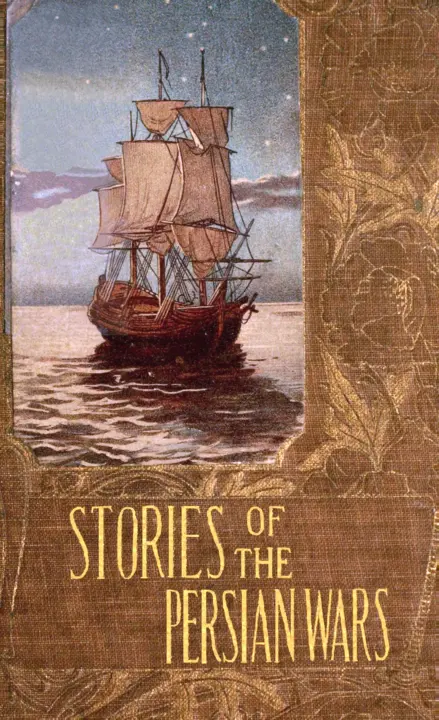
Stories of the Persian wars
Herodotus
THE CLASSIC COLLECTION · 1905
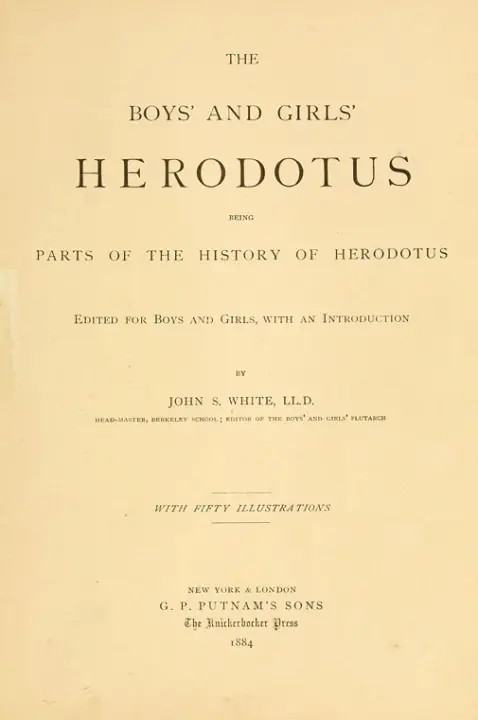
"The Boys' and Girls' Herodotus" by Herodotus is a historical account written in the late 19th century. This edition, edited for younger readers by John S. White, aims to make the classic writings of Herodotus accessible to boys and girls, blending historical facts with engaging storytelling. The work discusses the origins of historical events, particularly the conflicts between the Greeks and various nations, introduced through the lens of Herodotus's experiences and narrative style. At the start of the narrative, the scene is set in ancient Athens, near the end of the year 446 B.C., as the city faces political uncertainty. Herodotus is described as a famed historian sharing captivating tales before an audience, including a young Thucydides. The introduction highlights his intent to document the historical struggles between Greeks and barbarians, showcasing the origins of various conflicts, customs, and significant figures. The narrative establishes Herodotus’s honest and vivid storytelling approach that includes anecdotes, making it relatable and appealing to younger audiences. The opening chapters delve into the early effects of the conflict over respect and relationships that escalated into war, providing a foundation for the historical accounts that follow.
Introduction adapted from the source catalogue; source summaries may be automatically generated.
Free to read · English · 112,601 words · No account needed
MAKE TIME FOR A GOOD BOOK
On by default. Untick to stop anonymous reading totals. Each page counts after 10 seconds in view. How this works.
Anonymous counting is on unless you have switched it off.
The same queen also contrived the following deception. Over the most frequented gate of the city she prepared a sepulchre for herself, high up above the gate itself; and on the sepulchre she had engraved, SHOULD ANY ONE OF MY SUCCESSORS, KINGS OF BABYLON, FIND HIMSELF IN WANT OF MONEY, LET HIM OPEN THIS SEPULCHRE, AND TAKE AS MUCH AS HE CHOOSES; BUT IF HE BE NOT IN WANT, LET HIM NOT OPEN IT; FOR THAT WERE NOT WELL. This monument remained undisturbed, until the kingdom fell to Darius; but it seemed hard to Darius that this gate should be of no use, and that when money was lying there, and this money inviting him to take it, he should not do so; but no use was made of this gate for this reason, that a dead body was over the head of any one who passed through it. He therefore opened the sepulchre, and instead of money, found only the body, and these words written: HADST THOU NOT BEEN INSATIABLY COVETOUS, AND GREEDY OF THE MOST SORDID GAIN, THOU WOULDEST NOT HAVE OPENED THE CHAMBERS OF THE DEAD.
Cyrus made war against the son of this queen, who bore the name of his father Labynetus, and had the empire of Assyria. Now when the great king leads his army in person, he carries with him from home well prepared provisions and cattle; and he takes with him water from the river Choaspes, which flows past Susa, of which alone, the king drinks. A great number of four-wheeled carriages drawn by mules carry the water of this river, after it has been boiled in silver vessels, and follow him from place to place wherever he marches. Cyrus, in his march against Babylon, arrived at the river Gyndes, whose fountains are in the Matianian mountains, and which flows through the land of the Dardanians, and falls into another river, the Tigris; the latter, flowing by the city of Opis, discharges itself into the Red Sea. When Cyrus was endeavoring to cross this river Gyndes, which can be passed only in boats, one of the sacred white horses through wantonness plunged into the stream, and attempted to swim over, but the stream having carried him away and drowned him, Cyrus was much enraged with the river for this affront, and threatened to make his stream so weak, that henceforth women should easily cross it without wetting their knees. After this menace, deferring his expedition against Babylon, he divided his army into two parts; and marked out by lines one hundred and eighty channels, on each side of the river, diverging every way; then having distributed his army, he commanded them to dig. His design was indeed executed by the great numbers he employed; but they spent the whole summer in the work. When Cyrus had avenged himself on the river Gyndes, by distributing it into three hundred and sixty channels, and the second spring began to shine, he then advanced against Babylon. But the Babylonians, having taken the field, awaited his coming; and when he had advanced near the city, the Babylonians gave battle, and, being defeated, were shut up in the city. But as they had been long aware of the restless spirit of Cyrus, and saw that he attacked all nations alike, they had laid up provisions for many years; and therefore were under no apprehensions about a siege. On the other hand, Cyrus found himself in difficulty, since much time had elapsed, and his affairs were not at all advanced. Whether therefore some one else made the suggestion to him in his perplexity, or whether he himself devised the plan, he had recourse to the following stratagem. Having stationed the bulk of his army near the passage of the river where it enters Babylon, and again having stationed another division beyond the city, where the river makes its exit, he gave orders to his forces to enter the city as soon as they should see the stream fordable. Having thus stationed his forces, and given these directions, he himself marched away with the ineffective part of his army; and coming to the lake, Cyrus did the same with respect to the river and the lake as the queen of the Babylonians had done. For having diverted the river, by means of a canal, into the lake, which was before a swamp, he made the ancient channel fordable by the sinking of the river. When this took place, the Persians who were appointed to that purpose close to the stream of the river, which had now subsided to about the middle of a man's thigh, entered Babylon by this passage. If, however, the Babylonians had been aware of it beforehand, or had known what Cyrus was about, they would not have suffered the Persians to enter the city, but would have utterly destroyed them; for having shut all the little gates that lead down to the river, and mounting the walls that extend along the banks of the river, they would have caught them as in a net; whereas the Persians came upon them by surprise. It is related by the people who inhabited this city, that on account of its great extent, when they who were at the extremities were taken, those of the Babylonians who inhabited the centre knew nothing of the capture (for it happened to be a festival) but they were dancing at the time, and enjoying themselves, till they received certain information of the truth. Thus was Babylon taken for the first time.[9]
Your reading position is saved on this browser. Take it to another device with a library code. Reading pages adapt to text, rather than matching a printed edition.
BEHIND THE BOOK
This eBook is for the use of anyone anywhere in the United States and most other parts of the world at no cost and with almost no restrictions whatsoever. You may copy it, give it away or re-use it under the terms of the Project Gutenberg License included with this eBook or online at www.gutenberg.org. If you are not located in the United States, you will have to check the laws of the country where you are located before using this eBook. Read the source licence.
The original source file, including credits and licence, is retained by this library. Request an original-format copy at no charge. Please include the book title and Project Gutenberg identifier #55758.
KEEP YOUR CURIOSITY GOING
Cécile Tormay

Moritz Busch
John L. Ransom
Frances Wright
Cécile Tormay

Mabel Potter Daggett