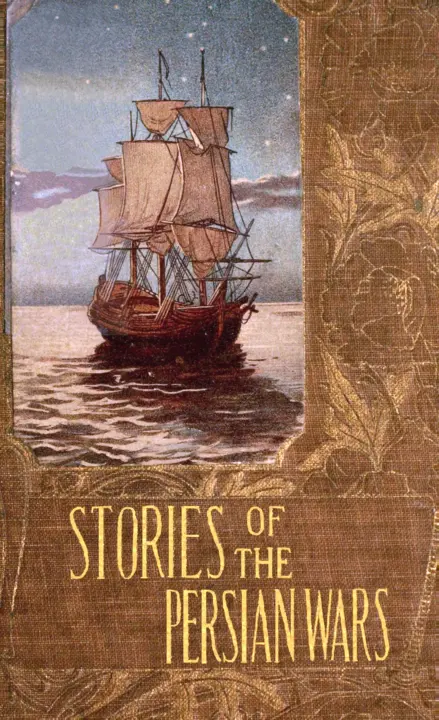
Stories of the Persian wars
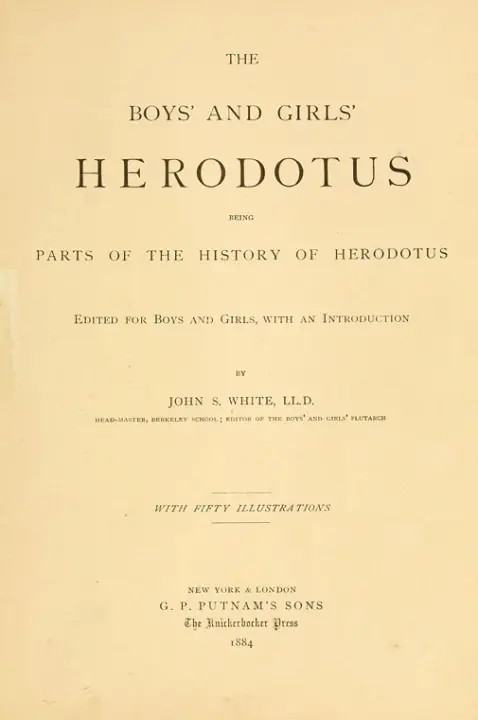
Herodotus
THE CLASSIC COLLECTION · 1905
"The Boys' and Girls' Herodotus" by Herodotus is a historical account written in the late 19th century. This edition, edited for younger readers by John S. White, aims to make the classic writings of Herodotus accessible to boys and girls, blending historical facts with engaging storytelling. The work discusses the origins of historical events, particularly the conflicts between the Greeks and various nations, introduced through the lens of Herodotus's experiences and narrative style. At the start of the narrative, the scene is set in ancient Athens, near the end of the year 446 B.C., as the city faces political uncertainty. Herodotus is described as a famed historian sharing captivating tales before an audience, including a young Thucydides. The introduction highlights his intent to document the historical struggles between Greeks and barbarians, showcasing the origins of various conflicts, customs, and significant figures. The narrative establishes Herodotus’s honest and vivid storytelling approach that includes anecdotes, making it relatable and appealing to younger audiences. The opening chapters delve into the early effects of the conflict over respect and relationships that escalated into war, providing a foundation for the historical accounts that follow.
Introduction adapted from the source catalogue; source summaries may be automatically generated.
Free to read · English · 112,601 words · No account needed
MAKE TIME FOR A GOOD BOOK
On by default. Untick to stop anonymous reading totals. Each page counts after 10 seconds in view. How this works.
Anonymous counting is on unless you have switched it off.
There is also another temple below, within the precinct at Babylon; in it is a large golden statue of Jupiter seated, and near it a great table of gold; the throne also and the step are of gold, which together weigh eight hundred talents [twenty-two tons], as the Chaldæans affirm. Outside the temple is a golden altar; and another large altar, where full-grown sheep are sacrificed; for on the golden altar only sucklings may be offered. On the great altar the Chaldæans consume yearly a thousand talents [twenty-seven tons] of frankincense when they celebrate the festival of this god. There was also at that time within the precincts of this temple a statue of solid gold, twelve cubits high [eighteen feet]; I, indeed, did not see it, but only relate what is said by the Chaldæans. Darius, son of Hystaspes, formed a design to take away this statue, but dared not do so; but Xerxes, son of Darius, took it, and killed the priest who forbade him to remove it.
There were many others who reigned over Babylon, whom I shall mention in my Assyrian history, who beautified the walls and temples, and amongst them were two women. The first of these, named Semiramis, lived five generations before the other; she raised mounds along the plain, which are worthy of admiration; for before, the river used to overflow the whole plain like a sea. But the other, who was queen next after her, and whose name was Nitocris, (and she was much more sagacious than the other queen,) in the first place left monuments of herself, which I shall presently describe; and in the next place, when she saw the power of the Medes growing formidable and restless, and that, among other cities, Nineveh was captured by them, she took every possible precaution for her own defence. First of all, the River Euphrates, which before ran in a straight line, and which flows through the middle of the city, by having channels dug above, she made so winding, that in its course it touched three times at one and the same village in Assyria, called Arderica: and to this day, those who go from our sea to Babylon, if they travel by the Euphrates, come three times to this village on three successive days. She also raised on either bank of the river a mound, astonishing for its magnitude and height. At a considerable distance above Babylon, she had a reservoir for a lake dug, carrying it out some distance from the river, and in the depth digging down to water, and in width making its circumference of four hundred and twenty stades [about fifty-two and a half miles]: she consumed the soil from this excavation by heaping it up on the banks of the river, and when it was completely dug, she had stones brought and built a casing to it all round. She had both these works done, the river made winding, and the whole excavation a lake, in order that the current, being broken by frequent turnings, might be more slow, and the navigation to Babylon tedious, and that after the voyage, a long march round the lake might follow. All this was done in that part of the country where the approach to Babylon is nearest, and where is the shortest way for the Medes; in order that the Medes might not, by holding intercourse with her people, become acquainted with her affairs. She enclosed herself, therefore, with these defences by digging, and immediately afterwards made the following addition. As the city consisted of two divisions, which were separated by the river, during the reign of former kings, when any one had occasion to cross from one division to the other, he was obliged to cross in a boat: and this, in my opinion, was very troublesome: she therefore provided for this, for after she had dug the reservoir for the lake, she left this other monument built by similar toil. She had large blocks of stone cut, and when they were ready and the place was completely dug out, she turned the whole stream of the river into the place she had dug: while this was filling, and the ancient channel had become dry, in the first place, she lined with burnt bricks the banks of the river throughout the city, and the descents that lead from the gates to the river, in the same manner as the walls. In the next place, about the middle of the city, she built a bridge with the stones she had prepared, and bound them together with plates of lead and iron. Upon these stones she laid, during the day, square planks of timber, on which the Babylonians might pass over; but at night these planks were removed, to prevent people from crossing by night and robbing one another. When the hollow that was dug had become a lake filled by the river, and the bridge was finished, she brought back the river to its ancient channel from the lake.
Your reading position is saved on this browser. Take it to another device with a library code. Reading pages adapt to text, rather than matching a printed edition.
BEHIND THE BOOK
This eBook is for the use of anyone anywhere in the United States and most other parts of the world at no cost and with almost no restrictions whatsoever. You may copy it, give it away or re-use it under the terms of the Project Gutenberg License included with this eBook or online at www.gutenberg.org. If you are not located in the United States, you will have to check the laws of the country where you are located before using this eBook. Read the source licence.
The original source file, including credits and licence, is retained by this library. Request an original-format copy at no charge. Please include the book title and Project Gutenberg identifier #55758.
KEEP YOUR CURIOSITY GOING
Cécile Tormay

Moritz Busch
John L. Ransom
Frances Wright
Cécile Tormay

Mabel Potter Daggett