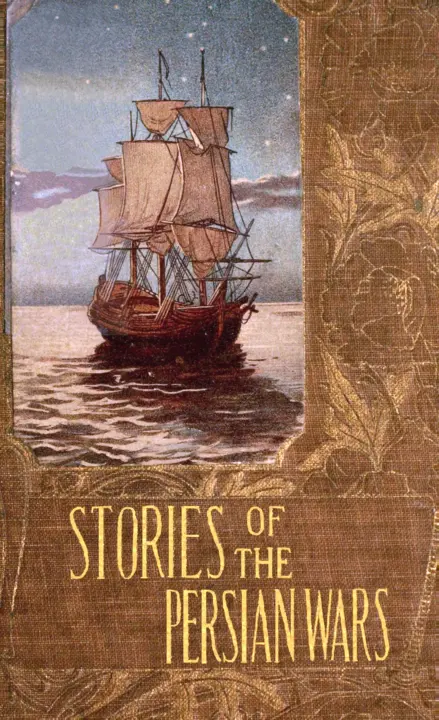
Stories of the Persian wars
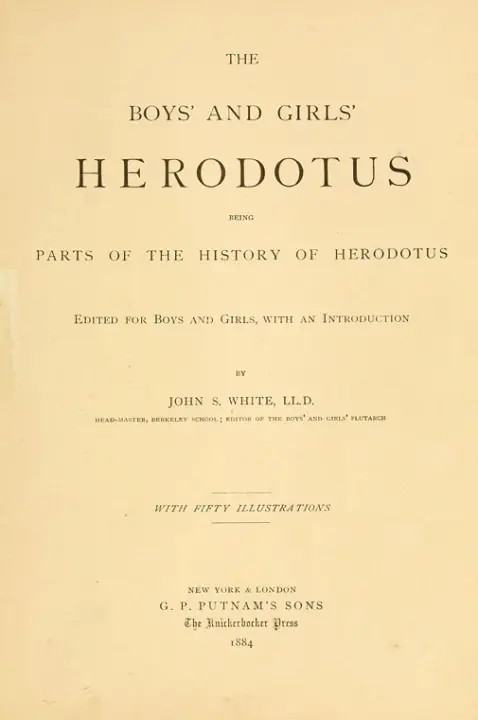
Herodotus
THE CLASSIC COLLECTION · 1905
"The Boys' and Girls' Herodotus" by Herodotus is a historical account written in the late 19th century. This edition, edited for younger readers by John S. White, aims to make the classic writings of Herodotus accessible to boys and girls, blending historical facts with engaging storytelling. The work discusses the origins of historical events, particularly the conflicts between the Greeks and various nations, introduced through the lens of Herodotus's experiences and narrative style. At the start of the narrative, the scene is set in ancient Athens, near the end of the year 446 B.C., as the city faces political uncertainty. Herodotus is described as a famed historian sharing captivating tales before an audience, including a young Thucydides. The introduction highlights his intent to document the historical struggles between Greeks and barbarians, showcasing the origins of various conflicts, customs, and significant figures. The narrative establishes Herodotus’s honest and vivid storytelling approach that includes anecdotes, making it relatable and appealing to younger audiences. The opening chapters delve into the early effects of the conflict over respect and relationships that escalated into war, providing a foundation for the historical accounts that follow.
Introduction adapted from the source catalogue; source summaries may be automatically generated.
Free to read · English · 112,601 words · No account needed
MAKE TIME FOR A GOOD BOOK
On by default. Untick to stop anonymous reading totals. Each page counts after 10 seconds in view. How this works.
Anonymous counting is on unless you have switched it off.
Cyrus, having set him at liberty, placed him by his own side, and showed him great respect. But Crœsus, absorbed in thought remained silent; and presently turning round and beholding the Persians sacking the city of the Lydians, he said, "Does it become me, O king, to tell you what is passing through my mind, or to keep silence?" Cyrus bade him say with confidence whatever he wished; upon which Crœsus asked him, "What is this vast crowd so earnestly employed about?" He answered, "They are sacking your city, and plundering your riches." "Not so," Crœsus replied, "they are neither sacking my city, nor plundering my riches, for they are no longer mine; they are ravaging what belongs to you." The reply of Crœsus attracted the attention of Cyrus; he therefore ordered all the rest to withdraw, and asked Crœsus what he thought should be done in the present conjuncture. He answered: "Since the gods have made me your servant, I think it my duty to acquaint you, if I perceive anything deserving of remark. The Persians, who are by nature overbearing, are poor. If, therefore, you permit them to plunder and possess great riches, you may expect the following results; whoso acquires the greatest riches, be assured, will be ready to rebel. Therefore, if you approve what I say, adopt the following plan: place some of your body-guard as sentinels at every gate, with orders to take the booty from all those who would go out, and to acquaint them that the tenth must of necessity be consecrated to Jupiter; thus you will not incur the odium of taking away their property; and they, acknowledging your intention to be just, will readily obey." Cyrus was exceedingly delighted at this suggestion, and ordered his guards to carry it out, then turning to Crœsus, he said: "Since you are resolved to display the deeds and words of a true king, ask whatever boon you desire on the instant." "Sir," he answered, "the most acceptable favor you can bestow upon me is, to let me send my fetters to the god of the Greeks, whom I have honored more than any other deity, and to ask him, if it be his custom to deceive those who deserve well of him." Certain Lydians were accordingly sent to Delphi, with orders to lay his fetters at the entrance of the temple, and to ask the god, if he were not ashamed to have encouraged Crœsus by his oracles to make war on the Persians assuring him that he would put an end to the power of Cyrus, of which war such were the first-fruits (commanding them at these words to show the fetters), and at the same time to ask if it were the custom of the Grecian gods to be ungrateful. When the Lydians arrived at Delphi, and had delivered their message, the Pythian is reported to have made this answer: "The god himself even cannot avoid the decrees of fate; and Crœsus has atoned for the crime of Gyges his ancestor in the fifth generation, who, being one of the body-guard of the Heraclidæ, murdered his master, Candaules, and usurped his dignity, to which he had no right. But although Apollo was desirous that the fall of Sardis might happen in the time of the sons of Crœsus, and not during his reign, yet it was not in his power to avert the fates; but so far as they allowed he accomplished, and conferred the boon on him; for he delayed the capture of Sardis for the space of three years. Let Crœsus know, therefore, that he was taken prisoner three years later than the fates had ordained; and in the next place, he came to his relief, when he was upon the point of being burnt alive. Then, as to the prediction of the oracle, Crœsus has no right to complain; for Apollo foretold him that if he made war on the Persians, he would subvert a great empire; and had he desired to be truly informed, he ought to have sent again to inquire, whether his own or that of Cyrus was meant. But since he neither understood the oracle, nor inquired again, let him lay the blame on himself. And when he last consulted the oracle, he did not understand the answer concerning the mule; for Cyrus was that mule; inasmuch as he was born of parents of different nations, the mother superior, but the father inferior. For she was a Mede, and daughter of Astyages, king of Media; but he was a Persian, subject to the Medes." When Crœsus heard this reply of the priestess of Apollo, he acknowledged the fault to be his and not the god's.
Your reading position is saved on this browser. Take it to another device with a library code. Reading pages adapt to text, rather than matching a printed edition.
BEHIND THE BOOK
This eBook is for the use of anyone anywhere in the United States and most other parts of the world at no cost and with almost no restrictions whatsoever. You may copy it, give it away or re-use it under the terms of the Project Gutenberg License included with this eBook or online at www.gutenberg.org. If you are not located in the United States, you will have to check the laws of the country where you are located before using this eBook. Read the source licence.
The original source file, including credits and licence, is retained by this library. Request an original-format copy at no charge. Please include the book title and Project Gutenberg identifier #55758.
KEEP YOUR CURIOSITY GOING
Cécile Tormay

Moritz Busch
John L. Ransom
Frances Wright
Cécile Tormay

Mabel Potter Daggett