Stories of the Persian wars
Herodotus
THE CLASSIC COLLECTION · 1905
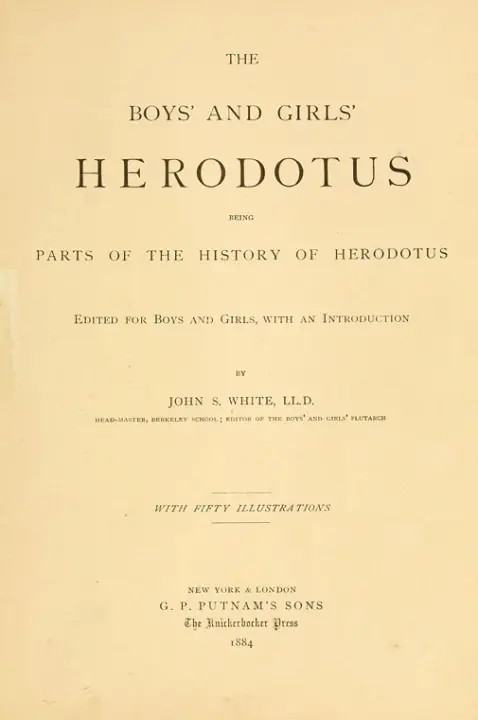
"The Boys' and Girls' Herodotus" by Herodotus is a historical account written in the late 19th century. This edition, edited for younger readers by John S. White, aims to make the classic writings of Herodotus accessible to boys and girls, blending historical facts with engaging storytelling. The work discusses the origins of historical events, particularly the conflicts between the Greeks and various nations, introduced through the lens of Herodotus's experiences and narrative style. At the start of the narrative, the scene is set in ancient Athens, near the end of the year 446 B.C., as the city faces political uncertainty. Herodotus is described as a famed historian sharing captivating tales before an audience, including a young Thucydides. The introduction highlights his intent to document the historical struggles between Greeks and barbarians, showcasing the origins of various conflicts, customs, and significant figures. The narrative establishes Herodotus’s honest and vivid storytelling approach that includes anecdotes, making it relatable and appealing to younger audiences. The opening chapters delve into the early effects of the conflict over respect and relationships that escalated into war, providing a foundation for the historical accounts that follow.
Introduction adapted from the source catalogue; source summaries may be automatically generated.
Free to read · English · 112,601 words · No account needed
MAKE TIME FOR A GOOD BOOK
On by default. Untick to stop anonymous reading totals. Each page counts after 10 seconds in view. How this works.
Anonymous counting is on unless you have switched it off.
Sardis was taken in the following manner. On the fourteenth day after Crœsus had been besieged, Cyrus sent horsemen throughout his army, and proclaimed that he would liberally reward the man who should first mount the wall; upon this several attempts were made, and as often failed; till, after the rest had desisted, a Mardian, whose name was Hyrœades, endeavored to climb up on that part of the citadel where no guard was stationed, for on that side the citadel was precipitous and impracticable. Hyrœades had seen a Lydian the day before come down this precipice for a helmet that had rolled down, and carry it up again. He thereupon ascended the same way, followed by divers Persians; and when great numbers had gone up, Sardis was thus taken, and the whole town plundered.
The following incidents befel Crœsus himself. He had a son of whom I have before made mention, who was dumb. Now, in the time of his former prosperity, Crœsus had done every thing he could for him, and among other expedients had sent to consult the oracle of Delphi concerning him; but the Pythian gave him this answer:
"O foolish king of Lydia, do not seek
To hear thy son within thy palace speak!
Better for thee that pleasure to forego—
The day he speaks will be a day of woe."
When the city was taken, one of the Persians, not knowing Crœsus, was about to kill him; Crœsus, though he saw him approach, took no heed of him, caring not if he should die by the blow; but this speechless son of his, when he saw the Persian advancing against him, through dread and anguish, burst into speech, and said: "Man, kill not Crœsus." These were the first words he ever uttered; but from that time he continued to speak during the remainder of his life. So the Persians got possession of Sardis, and made Crœsus prisoner, after he had reigned fourteen years, been besieged fourteen days, and lost his great empire, as the oracle had predicted. The Persians, having taken him, conducted him to Cyrus; and he, having heaped up a great pile, placed Crœsus upon it, bound with fetters, and with him fourteen young Lydians; designing either to offer this sacrifice to some god, as the first fruits of his victory, or wishing to perform a vow; or perhaps, having heard that Crœsus was a religious person, he placed him on the pile for the purpose of discovering whether any deity would save him from being burned alive. When Crœsus stood upon the pile, notwithstanding the weight of his misfortunes, the words of Solon recurred to him, as spoken by inspiration of the deity, that "No living man could be justly called happy." When this occurred to him, it is said, that after a long silence he recovered himself, and uttering a groan, thrice pronounced the name of Solon; when Cyrus heard him, he commanded his interpreters to ask Crœsus whom it was he called upon; Crœsus for some time kept silence; but at last, being constrained to speak, said: "I named a man, whose discourses I more desire all tyrants might hear, than to be possessor of the greatest riches." When he gave them this obscure answer, they again inquired what he said, and were very importunate; he at length told them that Solon, an Athenian, formerly visited him, and having viewed all his treasures, made no account of them; telling, in a word, how every thing had befallen him as Solon had warned him, though his discourse related to all mankind as much as to himself, and especially to those who imagine themselves happy. The pile now was kindled, and the outer parts began to burn; when Cyrus, informed by the interpreters of what Crœsus had said, relented, considering that being but a man, he was yet going to burn another man alive, who had been no way inferior to himself in prosperity; and moreover, fearing retribution, and reflecting that nothing human is constant, commanded the fire to be instantly extinguished, and Crœsus, with those who were about him, to be taken down. But they with all their endeavors were unable to master the fire. Crœsus, perceiving that Cyrus had altered his resolution, when he saw every man endeavoring to put out the fire, but unable to get the better of it, shouted aloud, invoking Apollo, and besought him, if ever any of his offerings had been agreeable to him, to protect and deliver him from the present danger. And the Lydians relate, as he with tears invoked the god, on a sudden clouds were seen gathering in the air, which before was serene, and that a violent storm burst forth and vehement rain fell and extinguished the flames; by which Cyrus perceiving that Crœsus was beloved by the gods, and a good man, when he had had him taken down from the pile, asked him the following question: "Who persuaded you, Crœsus, to invade my territories, and to become my enemy instead of my friend?" He answered: "O king, I have done this for your good but my own evil fortune, and the god of the Greeks who encouraged me to make war is the cause of all. For no man is so void of understanding as to prefer war before peace; for in the latter children bury their fathers; in the former, fathers bury their children. But, I suppose, it pleased the gods that these things should be so."
Your reading position is saved on this browser. Take it to another device with a library code. Reading pages adapt to text, rather than matching a printed edition.
BEHIND THE BOOK
This eBook is for the use of anyone anywhere in the United States and most other parts of the world at no cost and with almost no restrictions whatsoever. You may copy it, give it away or re-use it under the terms of the Project Gutenberg License included with this eBook or online at www.gutenberg.org. If you are not located in the United States, you will have to check the laws of the country where you are located before using this eBook. Read the source licence.
The original source file, including credits and licence, is retained by this library. Request an original-format copy at no charge. Please include the book title and Project Gutenberg identifier #55758.
KEEP YOUR CURIOSITY GOING
Cécile Tormay

Moritz Busch
John L. Ransom
Frances Wright
Cécile Tormay

Mabel Potter Daggett