
Switch off
Oliver Optic
THE CLASSIC COLLECTION · 1896
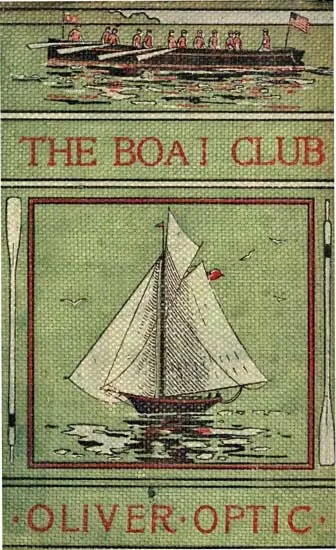
"The Boat Club; or, The Bunkers of Rippleton" by Oliver Optic is a novel written in the late 19th century. Targeted primarily at young readers, the narrative centers around themes of friendship, moral decisions, and the joys of outdoor adventures. The story particularly follows Frank Sedley and his friends as they navigate their relationships while engaging in club activities centered around boating on Wood Lake. The beginning of the book introduces us to Frank Sedley and his friend Charles Hardy during the lead-up to the Fourth of July. As they discuss their plans for the celebration, Frank contemplates using their saved money to help a local widow and her children instead of spending it on fireworks and treats. Their decision to support the widow highlights their growing sense of responsibility and compassion. The initial chapters establish the boys' characters, their strong friendship, and their diverse backgrounds, ultimately paving the way for their involvement with the titular boat club and the adventures that await them on the lake.
Introduction adapted from the source catalogue; source summaries may be automatically generated.
Free to read · English · 46,119 words · No account needed
MAKE TIME FOR A GOOD BOOK
On by default. Untick to stop anonymous reading totals. Each page counts after 10 seconds in view. How this works.
Anonymous counting is on unless you have switched it off.
When, therefore, the coxswain called the meeting to order, all noise and conversation immediately ceased; and the members of the club seemed determined to conduct themselves with more propriety than the "legal voters" of Rippleton had at the town meeting they had attended.
Frank, in the words of the newspaper reporters, "made a neat and appropriate speech," on the occasion of taking possession of the new hall. After this important matter had been disposed of, the coxswain remarked that the first business of the club would be to select a name for the hall.
"Mr. Chairman," said Charles Hardy, rising with the utmost gravity and
decorum.
Uncle Ben laughed outright; but immediately apologized for his unseemly mirth, and fearful lest he should disturb the dignified body again, he withdrew from the hall, and busied himself in polishing up the brass work of the boat.
"Charles Hardy," said the young chairman, bowing to the member who had
obtained the floor.
"I move that this hall, hereafter, henceforward, and for all time to come, be called Sedley Hall," said Charles, who, in the absence of any work on parliamentary tactics in his father's library, had carefully studied the "Business Man's Assistant," from which he had stored his memory with a variety of legal and technical phrases. He had the jingle of them in his head, and did not mind much about the substance.
Captain Sedley entered the hall just as he made his motion.
"Second the motion," said Fred Harper.
"It is moved and seconded that this room be called Sedley Hall," continued the coxswain, rising from the chair. "The question is open for discussion."
"Mr. Chairman," said Captain Sedley, scarcely able to control his inclination to indulge in a hearty laugh at the dignity and formality of the proceedings, "though not, strictly speaking, a member of the club, perhaps you will indulge me in a few remarks on the question before the house. I am very grateful to you for the honor to my name and family which is contemplated by the excellent member on the other side of the table; but for reasons of my own, I must beg the gentleman to withdraw his motion."
"He cannot withdraw without the consent of the house--of the club, I mean," said Frank, blushing at his blunder.
"It is customary when no objection is made," replied Captain Sedley gravely, "to permit a motion to be withdrawn."
"Mr. Chairman," said Charles, rising, "for the obvious reasons
mentioned by the honorable and distinguished gentleman, I withdraw my
motion."
At the risk of disturbing the dignity of the meeting, Captain Sedley remarked that he had stated no reasons.
Your reading position is saved on this browser. Take it to another device with a library code. Reading pages adapt to text, rather than matching a printed edition.
BEHIND THE BOOK
This eBook is for the use of anyone anywhere in the United States and most other parts of the world at no cost and with almost no restrictions whatsoever. You may copy it, give it away or re-use it under the terms of the Project Gutenberg License included with this eBook or online at www.gutenberg.org. If you are not located in the United States, you will have to check the laws of the country where you are located before using this eBook. Read the source licence.
The original source file, including credits and licence, is retained by this library. Request an original-format copy at no charge. Please include the book title and Project Gutenberg identifier #24557.
KEEP YOUR CURIOSITY GOING
Coulson Kernahan

Maurice Baring
Frances Wright
Cécile Tormay

Frederic Jesup Stimson

W. H. P. (William Henry Pope) Jarvis
