
Switch off
Oliver Optic
THE CLASSIC COLLECTION · 1896
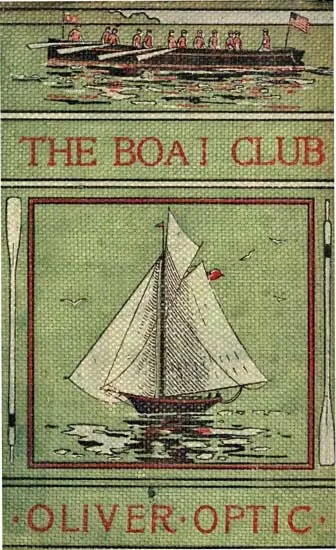
"The Boat Club; or, The Bunkers of Rippleton" by Oliver Optic is a novel written in the late 19th century. Targeted primarily at young readers, the narrative centers around themes of friendship, moral decisions, and the joys of outdoor adventures. The story particularly follows Frank Sedley and his friends as they navigate their relationships while engaging in club activities centered around boating on Wood Lake. The beginning of the book introduces us to Frank Sedley and his friend Charles Hardy during the lead-up to the Fourth of July. As they discuss their plans for the celebration, Frank contemplates using their saved money to help a local widow and her children instead of spending it on fireworks and treats. Their decision to support the widow highlights their growing sense of responsibility and compassion. The initial chapters establish the boys' characters, their strong friendship, and their diverse backgrounds, ultimately paving the way for their involvement with the titular boat club and the adventures that await them on the lake.
Introduction adapted from the source catalogue; source summaries may be automatically generated.
Free to read · English · 46,119 words · No account needed
MAKE TIME FOR A GOOD BOOK
On by default. Untick to stop anonymous reading totals. Each page counts after 10 seconds in view. How this works.
Anonymous counting is on unless you have switched it off.
"That wouldn't be fair, Frank."
"Why not?"
"You not only rob yourself of the fun, but me too."
"I really pity the poor woman so much that I cannot find it in my heart to spend the money foolishly, when it will buy so many comforts for her."
"Your father will give you some money for her."
"That isn't the thing."
"What do you mean?"
"You went to meeting last Sunday?"
"Yes."
"And heard the sermon?"
"Some of it," replied Charles, smiling.
"You remember the minister spoke of the luxury of doing good; of the benefit one gets by sacrificing his inclination for the good of others, or something like that; I can't express it as he did, though I have the idea."
Frank paused, and looked earnestly into the face of his friend, to
ascertain whether he was likely to find any sympathy in the heart of
Charles.
"I do remember it, Frank. He told a story to illustrate his meaning."
"That was it. I don't very often mind much about the sermon, but somehow I was very much interested in that one."
"And so you mean to give your money to the widow Weston, just to see how you will feel after it," added Charles with a laugh.
"No; that isn't it."
"What is it, then?"
"I will give it to her because I really feel that she needs it more than I do. I feel a pleasure in the thought of sacrificing my inclination for her happiness, which is more satisfactory than all the fun I anticipate to-morrow."
"You'll be a parson, Frank."
"No, I won't; I will do my duty."
"Have you made up your mind?"
"We can have a good time at home."
"Pooh!"
"I shall give my money to the widow Weston, at any rate."
Charles Hardy could not but admire the generosity of his friend, though he found it difficult to abandon the thought of the pleasure he anticipated in spending the Fourth in Boston. He stood in silent thought a few moments, and then spoke.
"Well, Frank," said he, "if you have determined to give your money to the widow, I shall follow your example."
"But, Charley, I didn't mean to influence you. I will even go to Boston with you, though I have no money."
"I will give my money to the widow. I think you are right."
"Good, Charley! I like you for it."
"I have two dollars and a quarter," continued Charles, taking the money
from his pocket.
"We shall make up just seven dollars. How it will rejoice the heart of the poor woman!" exclaimed Frank with enthusiasm.
Your reading position is saved on this browser. Take it to another device with a library code. Reading pages adapt to text, rather than matching a printed edition.
BEHIND THE BOOK
This eBook is for the use of anyone anywhere in the United States and most other parts of the world at no cost and with almost no restrictions whatsoever. You may copy it, give it away or re-use it under the terms of the Project Gutenberg License included with this eBook or online at www.gutenberg.org. If you are not located in the United States, you will have to check the laws of the country where you are located before using this eBook. Read the source licence.
The original source file, including credits and licence, is retained by this library. Request an original-format copy at no charge. Please include the book title and Project Gutenberg identifier #24557.
KEEP YOUR CURIOSITY GOING
Coulson Kernahan

Maurice Baring
Frances Wright
Cécile Tormay

Frederic Jesup Stimson

W. H. P. (William Henry Pope) Jarvis
