
Switch off
Oliver Optic
THE CLASSIC COLLECTION · 1896
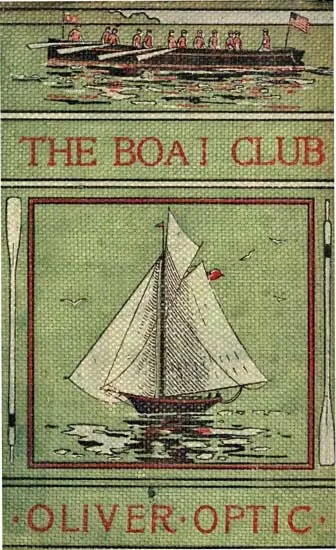
"The Boat Club; or, The Bunkers of Rippleton" by Oliver Optic is a novel written in the late 19th century. Targeted primarily at young readers, the narrative centers around themes of friendship, moral decisions, and the joys of outdoor adventures. The story particularly follows Frank Sedley and his friends as they navigate their relationships while engaging in club activities centered around boating on Wood Lake. The beginning of the book introduces us to Frank Sedley and his friend Charles Hardy during the lead-up to the Fourth of July. As they discuss their plans for the celebration, Frank contemplates using their saved money to help a local widow and her children instead of spending it on fireworks and treats. Their decision to support the widow highlights their growing sense of responsibility and compassion. The initial chapters establish the boys' characters, their strong friendship, and their diverse backgrounds, ultimately paving the way for their involvement with the titular boat club and the adventures that await them on the lake.
Introduction adapted from the source catalogue; source summaries may be automatically generated.
Free to read · English · 46,119 words · No account needed
MAKE TIME FOR A GOOD BOOK
On by default. Untick to stop anonymous reading totals. Each page counts after 10 seconds in view. How this works.
Anonymous counting is on unless you have switched it off.
"But from trouble and affliction come forth our purest aspirations. God is good to us, even when he sends us trials and sorrows."
"I will not complain; I have much to be thankful for."
In a few moments the horse and chaise were ready.
"I am going over to see Farmer Whipple, Mrs. Weston, and then I shall ride down to Rippleton. Keep your spirits up, and be assured everything shall be done to comfort your son, and to prove his innocence. I shall engage Squire Benson to defend him."
"Heaven bless you, Captain Sedley," said the poor widow, wiping away her tears, as her benevolent friend got into his chaise.
Farmer Whipple was fortunately at home when he arrived at his house, and Captain Sedley immediately opened his business.
"I don't much think that Tony did it," said the farmer; "but things
were agin him, you see."
"How much money was there in the wallet?" asked Captain Sedley.
"More'n I can afford to lose, Cap'n. It was a careless trick of mine."
"What was the amount?"
"There was forty-six dollars in bills, besides some odd change."
"Do you remember what banks the bills were on?"
"Most on 'em. There was a twenty dollar bill on the Rippleton Bank, a ten on the Village Bank, and some small bills, mostly on Boston Banks."
"Where is the wallet now?"
"I got it; Squire Little said I might take it agin."
"Was the money all right?"
"Bless you, no! If it had been, I wouldn't say a word. All the small bills were there, but the big ones were gone."
"Indeed!"
"That's the wo'st on't."
"Have you any description of the lost bills?"
"Well, yes; I reckon I should know the twenty agin, if I saw it."
"How?"
"Well, it happens rather lucky. Arter we came from the jail, I went into Doolittle's store to git some tea. When I went in there, he was fixin' some kind of a plate, with his name on't; a pencil plate, I believe he called it."
"A stencil plate," said Captain Sedley.
"Jest so; he was marking his name on the back of some bank bills with it. I telled him about the robbery, and that the twenty dollar bill he give me the day before was gone with the rest. Then he telled me that that twenty dollar bill was marked with his 'pencil plate,' d'ye see?"
"He might have marked a dozen others with it," added Captain Sedley.
"No, he didn't. You see, he didn't git the plate till jest afore he paid me that bill, and he is sartin that is the only twenty dollar bill he has marked."
Your reading position is saved on this browser. Take it to another device with a library code. Reading pages adapt to text, rather than matching a printed edition.
BEHIND THE BOOK
This eBook is for the use of anyone anywhere in the United States and most other parts of the world at no cost and with almost no restrictions whatsoever. You may copy it, give it away or re-use it under the terms of the Project Gutenberg License included with this eBook or online at www.gutenberg.org. If you are not located in the United States, you will have to check the laws of the country where you are located before using this eBook. Read the source licence.
The original source file, including credits and licence, is retained by this library. Request an original-format copy at no charge. Please include the book title and Project Gutenberg identifier #24557.
KEEP YOUR CURIOSITY GOING
Coulson Kernahan

Maurice Baring
Frances Wright
Cécile Tormay

Frederic Jesup Stimson

W. H. P. (William Henry Pope) Jarvis
