
Switch off
Oliver Optic
THE CLASSIC COLLECTION · 1896
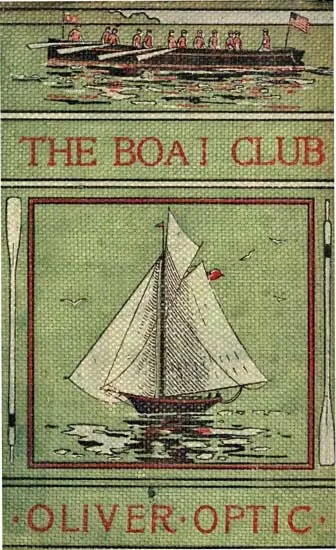
"The Boat Club; or, The Bunkers of Rippleton" by Oliver Optic is a novel written in the late 19th century. Targeted primarily at young readers, the narrative centers around themes of friendship, moral decisions, and the joys of outdoor adventures. The story particularly follows Frank Sedley and his friends as they navigate their relationships while engaging in club activities centered around boating on Wood Lake. The beginning of the book introduces us to Frank Sedley and his friend Charles Hardy during the lead-up to the Fourth of July. As they discuss their plans for the celebration, Frank contemplates using their saved money to help a local widow and her children instead of spending it on fireworks and treats. Their decision to support the widow highlights their growing sense of responsibility and compassion. The initial chapters establish the boys' characters, their strong friendship, and their diverse backgrounds, ultimately paving the way for their involvement with the titular boat club and the adventures that await them on the lake.
Introduction adapted from the source catalogue; source summaries may be automatically generated.
Free to read · English · 46,119 words · No account needed
MAKE TIME FOR A GOOD BOOK
On by default. Untick to stop anonymous reading totals. Each page counts after 10 seconds in view. How this works.
Anonymous counting is on unless you have switched it off.
"I presume you meant nothing wrong; but such expressions do not add anything to the force of language, and using them may induce a bad habit. If you associated with boys accustomed to use profanity, this desire to use strong words would lead you into the practice."
"I never thought of that."
"Just now you said, 'By gracious!' Such phrases are apt to induce profanity, and are no addition whatever to the force of your remark."
"I don't know that they are."
"You were very much surprised at seeing this boat."
"We were, indeed."
"Frank, it is yours," added Captain Sedley, turning with a smile to his
son.
"Mine, father!" exclaimed Frank, clapping his hands.
"It is yours, and of course your friends will derive as much pleasure from its use as you will yourself."
"But where did it come from, father?"
"Two months ago, when the Bunkers first began to amuse themselves with the raft, the idea of procuring it occurred to me. I saw that you and Charles both had a great desire to join in their sports. For obvious reasons I could not permit Frank to do so; but I immediately resolved that you should have the means of enjoying yourselves on the lake in safety and comfort, and I ordered this boat to be built."
"Isn't she a beauty!" exclaimed Charles.
"But, Charles, do you remember what you said a fortnight ago?"
"No, sir."
"When you were talking here on the evening before the Fourth of July?"
"I said a great many things, I suppose, and some of them not quite so bright as they might have been," replied Charles, wondering what weakness of his was now to be exposed.
"Your remark was to the effect that boys who were obliged to mind their parents were the losers for their obedience."
"But I did not mean so, sir."
"You meant some of it, Charles. You wanted to go on the raft, and you felt at that moment as though it was a disagreeable duty to obey your parents. But I think it was only a momentary feeling."
"I am sure it was, sir."
"Let this beautiful boat, then, convince you that obedience to your parents is your duty, and ought to be your pleasure."
"How came it here, father?" asked Frank. "I am completely mystified."
"Uncle Ben has been in Boston the past three days, procuring its
outfit; and yesterday it was brought up to the village on the
railroad."
"That's why you would not tell me where he was."
"It is; I thought I would surprise you. Last night after dark Uncle Ben and I rowed it up from the village."
Your reading position is saved on this browser. Take it to another device with a library code. Reading pages adapt to text, rather than matching a printed edition.
BEHIND THE BOOK
This eBook is for the use of anyone anywhere in the United States and most other parts of the world at no cost and with almost no restrictions whatsoever. You may copy it, give it away or re-use it under the terms of the Project Gutenberg License included with this eBook or online at www.gutenberg.org. If you are not located in the United States, you will have to check the laws of the country where you are located before using this eBook. Read the source licence.
The original source file, including credits and licence, is retained by this library. Request an original-format copy at no charge. Please include the book title and Project Gutenberg identifier #24557.
KEEP YOUR CURIOSITY GOING
Coulson Kernahan

Maurice Baring
Frances Wright
Cécile Tormay

Frederic Jesup Stimson

W. H. P. (William Henry Pope) Jarvis
