
Switch off
Oliver Optic
THE CLASSIC COLLECTION · 1896
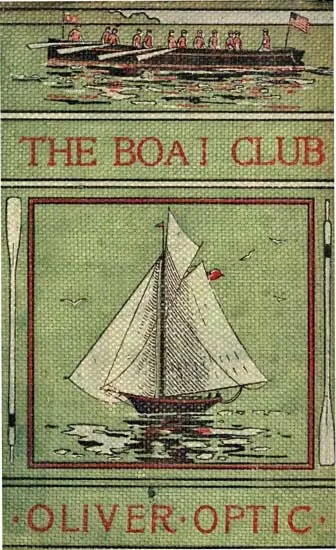
"The Boat Club; or, The Bunkers of Rippleton" by Oliver Optic is a novel written in the late 19th century. Targeted primarily at young readers, the narrative centers around themes of friendship, moral decisions, and the joys of outdoor adventures. The story particularly follows Frank Sedley and his friends as they navigate their relationships while engaging in club activities centered around boating on Wood Lake. The beginning of the book introduces us to Frank Sedley and his friend Charles Hardy during the lead-up to the Fourth of July. As they discuss their plans for the celebration, Frank contemplates using their saved money to help a local widow and her children instead of spending it on fireworks and treats. Their decision to support the widow highlights their growing sense of responsibility and compassion. The initial chapters establish the boys' characters, their strong friendship, and their diverse backgrounds, ultimately paving the way for their involvement with the titular boat club and the adventures that await them on the lake.
Introduction adapted from the source catalogue; source summaries may be automatically generated.
Free to read · English · 46,119 words · No account needed
MAKE TIME FOR A GOOD BOOK
On by default. Untick to stop anonymous reading totals. Each page counts after 10 seconds in view. How this works.
Anonymous counting is on unless you have switched it off.
"I should not have been afraid but that I could have managed the boat as well as Frank did," replied Charles, more boldly.
"I don't know but you could, Charley," answered Fred; "but I doubt it."
"I am pretty sure I could."
"Perhaps you will be elected the next coxswain, Charley," continued Fred; and there was a slight twinkle in his mischievous eye.
"No! Oh, no! I'm sure I don't want to be coxswain."
"You don't!"
"No; I never thought of such a thing."
"Didn't?"
"I'm sure I never did."
"Then I will tell the fellows, so that they needn't throw their votes away upon you," said Fred roguishly.
"Well, as to that, of course I should serve if chosen. I want to do just what the fellows want to have me do."
"They don't want you to be coxswain if you don't wish to be, because there are enough of them who do desire the office."
"Well, I don't exactly want it, but----"
Charles suddenly paused.
"But what, Charley?"
"I want the club should have the best officer we can get."
Fred laughed heartily.
"I want the office, Charley; I should like it first-rate," continued he; "but I don't expect to get it, and am perfectly willing to abide the decision of the club. Majority rules."
"Order," said Frank, rapping on the table.
The boys all took their chairs; and Frank stated the business of the meeting, which was to elect a coxswain for the next two weeks.
"Our Director will be with us in a moment," continued he, "and has something to say before we proceed with the election."
"Here he comes," said Fred.
"Mr. Chairman, and members of the Zephyr Boat Club," began Captain Sedley, with a smile on his benevolent features, "you remember I cautioned you a week ago not to talk about this election. I presume you have observed my request. I had strong reasons for doing so. In the first place, I do not wish to have any unpleasant feelings excited by these elections; and, in the second place, I wish you to learn the first duty of a republican citizen--to cast an independent vote. Among boys, as among men, there is often one who wields an influence over others--an influence which is not always directed by truth and justice. One, by his mental power or social position, controls others. They follow his example without always inquiring whether it is good or bad. I want you to think for yourselves; to make up your minds, without any assistance from others, in regard to the fitness of the person for whom you vote. I desire each of you to deposit his ballot in the box, without communication with others--without telling them, or letting them know by any means, for whom you vote. Now the box is ready, and you may separate to prepare your votes. The poll shall be kept open ten minutes."
Your reading position is saved on this browser. Take it to another device with a library code. Reading pages adapt to text, rather than matching a printed edition.
BEHIND THE BOOK
This eBook is for the use of anyone anywhere in the United States and most other parts of the world at no cost and with almost no restrictions whatsoever. You may copy it, give it away or re-use it under the terms of the Project Gutenberg License included with this eBook or online at www.gutenberg.org. If you are not located in the United States, you will have to check the laws of the country where you are located before using this eBook. Read the source licence.
The original source file, including credits and licence, is retained by this library. Request an original-format copy at no charge. Please include the book title and Project Gutenberg identifier #24557.
KEEP YOUR CURIOSITY GOING
Coulson Kernahan

Maurice Baring
Frances Wright
Cécile Tormay

Frederic Jesup Stimson

W. H. P. (William Henry Pope) Jarvis
