
Switch off
Oliver Optic
THE CLASSIC COLLECTION · 1896
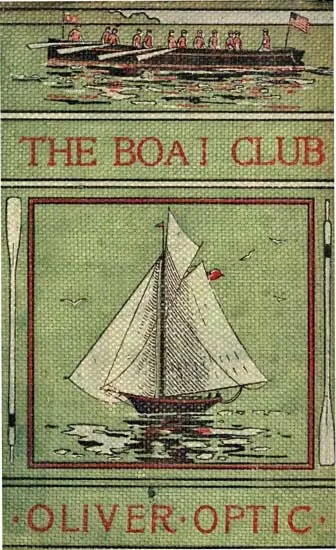
"The Boat Club; or, The Bunkers of Rippleton" by Oliver Optic is a novel written in the late 19th century. Targeted primarily at young readers, the narrative centers around themes of friendship, moral decisions, and the joys of outdoor adventures. The story particularly follows Frank Sedley and his friends as they navigate their relationships while engaging in club activities centered around boating on Wood Lake. The beginning of the book introduces us to Frank Sedley and his friend Charles Hardy during the lead-up to the Fourth of July. As they discuss their plans for the celebration, Frank contemplates using their saved money to help a local widow and her children instead of spending it on fireworks and treats. Their decision to support the widow highlights their growing sense of responsibility and compassion. The initial chapters establish the boys' characters, their strong friendship, and their diverse backgrounds, ultimately paving the way for their involvement with the titular boat club and the adventures that await them on the lake.
Introduction adapted from the source catalogue; source summaries may be automatically generated.
Free to read · English · 46,119 words · No account needed
MAKE TIME FOR A GOOD BOOK
On by default. Untick to stop anonymous reading totals. Each page counts after 10 seconds in view. How this works.
Anonymous counting is on unless you have switched it off.
The boat was now approaching the vicinity of Centre Island.
"This is Captain Sedley's place," said the stranger.
"Yes, sir."
"There comes the Sylph, Frank," shouted Fred Harper.
"Uncle Ben is up to something, I suspect."
"What do you suppose it is?"
Before Frank could venture an opinion, a mass of smoke rose from the bows of the Sylph, and the mimic roar of a little cannon was heard.
"Hurrah! Tony, he is firing a salute in honor of the verdict," cried
Charles.
"Three cheers for Tony Weston," shouted Frank. "One!"
"Hurrah!"
"Two!"
"Hurrah!"
"Three!"
"Hurrah!"
The stranger joined lustily in the cheers; and when they had finished, Uncle Ben fired again. When the Zephyr came alongside the Sylph, the veteran congratulated the little hero of the day on his escape from the snares of his foes.
"You are a good boy, and I wish I had a bigger gun. You desarve a salute from a forty-two pounder," said Uncle Ben, as he rammed down the charge for another gun.
"Thank you, Uncle Ben, that gun is big enough for so small a boy as I
am."
The Zephyr continued on her course to the widow Weston's, followed by the Sylph, the old sailor saluting all the way.
The party landed, and marched up to the house, followed by the stranger. Tony embraced his sister and his little brother, and with tears of joy told them that he was acquitted. Mrs. Weston and Captain Sedley had not yet arrived.
In half an hour they came. Mrs. Weston welcomed her guests, and among
them the stranger.
"I don't know you, sir, but you are welcome to my poor cottage," said
she, with a courtesy.
"Thank you, ma'am. I have just come from California. I believe you had a son who went out there."
"I did. Poor George! I suppose he is dead," answered the widow, wiping
a tear from her eye.
"I come to tell you about him, ma'am."
"Then he is dead!"
"No; he is alive and well."
"Heaven bless you for the news!" ejaculated the poor woman.
It was indeed a day of gladness to her.
"He is coming home soon."
"I am glad to hear it. Where has he been?"
"He has been at the mines."
"I haven't heard a word from him since he first reached San Francisco."
"He has written several times; but the means of communication with San Francisco and the diggings were very uncertain. I suppose his letters miscarried."
"But tell me about him. Has his health been good?"
"Very good; and he has been remarkably lucky. Folks say he has made over a hundred thousand dollars digging and trading."
Your reading position is saved on this browser. Take it to another device with a library code. Reading pages adapt to text, rather than matching a printed edition.
BEHIND THE BOOK
This eBook is for the use of anyone anywhere in the United States and most other parts of the world at no cost and with almost no restrictions whatsoever. You may copy it, give it away or re-use it under the terms of the Project Gutenberg License included with this eBook or online at www.gutenberg.org. If you are not located in the United States, you will have to check the laws of the country where you are located before using this eBook. Read the source licence.
The original source file, including credits and licence, is retained by this library. Request an original-format copy at no charge. Please include the book title and Project Gutenberg identifier #24557.
KEEP YOUR CURIOSITY GOING
Coulson Kernahan

Maurice Baring
Frances Wright
Cécile Tormay

Frederic Jesup Stimson

W. H. P. (William Henry Pope) Jarvis
