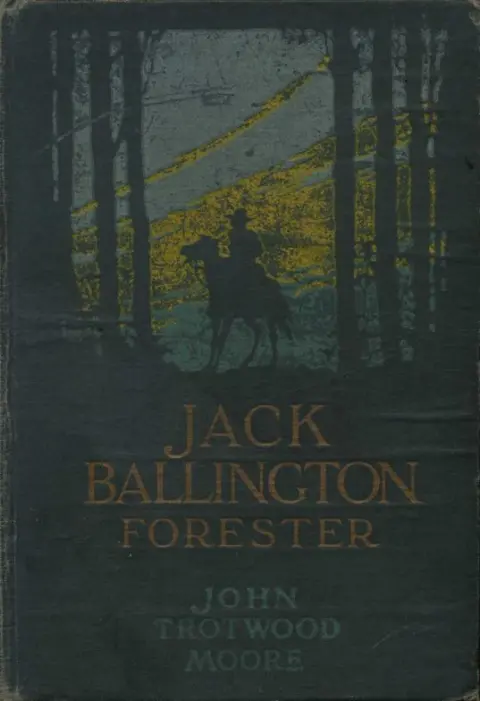
Jack Ballington, Forester
John Trotwood Moore
THE CLASSIC COLLECTION · 1906
"The Bishop of Cottontown: A Story of the Southern Cotton Mills" by John Trotwood Moore is a novel written in the early 20th century. The story is set in the Southern cotton mills of Tennessee and deals with themes of ambition, social class, and the struggles of working-class individuals. Key characters introduced include Richard Travis, a man of strength but lacking moral integrity, and Helen Conway, a young woman entwined in the intricate social dynamics and romantic tensions of her community. The opening of the novel paints a vivid picture of the beauty of the cotton plant, likening its life cycle to artistic creation. It introduces the setting with descriptions emphasizing the vibrant landscape of the Tennessee Valley, reflecting on the area's harvests and the complexities of life in the cotton mills. The narrative transitions to characters like Richard Travis, who is portrayed with a blend of physical strength and moral weaknesses, and introduces the trace of romantic tension surrounding Helen Conway. This first section establishes a foundation of both lyrical descriptions and hints at deeper social issues, setting the stage for the unfolding drama amidst the struggle for existence in a changing Southern landscape.
Introduction adapted from the source catalogue; source summaries may be automatically generated.
Free to read · English · 154,383 words · No account needed
MAKE TIME FOR A GOOD BOOK
On by default. Untick to stop anonymous reading totals. Each page counts after 10 seconds in view. How this works.
Anonymous counting is on unless you have switched it off.
The charging became intermittent. Then out of the night, as Hood sat listening, again came the old man, his face as white as his long hair, his horse once black, now white with foam.
"General Gist too, is dead," he said sadly.
"Tell Granbury, Carter, Strahl--General! Throw them in there and capture that battery and break that line."
The old man vanished once more and rode into the shock and shout of
battle.
General Strahl was leading his brigade again against the breastworks. "Strahl's and Carter's brigade came gallantly to the assistance of Gist's and Gordon's" runs the confederate report sent to Richmond, "but the enemy's fire from the houses in the rear of the line and from guns posted on the far side of the river so as to enfilade the field, tore their line to pieces before it reached the locust abatis."
General Carter fell mortally wounded before reaching the breastworks, but General Strahl reached the ditch, filled with dead and dying men, though his entire staff had been killed. Here he stood with only two men around him, Cunningham and Brown. "Keep firing" said Strahl as he stood on the bodies of the dead and passed up guns to the two privates. The next instant Brown fell heavily; he, too, was dead.
"What shall I do, General?" asked Cunningham.
"Keep firing," said Strahl.
Again Cunningham fired. "Pass me another gun, General," said Cunningham. There was no answer--the general was dead.
Not a hundred yards away lay General Granbury, dead. He died leading the brave Texans to the works.
To the commanding General it seemed an age before the old man returned. Then he saw him in the darkness afar off, before he reached the headquarters. The General thought of death on his pale horse and shivered.
"Granbury, Carter, Strahl--all dead, General," he said. "Colonels command divisions, Captains are commanding brigades."
"How does Cheatham estimate his loss?" asked the General.
"At half his command killed and wounded," said the old soldier sadly.
"My God!--my God!--this awful, awful day!" cried Hood.
There was a moment's silence and then: "General?" It came from
General Travis.
The General looked up.
"May I lead the Tennessee troops in--I have led them often before."
Hood thought a moment, then nodded and the horse and the rider were gone. It was late--nearly midnight. The firing on both sides had nearly ceased,--only a desultory rattling--the boom of a gun now and then. But O, the agony, the death, the wild confusion! This was something like the babel that greeted the old soldier's ears as he rode forward:
Your reading position is saved on this browser. Take it to another device with a library code. Reading pages adapt to text, rather than matching a printed edition.
John Trotwood Moore
BEHIND THE BOOK
This eBook is for the use of anyone anywhere in the United States and most other parts of the world at no cost and with almost no restrictions whatsoever. You may copy it, give it away or re-use it under the terms of the Project Gutenberg License included with this eBook or online at www.gutenberg.org. If you are not located in the United States, you will have to check the laws of the country where you are located before using this eBook. Read the source licence.
The original source file, including credits and licence, is retained by this library. Request an original-format copy at no charge. Please include the book title and Project Gutenberg identifier #23637.
KEEP YOUR CURIOSITY GOING
Coulson Kernahan

Maurice Baring
Frances Wright
Cécile Tormay

Frederic Jesup Stimson

W. H. P. (William Henry Pope) Jarvis