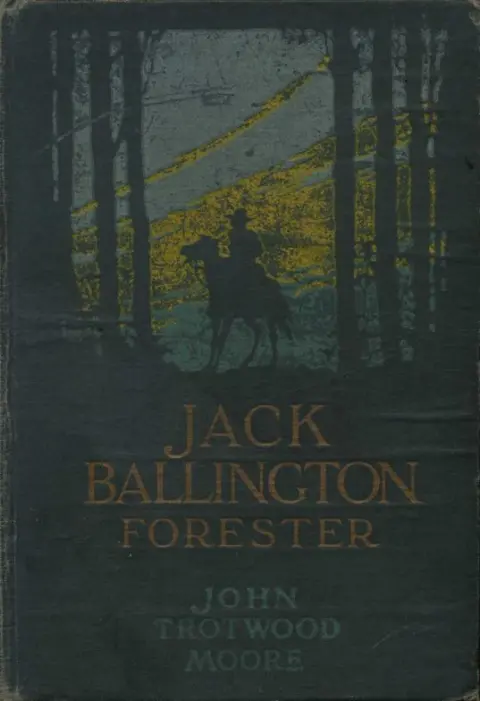
Jack Ballington, Forester
John Trotwood Moore
THE CLASSIC COLLECTION · 1906
"The Bishop of Cottontown: A Story of the Southern Cotton Mills" by John Trotwood Moore is a novel written in the early 20th century. The story is set in the Southern cotton mills of Tennessee and deals with themes of ambition, social class, and the struggles of working-class individuals. Key characters introduced include Richard Travis, a man of strength but lacking moral integrity, and Helen Conway, a young woman entwined in the intricate social dynamics and romantic tensions of her community. The opening of the novel paints a vivid picture of the beauty of the cotton plant, likening its life cycle to artistic creation. It introduces the setting with descriptions emphasizing the vibrant landscape of the Tennessee Valley, reflecting on the area's harvests and the complexities of life in the cotton mills. The narrative transitions to characters like Richard Travis, who is portrayed with a blend of physical strength and moral weaknesses, and introduces the trace of romantic tension surrounding Helen Conway. This first section establishes a foundation of both lyrical descriptions and hints at deeper social issues, setting the stage for the unfolding drama amidst the struggle for existence in a changing Southern landscape.
Introduction adapted from the source catalogue; source summaries may be automatically generated.
Free to read · English · 154,383 words · No account needed
MAKE TIME FOR A GOOD BOOK
On by default. Untick to stop anonymous reading totals. Each page counts after 10 seconds in view. How this works.
Anonymous counting is on unless you have switched it off.
Travis caught her hand in the dark and she clung to him. A hound stepped out from under the steps and licked her other hand. She jumped and gave a little shriek. Then, when she understood, she stroked the poor thing's head, its eyes staring hungrily in the dim light.
She followed Travis up the steps. Within, he struck a match, and she saw the emptiness of it all--the broken plastering and the paper torn off in spots, a dirty, littered floor, and an old sofa and a few other things left, too worthless to be moved.
She held up bravely, but tears were running down her cheeks. Travis struck another match to light a lamp which had been forgotten and left on the mantel. He attempted to light it, but something huge and black swept by and extinguished it. Helen shrieked again, and coming up timidly seized his arm in the dark. He could feel her heart beating excitedly against it.
He struck another match.
"Don't be uneasy, it is nothing but an owl."
The light was turned up and showed an owl sitting on the top of an
old tester that had formerly been the canopy of her grandmother's
bed.
The owl stared stupidly at them--turning its head solemnly.
Helen laughed hysterically.
"Now, sit down on the old sofa," he said. "There is much to say to you. We are now on the verge of a tragedy or a farce, or--"
"Sometimes plays end well, where all are happy, do they not?" she asked, smiling hysterically and sitting by him, but looking at the uncanny owl beyond. She was silent, then:
"Oh, I--I--don't you think I am entitled now--to have something end happily--now--once--in my life?"
He pitied her and was silent.
"Tell me," she said after a while, "you have moved father and Lily to--to--one of the Cottontown cottages?"
He arose: "In a little while I will tell you, but now we must have something to eat first--you see I had this lunch fixed for our journey." He went out, over to his lap-robe and cushion, and brought a basket and placed it on an old table.
"You may begin now and be my housekeeper," he smiled. "Isn't it time you were learning? I daresay I'll not find you a novice, though."
She flushed and smiled. She arose gracefully, and her pretty hands soon had the lunch spread, Travis helping her awkwardly.
It was a pretty picture, he thought--her flushed girlish face, yet matronly ways. He watched her slyly, with a sad joyousness in his eyes, drinking it in, as one who had hungered long for contentment and peace, such as this.
Your reading position is saved on this browser. Take it to another device with a library code. Reading pages adapt to text, rather than matching a printed edition.
John Trotwood Moore
BEHIND THE BOOK
This eBook is for the use of anyone anywhere in the United States and most other parts of the world at no cost and with almost no restrictions whatsoever. You may copy it, give it away or re-use it under the terms of the Project Gutenberg License included with this eBook or online at www.gutenberg.org. If you are not located in the United States, you will have to check the laws of the country where you are located before using this eBook. Read the source licence.
The original source file, including credits and licence, is retained by this library. Request an original-format copy at no charge. Please include the book title and Project Gutenberg identifier #23637.
KEEP YOUR CURIOSITY GOING
Coulson Kernahan

Maurice Baring
Frances Wright
Cécile Tormay

Frederic Jesup Stimson

W. H. P. (William Henry Pope) Jarvis