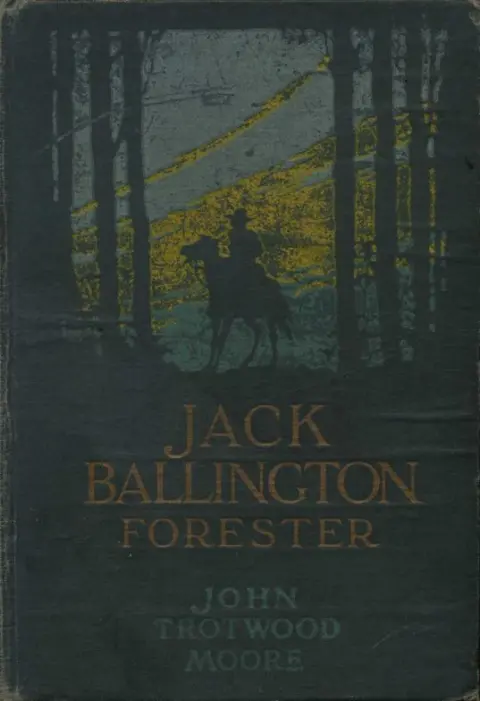
Jack Ballington, Forester
John Trotwood Moore
THE CLASSIC COLLECTION · 1906
"The Bishop of Cottontown: A Story of the Southern Cotton Mills" by John Trotwood Moore is a novel written in the early 20th century. The story is set in the Southern cotton mills of Tennessee and deals with themes of ambition, social class, and the struggles of working-class individuals. Key characters introduced include Richard Travis, a man of strength but lacking moral integrity, and Helen Conway, a young woman entwined in the intricate social dynamics and romantic tensions of her community. The opening of the novel paints a vivid picture of the beauty of the cotton plant, likening its life cycle to artistic creation. It introduces the setting with descriptions emphasizing the vibrant landscape of the Tennessee Valley, reflecting on the area's harvests and the complexities of life in the cotton mills. The narrative transitions to characters like Richard Travis, who is portrayed with a blend of physical strength and moral weaknesses, and introduces the trace of romantic tension surrounding Helen Conway. This first section establishes a foundation of both lyrical descriptions and hints at deeper social issues, setting the stage for the unfolding drama amidst the struggle for existence in a changing Southern landscape.
Introduction adapted from the source catalogue; source summaries may be automatically generated.
Free to read · English · 154,383 words · No account needed
MAKE TIME FOR A GOOD BOOK
On by default. Untick to stop anonymous reading totals. Each page counts after 10 seconds in view. How this works.
Anonymous counting is on unless you have switched it off.
It was not the smile of happiness. He did not know it because, being blind, he could not know. It was the happiness of work--achievement.
He came in smiling. "Why are you so much happier than last week?"
"Would you really like to know?" she said, looking him frankly in the
eyes.
He touched her hair playfully. She moved her head and shook it
warningly.
"It is because I am at work and father is trying so hard to reform."
"I thought maybe it was because you had found out how much I love
you."
It was his old, stereotyped, brazen way, but she did not know it and
blushed prettily.
"You are kind, Mr. Travis, but--but that mustn't be thought of. Please, but I wish you wouldn't talk that way."
"Why, it is true, my queen--of The Gaffs?" he said smiling.
She began to work again.
He came over to her and bent low:
"You know I am to take you Monday night"--
Her hands flew very rapidly--her cheeks mantled into a rich glow. One of the threads snapped. She stopped, confused.
Travis glanced around. No one was near. He bent and kissed her hair:
"My queen," he whispered, "my beautiful queen."
Then he walked quickly out. He went to his office, but he still saw the beautiful picture. It thrilled him and then there swept up over him another picture, and he cried savagely to himself:
"I'll make her sorry. She shall bow to that fine thing yet--my
queen."
Nor would it leave him that day, and into the night he dreamed of her, and it was the same Titian picture in a background of red sunset. And her machine was a harp she was playing. He wakened and smiled:
"Am I falling in love with that girl? That will spoil it all."
He watched her closely the next day, for it puzzled him to know why she had changed so rapidly in her manner toward him. He had ridden to Millwood to bring her to the mill, himself; and he had some exquisite roses for her--clipped in the hot-house by his own hands. It was with an unmistakable twitch of jealousy that he learned that Clay Westmore had already come by and gone with her.
"I know what it is now," he said to Jud Carpenter at the mill that morning; "she is half in love with that slow, studious fellow."
Jud laughed: "Say, excuse me, sah--but hanged if you ain't got all
the symptoms, y'self, boss?"
Travis flushed:
"Oh, when I start out to do a thing I want to do it--and I'm going to take her with me, or die trying."
Your reading position is saved on this browser. Take it to another device with a library code. Reading pages adapt to text, rather than matching a printed edition.
John Trotwood Moore
BEHIND THE BOOK
This eBook is for the use of anyone anywhere in the United States and most other parts of the world at no cost and with almost no restrictions whatsoever. You may copy it, give it away or re-use it under the terms of the Project Gutenberg License included with this eBook or online at www.gutenberg.org. If you are not located in the United States, you will have to check the laws of the country where you are located before using this eBook. Read the source licence.
The original source file, including credits and licence, is retained by this library. Request an original-format copy at no charge. Please include the book title and Project Gutenberg identifier #23637.
KEEP YOUR CURIOSITY GOING
Coulson Kernahan

Maurice Baring
Frances Wright
Cécile Tormay

Frederic Jesup Stimson

W. H. P. (William Henry Pope) Jarvis