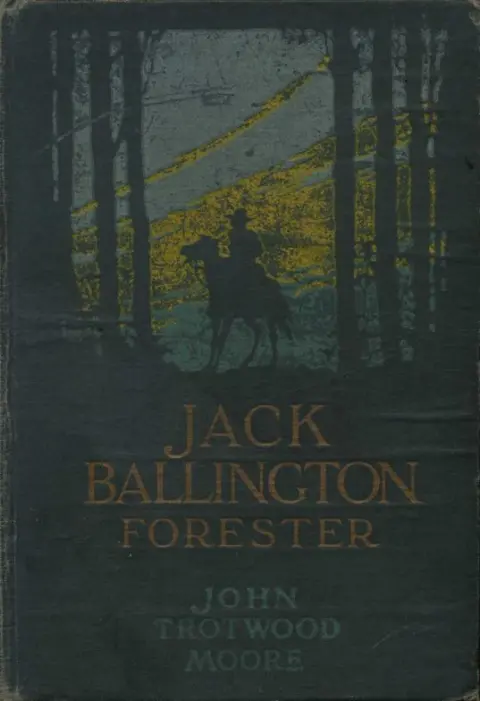
Jack Ballington, Forester
John Trotwood Moore
THE CLASSIC COLLECTION · 1906
"The Bishop of Cottontown: A Story of the Southern Cotton Mills" by John Trotwood Moore is a novel written in the early 20th century. The story is set in the Southern cotton mills of Tennessee and deals with themes of ambition, social class, and the struggles of working-class individuals. Key characters introduced include Richard Travis, a man of strength but lacking moral integrity, and Helen Conway, a young woman entwined in the intricate social dynamics and romantic tensions of her community. The opening of the novel paints a vivid picture of the beauty of the cotton plant, likening its life cycle to artistic creation. It introduces the setting with descriptions emphasizing the vibrant landscape of the Tennessee Valley, reflecting on the area's harvests and the complexities of life in the cotton mills. The narrative transitions to characters like Richard Travis, who is portrayed with a blend of physical strength and moral weaknesses, and introduces the trace of romantic tension surrounding Helen Conway. This first section establishes a foundation of both lyrical descriptions and hints at deeper social issues, setting the stage for the unfolding drama amidst the struggle for existence in a changing Southern landscape.
Introduction adapted from the source catalogue; source summaries may be automatically generated.
Free to read · English · 154,383 words · No account needed
MAKE TIME FOR A GOOD BOOK
On by default. Untick to stop anonymous reading totals. Each page counts after 10 seconds in view. How this works.
Anonymous counting is on unless you have switched it off.
It was a small trick of Travis', for though the old pacer came with a rush that swept everything before it, the drive had been made too late. Travis had the heat won already.
Still there was no rule against it. He could yell and crack his whip and make all the noise he wished, and if the other horse was frightened, it was the fault of his nerves. Everybody who knew anything of racing knew that.
A perfect tornado of hisses met Travis at the grand-stand.
But he had won the heat! What did he care? He could scarcely stop his mare. She seemed like a bird and as fresh. He pulled her double to make her turn and come back after winning, and as she came she still fought the bit.
As he turned, he almost ran into the old pacer jogging, broken-hearted behind. The mare's mouth was wide open, and the Bishop's trained eye fell on the long tusk-like lower teeth, flashing in the sun.
Startled, he quivered from head to foot. He would not believe his own eyes. He looked closely again. There was no doubt of it--she was eight years old!
In an instant he knew--his heart sank, "We're robbed, Cap'n
Tom--Shiloh--my God!"
Travis drove smilingly back, amid hisses and cheers and the fluttering of ladies' handkerchiefs in the boxes.
"How about the gloves and candy now?" he called to them with his cap
in his hand.
Above the judges had hung out:
6th Heat: Lizzette, 1st; Ben Butler, 2nd. Time, 2:14.
When Flecker of Tennessee saw the time hung out, he jumped from his seat exclaiming: "Six heats and the last heat the fastest? Who ever heard of a tired mare cutting ten seconds off that way? By the eternal, but something's wrong there."
"Six heats an' the last one the fastest--By gad, sah," said Col. Troup. "It is strange. That mare Lizzette is a wonder, an' by gad, sah, didn't the old pacer come? By gad, but if he'd begun that drive jus' fifty yards sooner--our money"--
Flecker groaned: "We're gone, Colonel--one thousand we put up and the
one we hedged with."
"By gad, sah, but, Flecker, don't you think Lizzette went smoother that last heat? She had a different stride, a different gait."
Flecker had not noticed it. "But it was a small thing," he said--"to frighten the old horse. No rule against it, but a gentleman--"
The Colonel smiled: "Damn such gentlemen, sah. They're a new breed to
me."
The old man went slowly back to the stable. He said nothing. He walked dazed, pale, trembling, heart-broken. But never before had he thought so keenly.
Your reading position is saved on this browser. Take it to another device with a library code. Reading pages adapt to text, rather than matching a printed edition.
John Trotwood Moore
BEHIND THE BOOK
This eBook is for the use of anyone anywhere in the United States and most other parts of the world at no cost and with almost no restrictions whatsoever. You may copy it, give it away or re-use it under the terms of the Project Gutenberg License included with this eBook or online at www.gutenberg.org. If you are not located in the United States, you will have to check the laws of the country where you are located before using this eBook. Read the source licence.
The original source file, including credits and licence, is retained by this library. Request an original-format copy at no charge. Please include the book title and Project Gutenberg identifier #23637.
KEEP YOUR CURIOSITY GOING
Coulson Kernahan

Maurice Baring
Frances Wright
Cécile Tormay

Frederic Jesup Stimson

W. H. P. (William Henry Pope) Jarvis