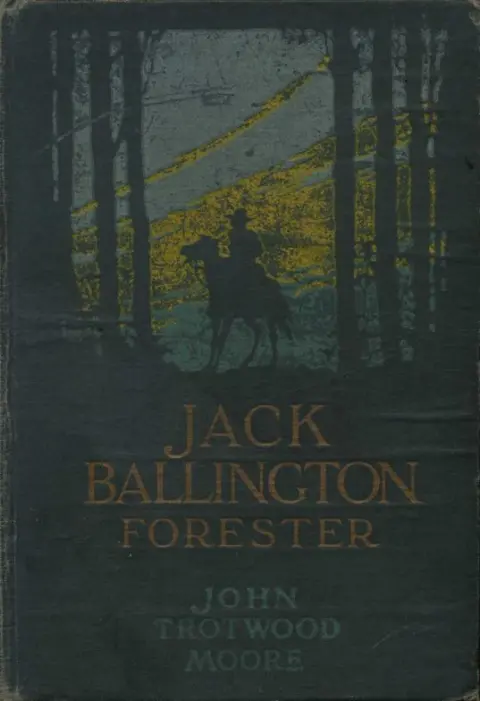
Jack Ballington, Forester
John Trotwood Moore
THE CLASSIC COLLECTION · 1906
"The Bishop of Cottontown: A Story of the Southern Cotton Mills" by John Trotwood Moore is a novel written in the early 20th century. The story is set in the Southern cotton mills of Tennessee and deals with themes of ambition, social class, and the struggles of working-class individuals. Key characters introduced include Richard Travis, a man of strength but lacking moral integrity, and Helen Conway, a young woman entwined in the intricate social dynamics and romantic tensions of her community. The opening of the novel paints a vivid picture of the beauty of the cotton plant, likening its life cycle to artistic creation. It introduces the setting with descriptions emphasizing the vibrant landscape of the Tennessee Valley, reflecting on the area's harvests and the complexities of life in the cotton mills. The narrative transitions to characters like Richard Travis, who is portrayed with a blend of physical strength and moral weaknesses, and introduces the trace of romantic tension surrounding Helen Conway. This first section establishes a foundation of both lyrical descriptions and hints at deeper social issues, setting the stage for the unfolding drama amidst the struggle for existence in a changing Southern landscape.
Introduction adapted from the source catalogue; source summaries may be automatically generated.
Free to read · English · 154,383 words · No account needed
MAKE TIME FOR A GOOD BOOK
On by default. Untick to stop anonymous reading totals. Each page counts after 10 seconds in view. How this works.
Anonymous counting is on unless you have switched it off.
It was the most comical, most splendid joke ever played in the Valley. Travis was not popular, neither was the dignified Col. Troup. Up to this time the crowd had not cared who won the purse; nor had they cared which of the pretty trotters received the crown. It meant only a little more swagger and show and money to throw away.
But here was something human, pathetic. Here was a touch of the stuff that made the grand-stand kin to the old man. The disreputable cart, the lifeless, blind old pacer, the home-made harness, the seediness of it all--the pathos.
Here was the quaint old man, who, all his life, had given for others, here was the ex-overseer and the ex-trainer of the Travis stables, trying to win the purse from gentlemen.
"Ten to one," said a prosperous looking man, as he looked quietly on--"the Bishop wants it for charity or another church. Like as not he knows of some poverty-stricken family he's going to feed."
"If that's so," shouted two young fellows who were listening, and who were partisans of Flecker of Tennessee, "if that's the way of it, we'll go over and take a hand in seeing that he has fair play."
They arose hastily, each shifting a pistol in his pocket, and butted through the crowd which was thronged around the Judge's stand, where the old man sat quietly smiling from his cart, and Travis and Troup were talking earnestly.
"Damned if I let Trombine start against such a combination as that, sah. I'll drive off the track now, sah--damned if I don't, sah!"
But the two young men had spoken to big fat Flecker of Tennessee, and he arose in his sulky-seat and said: "Now, gentlemen, clear the track and let us race. We will let the old man start. Say, old man," he laughed, "you won't feel bad if we shut you out the fust heat, eh?"
"No," smiled the Bishop--"an' I 'spec you will. Why, the old hoss
ain't raced in ten years."
"Oh, say, I thought you were going to say twenty," laughed Flecker.
Some rowdy had crowded around the old cart and attempted to unscrew the axle tap. But some one reached over the head of the crowd and gripped him where his shoulder and arm met, and pulled him forward and twirled him around like a top.
It was enough. It was ten minutes before he could lift up his arm at
all; it felt dead.
"Don't hurt nobody, Jack," whispered the old man, "be keerful."
Your reading position is saved on this browser. Take it to another device with a library code. Reading pages adapt to text, rather than matching a printed edition.
John Trotwood Moore
BEHIND THE BOOK
This eBook is for the use of anyone anywhere in the United States and most other parts of the world at no cost and with almost no restrictions whatsoever. You may copy it, give it away or re-use it under the terms of the Project Gutenberg License included with this eBook or online at www.gutenberg.org. If you are not located in the United States, you will have to check the laws of the country where you are located before using this eBook. Read the source licence.
The original source file, including credits and licence, is retained by this library. Request an original-format copy at no charge. Please include the book title and Project Gutenberg identifier #23637.
KEEP YOUR CURIOSITY GOING
Coulson Kernahan

Maurice Baring
Frances Wright
Cécile Tormay

Frederic Jesup Stimson

W. H. P. (William Henry Pope) Jarvis