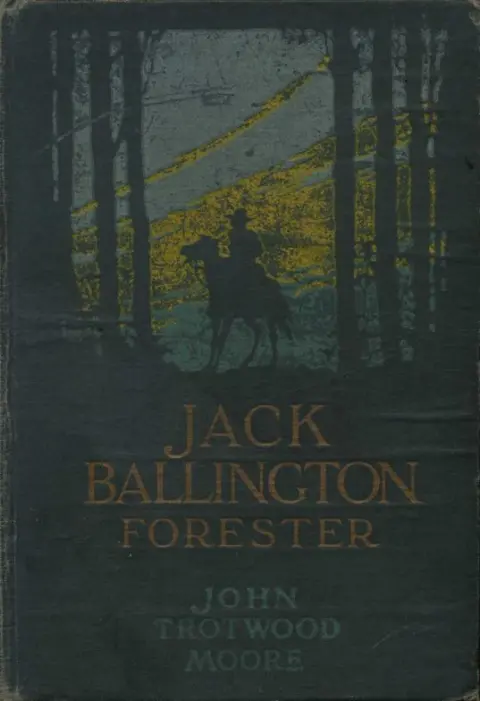
Jack Ballington, Forester
John Trotwood Moore
THE CLASSIC COLLECTION · 1906
"The Bishop of Cottontown: A Story of the Southern Cotton Mills" by John Trotwood Moore is a novel written in the early 20th century. The story is set in the Southern cotton mills of Tennessee and deals with themes of ambition, social class, and the struggles of working-class individuals. Key characters introduced include Richard Travis, a man of strength but lacking moral integrity, and Helen Conway, a young woman entwined in the intricate social dynamics and romantic tensions of her community. The opening of the novel paints a vivid picture of the beauty of the cotton plant, likening its life cycle to artistic creation. It introduces the setting with descriptions emphasizing the vibrant landscape of the Tennessee Valley, reflecting on the area's harvests and the complexities of life in the cotton mills. The narrative transitions to characters like Richard Travis, who is portrayed with a blend of physical strength and moral weaknesses, and introduces the trace of romantic tension surrounding Helen Conway. This first section establishes a foundation of both lyrical descriptions and hints at deeper social issues, setting the stage for the unfolding drama amidst the struggle for existence in a changing Southern landscape.
Introduction adapted from the source catalogue; source summaries may be automatically generated.
Free to read · English · 154,383 words · No account needed
MAKE TIME FOR A GOOD BOOK
On by default. Untick to stop anonymous reading totals. Each page counts after 10 seconds in view. How this works.
Anonymous counting is on unless you have switched it off.
"No, she aint eat a blessed thing, hardly, to-day," said her mother--"jes' seemed to have lost her appetite from a to izzard."
"I wish the store'd keep wild cherry bark and whiskey--somethin' to
make us eat. We cyant work unless we can eat," said Samantha,
woefully.
"Great Scott," said Jud, "what we want to do is to keep you folks from eatin' so much. Lem'me see," he added after a pause, as if still thinking he'd get to the source of her trouble--"Yistidday was Sunday--you didn't have to work--now what did you eat for breakfast?"
"Nothin'--oh, I aint got no appetite at all"--whined Miss Samantha.
"Well, what did you eat--I wanter find out what ails you?"
"Well, lem'me see," said Miss Samantha, counting on her fingers--"a biled mackrel, some fried bacon, two pones of corn bread--kinder forced it down."
"Ur-huh--" said Jud, thoughtfully--"of course you had to drink, too."
"Yes"--whined Miss Samantha woefully--"two glasses of buttermilk."
Jud elevated his eyebrows "An' for dinner?"
"O, Lor'. Jes' cu'dn't eat nothin' fur dinner," she wailed. "If the Company'd only get some cherry bark an' whiskey"--
"At dinner," said Mrs Carewe, stroking her chin--"we had some sour-kraut--she eat right pe'rtly of that--kinder seemed lak a appetizer to her. She mixed it with biled cabbage an' et right pe'rtly of it."
"An' some mo' buttermilk--it kinder cools my stomach," whined Miss Samantha. "An' hog-jowl, an' corn-bread--anything else Maw?"
"A raw onion in vinegar," said her mother--"It's the only thing that seems to make you want to eat a little. An' reddishes--we had some new reddishes fur dinner--didn't we, Samanthy?"
"Good Lord," snapped Jud--"reddishes an' buttermilk--no wonder you needed that weight on your stomach--it's all that kept you from floatin' in the air. Cyant eat--O good Lord!"
They were silent--Miss Samantha making wry faces with her pain.
"Of course you didn't eat no supper?" he asked.
"No--we don' eat no supper Sunday night," said Mrs. Carewe.
"Didn't eat none at all," asked Jud--"not even a little?"
"Well, 'bout nine o'clock I thought I'd eat a little, to keep me from gittin' hungry befo' day, so I et a raw onion, an' some black walnuts, and dried prunes, an'--an'--"
"A few apples we had in the cellar," added her mother, "an' a
huckleberry pie, an' buttermilk--"
Your reading position is saved on this browser. Take it to another device with a library code. Reading pages adapt to text, rather than matching a printed edition.
John Trotwood Moore
BEHIND THE BOOK
This eBook is for the use of anyone anywhere in the United States and most other parts of the world at no cost and with almost no restrictions whatsoever. You may copy it, give it away or re-use it under the terms of the Project Gutenberg License included with this eBook or online at www.gutenberg.org. If you are not located in the United States, you will have to check the laws of the country where you are located before using this eBook. Read the source licence.
The original source file, including credits and licence, is retained by this library. Request an original-format copy at no charge. Please include the book title and Project Gutenberg identifier #23637.
KEEP YOUR CURIOSITY GOING
Coulson Kernahan

Maurice Baring
Frances Wright
Cécile Tormay

Frederic Jesup Stimson

W. H. P. (William Henry Pope) Jarvis