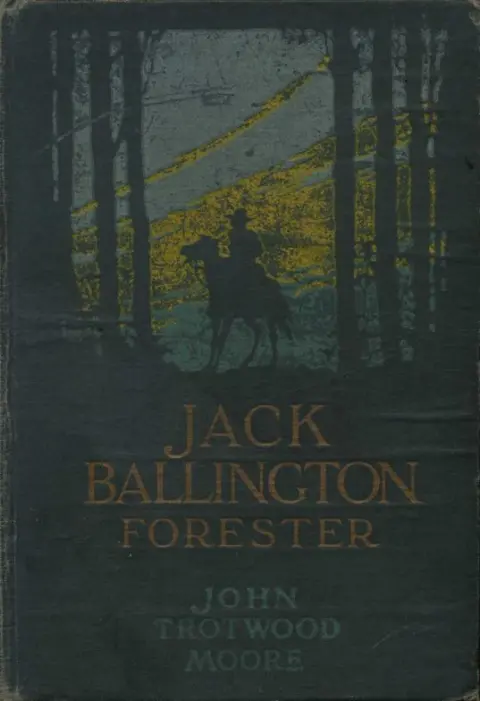
Jack Ballington, Forester
John Trotwood Moore
THE CLASSIC COLLECTION · 1906
"The Bishop of Cottontown: A Story of the Southern Cotton Mills" by John Trotwood Moore is a novel written in the early 20th century. The story is set in the Southern cotton mills of Tennessee and deals with themes of ambition, social class, and the struggles of working-class individuals. Key characters introduced include Richard Travis, a man of strength but lacking moral integrity, and Helen Conway, a young woman entwined in the intricate social dynamics and romantic tensions of her community. The opening of the novel paints a vivid picture of the beauty of the cotton plant, likening its life cycle to artistic creation. It introduces the setting with descriptions emphasizing the vibrant landscape of the Tennessee Valley, reflecting on the area's harvests and the complexities of life in the cotton mills. The narrative transitions to characters like Richard Travis, who is portrayed with a blend of physical strength and moral weaknesses, and introduces the trace of romantic tension surrounding Helen Conway. This first section establishes a foundation of both lyrical descriptions and hints at deeper social issues, setting the stage for the unfolding drama amidst the struggle for existence in a changing Southern landscape.
Introduction adapted from the source catalogue; source summaries may be automatically generated.
Free to read · English · 154,383 words · No account needed
MAKE TIME FOR A GOOD BOOK
On by default. Untick to stop anonymous reading totals. Each page counts after 10 seconds in view. How this works.
Anonymous counting is on unless you have switched it off.
Timidly she sat by him scarce lifting her eyes to speak, but conscious all the time that his eyes were devouring her, from her neck and hair to her slippered foot, sticking half way out from skirts of old lace-trimmed linen.
She reminded him at last that they should go back home.
No--he would have her at home directly. Yes, he'd have her there before the old nurse missed her.
She knew the trotters were going fast, but she did not know just how fast, until presently, in a cloud of whirling dust they flew around a buggy whose horse, trot as fast as it could, seemed stationary to the speed the pair showed as they passed.
It was Harry and Nellie. She glanced coldly at him, and when he raised his hat she cut him with a smile of scorn. She saw his jaw drop dejectedly as Richard Travis sang out banteringly:
"Sweets to the sweet, and good-bye to the three-minute class."
It was a good half hour, but it seemed but a few minutes before he had her back at the home gate, her cheeks burning with the glory of that burst of speed, and rush of air.
He had helped her out and stood holding her hand as one old enough to be her father. He smiled and, looking down at her glowing face, and hair, and neck, repeated:
"What thou art we know not.
What is most like thee?
From rainbow clouds there flow not
Drops so bright to see
As from thy presence showers a rain of melody."
Then he changed as she thanked him, and said: "When you go into the mill I shall have many pleasant surprises for you like this."
He bent over her and whispered: "I have arranged for your pay to be double--we are neighbors, you know--your father and I,--and a pretty girl, like you, need not work always."
She started and looked at him quickly.
The color went from her cheeks. Then it came again in a crimson tide, so full and rich, that Richard Travis, like Titian with his brush, stood spellbound before the work he had done.
Fearing he had said too much, he dropped his voice and with a twinkle
in his eye said:
"For there is Harry--you know."
All her timidity vanished--her hanging of the head, her silence, her blushes. Instead, there leaped into her eyes that light which Richard Travis had never seen before--the light of a Conway on mettle.
"I hate him."
"I do not blame you," he said. "I shall be a--father to you if you
will let me."
He pressed her hand, and raising his hat, was gone.
Your reading position is saved on this browser. Take it to another device with a library code. Reading pages adapt to text, rather than matching a printed edition.
John Trotwood Moore
BEHIND THE BOOK
This eBook is for the use of anyone anywhere in the United States and most other parts of the world at no cost and with almost no restrictions whatsoever. You may copy it, give it away or re-use it under the terms of the Project Gutenberg License included with this eBook or online at www.gutenberg.org. If you are not located in the United States, you will have to check the laws of the country where you are located before using this eBook. Read the source licence.
The original source file, including credits and licence, is retained by this library. Request an original-format copy at no charge. Please include the book title and Project Gutenberg identifier #23637.
KEEP YOUR CURIOSITY GOING
Coulson Kernahan

Maurice Baring
Frances Wright
Cécile Tormay

Frederic Jesup Stimson

W. H. P. (William Henry Pope) Jarvis