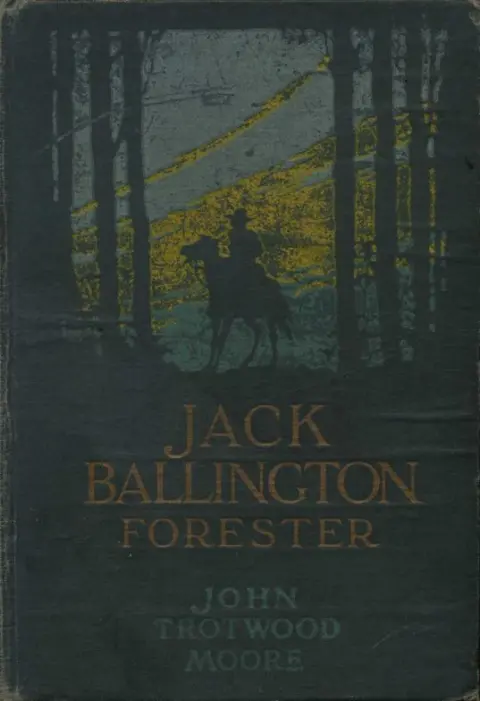
Jack Ballington, Forester
John Trotwood Moore
THE CLASSIC COLLECTION · 1906
"The Bishop of Cottontown: A Story of the Southern Cotton Mills" by John Trotwood Moore is a novel written in the early 20th century. The story is set in the Southern cotton mills of Tennessee and deals with themes of ambition, social class, and the struggles of working-class individuals. Key characters introduced include Richard Travis, a man of strength but lacking moral integrity, and Helen Conway, a young woman entwined in the intricate social dynamics and romantic tensions of her community. The opening of the novel paints a vivid picture of the beauty of the cotton plant, likening its life cycle to artistic creation. It introduces the setting with descriptions emphasizing the vibrant landscape of the Tennessee Valley, reflecting on the area's harvests and the complexities of life in the cotton mills. The narrative transitions to characters like Richard Travis, who is portrayed with a blend of physical strength and moral weaknesses, and introduces the trace of romantic tension surrounding Helen Conway. This first section establishes a foundation of both lyrical descriptions and hints at deeper social issues, setting the stage for the unfolding drama amidst the struggle for existence in a changing Southern landscape.
Introduction adapted from the source catalogue; source summaries may be automatically generated.
Free to read · English · 154,383 words · No account needed
MAKE TIME FOR A GOOD BOOK
On by default. Untick to stop anonymous reading totals. Each page counts after 10 seconds in view. How this works.
Anonymous counting is on unless you have switched it off.
Carpenter laughed: "That's it--you all'ers say the k'rect thing. 'N' as I was sayin'"--he went on--"it is a ground-hog case with 'em. The Major's drunk all the time. His farm an' home'll be sold soon. He's 'bleeged to put 'em in the mill--or the po'-house."
He paused, thinking. Then, "But ain't that Helen about the pretties' thing you ever seed?" He chuckled. "You're sly--but I seen you givin' her that airin' behin' Lizette and Sadie B.--"
"You've nothing to do with that," said Travis gruffly. "You want a new girl for our drawing-in machine--the best paying and most profitable place in the mill--off from the others--in a room by herself--no contact with mill-people--easy job--two dollars a day--"
"One dollar--you forgit, suh--one dollar's the reg'lar price, sah,"
interrupted the Whipper-in.
The other turned on him almost fiercely: "Your memory is as weak as your wits--two dollars, I tell you, and don't interrupt me again--"
"To be sho'," said the Whipper-in, meekly--"I did forgit--please
excuse me, sah."
"Then, in talking to Conway, you, of course, would draw his attention to the fact that he is to have a nice cottage free of rent--that will come in right handy when he finds himself out in the road--sold out and nowhere to go," he said.
"'N' the commissary," put in Carpenter quietly. "Excuse me, sah, but there's a mighty good bran' of whiskey there, you know!"
Travis smiled good humoredly: "Your wits are returning," he said; "I
think you understand."
"I'll see him to-morrow," said Carpenter, rising to go.
"Oh, don't be in a hurry," said Travis.
"Excuse me, sah, but I'm afraid I've bored you stayin' too long."
"Sit down," said the other, peremptorily--"you will need something to help you along the road. Shall we take another?"
So they took yet another drink, and Carpenter went out, calling his
dog.
Travis stood in the doorway and watched them go down the driveway. They both staggered lazily along. Travis smiled: "Both drunk--the dog on ham."
As he turned to go in, he reeled slightly himself, but he did not
notice it.
When he came back he was restless. He looked at the clock. "Too early for bed," he said. "I'd give a ten if Charley Biggers were here with his little cocktail laugh to try me a game of poker."
Suddenly he went to the window, and taking a small silver whistle from his pocket he blew it toward the stables. Soon afterwards a well dressed mulatto boy entered.
"How are the horses to-night, Jim?" he asked.
"Fine, sir--all eatin' well an' feelin' good."
"And Coquette--the saddle mare?"
"Like split silk, sir."
Your reading position is saved on this browser. Take it to another device with a library code. Reading pages adapt to text, rather than matching a printed edition.
John Trotwood Moore
BEHIND THE BOOK
This eBook is for the use of anyone anywhere in the United States and most other parts of the world at no cost and with almost no restrictions whatsoever. You may copy it, give it away or re-use it under the terms of the Project Gutenberg License included with this eBook or online at www.gutenberg.org. If you are not located in the United States, you will have to check the laws of the country where you are located before using this eBook. Read the source licence.
The original source file, including credits and licence, is retained by this library. Request an original-format copy at no charge. Please include the book title and Project Gutenberg identifier #23637.
KEEP YOUR CURIOSITY GOING
Coulson Kernahan

Maurice Baring
Frances Wright
Cécile Tormay

Frederic Jesup Stimson

W. H. P. (William Henry Pope) Jarvis