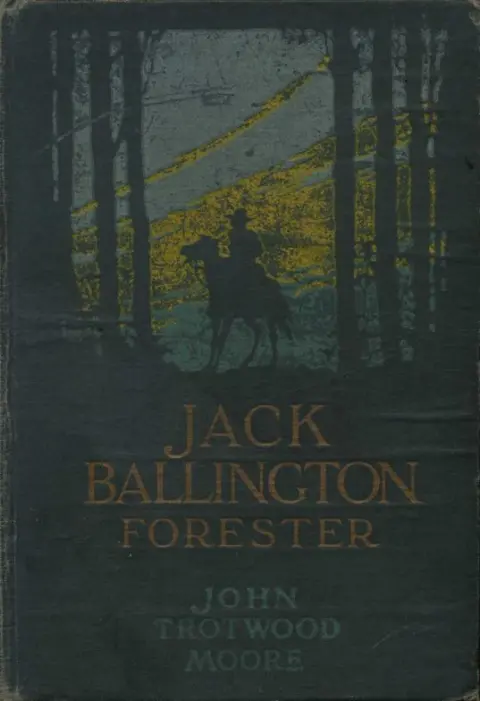
Jack Ballington, Forester
John Trotwood Moore
THE CLASSIC COLLECTION · 1906
"The Bishop of Cottontown: A Story of the Southern Cotton Mills" by John Trotwood Moore is a novel written in the early 20th century. The story is set in the Southern cotton mills of Tennessee and deals with themes of ambition, social class, and the struggles of working-class individuals. Key characters introduced include Richard Travis, a man of strength but lacking moral integrity, and Helen Conway, a young woman entwined in the intricate social dynamics and romantic tensions of her community. The opening of the novel paints a vivid picture of the beauty of the cotton plant, likening its life cycle to artistic creation. It introduces the setting with descriptions emphasizing the vibrant landscape of the Tennessee Valley, reflecting on the area's harvests and the complexities of life in the cotton mills. The narrative transitions to characters like Richard Travis, who is portrayed with a blend of physical strength and moral weaknesses, and introduces the trace of romantic tension surrounding Helen Conway. This first section establishes a foundation of both lyrical descriptions and hints at deeper social issues, setting the stage for the unfolding drama amidst the struggle for existence in a changing Southern landscape.
Introduction adapted from the source catalogue; source summaries may be automatically generated.
Free to read · English · 154,383 words · No account needed
MAKE TIME FOR A GOOD BOOK
On by default. Untick to stop anonymous reading totals. Each page counts after 10 seconds in view. How this works.
Anonymous counting is on unless you have switched it off.
"What--what?" said Uncle Davy between his sobs--"I ain't a dyin', Hillard? Oh, yes, I be. Sally and Tilly both say so."
"Now, look aheah, Davy, it ain't so. I've seed hundreds die--yes, hundreds--strong men, babes--women and little tots, strong ones, and weak and frail ones, given to tears, but I've never seed one die yet sheddin' a single tear, let alone blubberin' like a calf. It's agin nature. Davy, dyin' men don't weep. It's always all right with 'em. It's the one moment of all their lives, often, that everything is all right, seein' as they do, that all life has been a dream--all back of death jes' a beginnin' to live, an' so they die contented. No--no, Davy, if they've lived right they want to smile, not weep."
There was an immediate snuffing and drying of tears all around. Uncle Davy looked sheepishly at Aunt Sally, she passed the same look on to Tilly, and Tilly passed it to the coon dog. Here it rested in its birthplace.
"Come to think of it, Hillard," said Uncle Dave after a while, "but I
believe you are right."
Tilly came back, and she and Aunt Sally nodded their heads: "Yes,
Hillard, you're right," went on Uncle Davy, "Tilly and Sally both say
so."
"How come you to think you was dyin' anyway?" asked the Bishop.
"Hillard,--you kno', Hillard--the old man's been thinkin' he'd go sudden-like a long time." He raised his eyes to heaven: "Yes, Lord, thy servant is even ready."
"Last night I felt a kind o' flutterin' of my heart an' I cudn't breathe good. I thought it was death--death,--Hillard, on the back of his pale horse. Tilly and Sally both thought so."
The Bishop laughed. "That warn't death on the back of a horse, Davy--that was jus' wind on the stomach of an ass."
This was too much for Uncle Davy--especially when Tilly and Sally made it unanimous by giggling outright.
"You et cabbages for supper," said the Bishop.
Uncle Davy nodded, sheepishly.
"Then I sed my will an' Tilly writ it down an', oh, Hillard, I am so anxious to hear you read it. I wanter see how it'ull feel fer a man to have his will read after he is dead--an'--an' how his widder takes it," he added, glancing at Aunt Sally--"an' his friends. I wanter heah you read it, Hillard, in that deep organ way of yours,--like you read the Old Testament. In that In-the-Beginning-God-Created-the-Heaven-an'-the-Earth-Kinder voice! Drap your voice low like a organ, an' let the old man hear it befo' he goes. I fixed it when I thought I was a-dyin'."
Your reading position is saved on this browser. Take it to another device with a library code. Reading pages adapt to text, rather than matching a printed edition.
John Trotwood Moore
BEHIND THE BOOK
This eBook is for the use of anyone anywhere in the United States and most other parts of the world at no cost and with almost no restrictions whatsoever. You may copy it, give it away or re-use it under the terms of the Project Gutenberg License included with this eBook or online at www.gutenberg.org. If you are not located in the United States, you will have to check the laws of the country where you are located before using this eBook. Read the source licence.
The original source file, including credits and licence, is retained by this library. Request an original-format copy at no charge. Please include the book title and Project Gutenberg identifier #23637.
KEEP YOUR CURIOSITY GOING
Coulson Kernahan

Maurice Baring
Frances Wright
Cécile Tormay

Frederic Jesup Stimson

W. H. P. (William Henry Pope) Jarvis