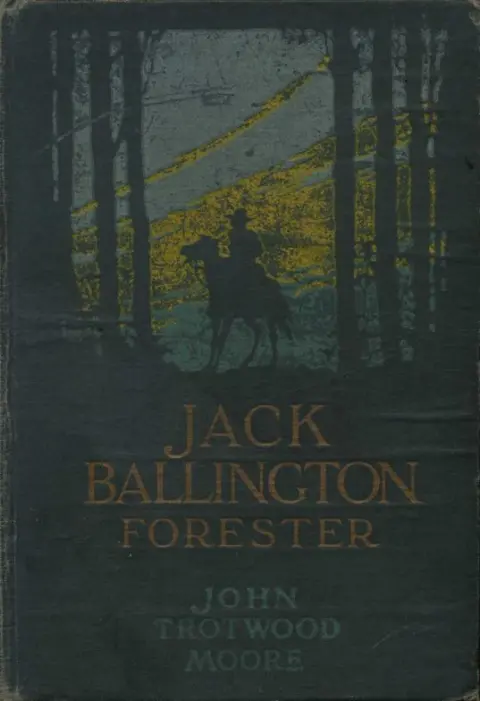
Jack Ballington, Forester
John Trotwood Moore
THE CLASSIC COLLECTION · 1906
"The Bishop of Cottontown: A Story of the Southern Cotton Mills" by John Trotwood Moore is a novel written in the early 20th century. The story is set in the Southern cotton mills of Tennessee and deals with themes of ambition, social class, and the struggles of working-class individuals. Key characters introduced include Richard Travis, a man of strength but lacking moral integrity, and Helen Conway, a young woman entwined in the intricate social dynamics and romantic tensions of her community. The opening of the novel paints a vivid picture of the beauty of the cotton plant, likening its life cycle to artistic creation. It introduces the setting with descriptions emphasizing the vibrant landscape of the Tennessee Valley, reflecting on the area's harvests and the complexities of life in the cotton mills. The narrative transitions to characters like Richard Travis, who is portrayed with a blend of physical strength and moral weaknesses, and introduces the trace of romantic tension surrounding Helen Conway. This first section establishes a foundation of both lyrical descriptions and hints at deeper social issues, setting the stage for the unfolding drama amidst the struggle for existence in a changing Southern landscape.
Introduction adapted from the source catalogue; source summaries may be automatically generated.
Free to read · English · 154,383 words · No account needed
MAKE TIME FOR A GOOD BOOK
On by default. Untick to stop anonymous reading totals. Each page counts after 10 seconds in view. How this works.
Anonymous counting is on unless you have switched it off.
Travis caught her eye and winked mischievously as he added: "Now, Cousin Alethea, you must promise me to make Alice ride her whenever she needs a tonic--every day, if necessary. I have bought her for Alice, and she must get the benefit of her before it grows too cold."
He turned to Alice Westmore: "You have only to tell me which days--if I am too busy to go with you--Jim will bring her over."
She smiled: "You are too kind, Richard, always thinking of my pleasure. A ride like this once a week is tonic enough."
She went into the house to change her habit. Her brother Clay, who had been sitting on the far end of the porch unobserved, arose and, without noticing Travis as he passed, walked into the house.
"I cannot imagine," said Mrs. Westmore apologetically, "what is the
matter with Clay to-day."
"Why?" asked Travis indifferently enough.
"He has neglected his geological specimens all day, nor has he ever been near his laboratory--he has one room he calls his laboratory, you know. To-night he is moody and troubled."
Travis said nothing. At tea Clay was not there.
When Travis left it was still early and Alice walked with him to the big gate. The moon shone dimly and the cool, pure light lay over everything like the first mist of frost in November. Beyond, in the field, where it struck into the open cotton bolls, it turned them into December snow-banks.
Travis led his saddle horse, and as they walked to the gate, the sweet and scarcely perceptible odor of the crepe-myrtle floated out on the open air.
The crepe-myrtle has a way of surprising us now and then, and often after a wet fall, it gives us the swan-song of a bloom, ere its delicate blossoms, touched to death by frost, close forever their scalloped pink eyes, on the rare summer of a life as spiritual as the sweet soft gulf winds which brought it to life.
Was it symbolic to-night,--the swan-song of the romance of Alice Westmore's life, begun under those very trees so many summers ago?
They stopped at the gate. Richard Travis lit a cigar before mounting
his horse. He seemed at times to-night restless, yet always
determined.
She had never seen him so nearly preoccupied as he had been once or
twice to-night.
"Do you not think?" he asked, after a while as they stood by the gate, "that I should have a sweet answer soon?"
Her eyes fell. The death song of the crepe-myrtle, aroused by a south wind suddenly awakened, smote her painfully.
"You know--you know how it is, Richard"--
Your reading position is saved on this browser. Take it to another device with a library code. Reading pages adapt to text, rather than matching a printed edition.
John Trotwood Moore
BEHIND THE BOOK
This eBook is for the use of anyone anywhere in the United States and most other parts of the world at no cost and with almost no restrictions whatsoever. You may copy it, give it away or re-use it under the terms of the Project Gutenberg License included with this eBook or online at www.gutenberg.org. If you are not located in the United States, you will have to check the laws of the country where you are located before using this eBook. Read the source licence.
The original source file, including credits and licence, is retained by this library. Request an original-format copy at no charge. Please include the book title and Project Gutenberg identifier #23637.
KEEP YOUR CURIOSITY GOING
Coulson Kernahan

Maurice Baring
Frances Wright
Cécile Tormay

Frederic Jesup Stimson

W. H. P. (William Henry Pope) Jarvis