THE CLASSIC COLLECTION✦The Pentateuch of printingCLASSIC FREE BOOKS
The Pentateuch of printing
William Blades
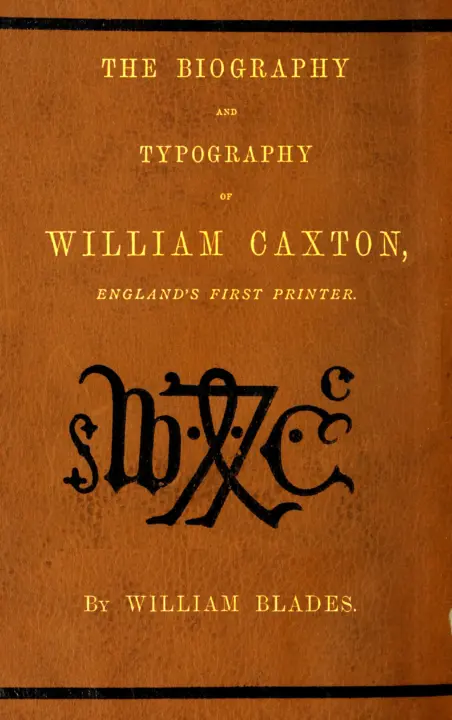
THE CLASSIC COLLECTION · 1861
"The biography and typography of William Caxton, England's first printer" by Blades is a historical and bibliographical study written in the late 19th century. It charts Caxton’s life and career alongside a meticulous analysis of his printed output, types, devices, and working methods, situating him within the rise of printing in England and the Low Countries. Drawing on company records, embassies, and court circles, it follows Caxton from Kentish origins through mercantile Bruges to Westminster, while also cataloguing his editions and discussing their rarity and features.
The opening of the volume sets the scope: a revised reprint that condenses earlier scholarship and adds notes on Caxton’s printer’s device and punctuation, while underscoring printing’s civilizational impact. It then outlines the plan—first a documentary life of Caxton, then detailed descriptions of his books by type, with appendices from Mercers’ and Bruges records. The narrative begins with Caxton’s birth in the Weald of Kent amid strong Flemish influence, a dialect anecdote about “eyren/eggs,” and a sober weighing of name variants to suggest a likely Causton connection. It proceeds to his 1438 apprenticeship to the wealthy mercer Robert Large, depicting London apprentice life, Large’s household and will, and vivid city scenes—dearth, pageantry, religious persecution, and civic unrest—culminating in Caxton’s departure abroad. In Bruges he emerges as a prosperous merchant, then Governor of the English Nation (Merchant Adventurers), mediating trade disputes, enforcing measures, and corresponding with London while treaties lapsed and were renewed; he begins translating the Recuyell under Duchess Margaret’s patronage and likely moves toward printing with Colard Mansion. A broad survey follows of 15th‑century bibliophilia—royal and ducal libraries in France and Burgundy, Louis de Bruges’s collection, English patrons—and of the book trades’ guild structure at Bruges and Antwerp. Finally, an initial technical chapter contrasts manuscripts and early print, explaining materials, binding habits, blank leaves, one‑page printing, signatures, hand‑painted initials, undated colophons, and typeforms that closely imitated contemporary handwriting.
Introduction adapted from the source catalogue; source summaries may be automatically generated.
Free to read · English · 119,581 words · No account needed
MAKE TIME FOR A GOOD BOOK
On by default. Untick to stop anonymous reading totals. Each page counts after 10 seconds in view. How this works.
Anonymous counting is on unless you have switched it off.
Every priest was obliged by the Canon Law to read the “Modus Fulminandi,” or Commination, and to preach at least one sermon every three months. These homilies appear to have been written for this purpose, and would probably meet with a good sale among the preaching orders of the clergy.
Nine copies are known, of which two only are in private hands.
NO. 51.--SERVITIUM DE VISITATIONE B. MARIÆ VIRGINIS. Quarto. Sine ullâ notâ. (1481-3).
COLLATION.--One 4n = 8 leaves, of which the last is blank.
TYPOGRAPHICAL PARTICULARS.--The type is entirely No. 4. The lines, which are fully spaced out, measure 3¼ inches in length; there are 26 lines to a full page. Without signatures, folios, or catchwords.
The first leaf is wanting in the only copy known. The second recto commences with space for a 2-line initial, with director,
~p~ ~Rima aut mihi tunc aurora refulsit &
horridis polo fugientibz vmbris celo ru
bescente die vtcunqz a nocte distinxi . tuc quo~
followed, on the same page, by--
~Lectio sexta~
On the verso is--
~Lectioties de Omel’ . p octauas prima die~
giving the lessons for the week. On the fourth recto is--
~Ad missam Jntroitus~
The sixth verso begins--
~Oratio sanctissimi . d. n. Sixti pape quarti~
The Text ends on the seventh verso, two lines short of a full page,
~et exultatioe ppetua renascamur . Per xpm
dominu nostru~
The only EXISTING COPY is in the British Museum (C. 21. c), and, although wanting the first leaf, has the final blank. Measurement, 8⅜ × 5⅝ inches.
NO. 52.--SEX PERELEGANTISSIMÆ EPISTOLÆ PER PETRUM CARMELIANUM EMENDATÆ. Quarto. Per Willelmum Caxton. In Westmonasterio. (1483.)
COLLATION.--~a b c~ are 4ns = 24 leaves, of which ~a j~ is blank.
TYPOGRAPHICAL PARTICULARS.--There is no title-page. The types used are Nos. 4 and 4*. The lines, which are spaced to an even length, measure 3¼ inches, and there are 26 to a page. Without catchwords or folios. The whole appearance of the print is like the “Servitium de Visitatione” and the “Order of Chivalry.”
The use of types 4 and 4* together points unmistakably to 1483 as the period of issue; and this date, gathered from the typographical particulars only, is completely verified by the letters themselves, the dates of which range from December 11th, 1482, to February, 1483.
The Text begins on ~a ij~ recto, with an introduction which occupies
three pages.
~h~ ~Ercules dux Ferrarie in eo ducatu
venetoru armis constitutus paulo post
vetustissimus eorum violat immunitates /
init foedus cum Therdinando Rege Nea-
politano Mediolanensium duce / et floren-
tinorum repu / quod per veneta foedor’ no
licebat / Ueneti propria reposcunt ⸝ ille ter-
giuersari ⸝ Xystus pontifex quartus / relic-
Therdinadi foed &c.~
The six letters begin on sig. ~a iij~ verso. On ~c~ 8 recto is the
following colophon:--
Your reading position is saved on this browser. Take it to another device with a library code. Reading pages adapt to text, rather than matching a printed edition.
William Blades
William Blades
William Blades
BEHIND THE BOOK
This eBook is for the use of anyone anywhere in the United States and most other parts of the world at no cost and with almost no restrictions whatsoever. You may copy it, give it away or re-use it under the terms of the Project Gutenberg License included with this eBook or online at www.gutenberg.org. If you are not located in the United States, you will have to check the laws of the country where you are located before using this eBook. Read the source licence.
The original source file, including credits and licence, is retained by this library. Request an original-format copy at no charge. Please include the book title and Project Gutenberg identifier #78654.
KEEP YOUR CURIOSITY GOING
Cécile Tormay

Moritz Busch
John L. Ransom
Frances Wright
Cécile Tormay

Mabel Potter Daggett