THE CLASSIC COLLECTION✦The Pentateuch of printingCLASSIC FREE BOOKS
The Pentateuch of printing
William Blades
THE CLASSIC COLLECTION · 1861
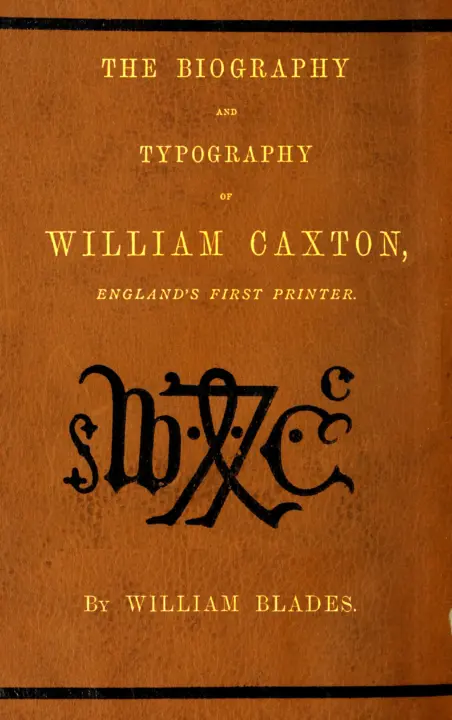
"The biography and typography of William Caxton, England's first printer" by Blades is a historical and bibliographical study written in the late 19th century. It charts Caxton’s life and career alongside a meticulous analysis of his printed output, types, devices, and working methods, situating him within the rise of printing in England and the Low Countries. Drawing on company records, embassies, and court circles, it follows Caxton from Kentish origins through mercantile Bruges to Westminster, while also cataloguing his editions and discussing their rarity and features.
The opening of the volume sets the scope: a revised reprint that condenses earlier scholarship and adds notes on Caxton’s printer’s device and punctuation, while underscoring printing’s civilizational impact. It then outlines the plan—first a documentary life of Caxton, then detailed descriptions of his books by type, with appendices from Mercers’ and Bruges records. The narrative begins with Caxton’s birth in the Weald of Kent amid strong Flemish influence, a dialect anecdote about “eyren/eggs,” and a sober weighing of name variants to suggest a likely Causton connection. It proceeds to his 1438 apprenticeship to the wealthy mercer Robert Large, depicting London apprentice life, Large’s household and will, and vivid city scenes—dearth, pageantry, religious persecution, and civic unrest—culminating in Caxton’s departure abroad. In Bruges he emerges as a prosperous merchant, then Governor of the English Nation (Merchant Adventurers), mediating trade disputes, enforcing measures, and corresponding with London while treaties lapsed and were renewed; he begins translating the Recuyell under Duchess Margaret’s patronage and likely moves toward printing with Colard Mansion. A broad survey follows of 15th‑century bibliophilia—royal and ducal libraries in France and Burgundy, Louis de Bruges’s collection, English patrons—and of the book trades’ guild structure at Bruges and Antwerp. Finally, an initial technical chapter contrasts manuscripts and early print, explaining materials, binding habits, blank leaves, one‑page printing, signatures, hand‑painted initials, undated colophons, and typeforms that closely imitated contemporary handwriting.
Introduction adapted from the source catalogue; source summaries may be automatically generated.
Free to read · English · 119,581 words · No account needed
MAKE TIME FOR A GOOD BOOK
On by default. Untick to stop anonymous reading totals. Each page counts after 10 seconds in view. How this works.
Anonymous counting is on unless you have switched it off.
The revival of literature in Europe, commencing with the latter part of the fourteenth century, its steady growth, and its wonderful development in the succeeding age, have been dwelt upon by many writers. Nowhere was this revival more strongly marked than in France and the Low Countries.
The French kings and the princes of the royal blood had been for many generations the constant patrons of authors and of all engaged in the production of books. In 1350, John II, who has the credit of having founded the library of the Louvre, ascended the throne of France. No particulars concerning the library of this monarch have been preserved, and it was probably of no great extent; but his literary tastes descended to each of his four sons, and from the inventories which have come down to us of the libraries of these princes, we obtain very interesting information as to the number, the description, the illuminations, the bindings, and the market value of the books which they contained. Charles, the eldest son, who succeeded his father in 1364, had a highly-developed taste for everything connected with the fine arts. He greatly increased the number of volumes in the Louvre library, so that in the ninth year of his reign, when Gilles Mallet drew up a catalogue, they amounted to 910, the greater number of which were written on fine vellum, and were magnificently bound, and enriched with gold clasps and precious stones. This library, the Duke of Bedford, when Regent of France, is supposed to have transported to England in 1429. In after years, a few of the volumes returned to France, but the famous library of the Louvre never recovered its ancient splendour. Louis, Duke of Anjou, second son of King John, shared to a great degree the love of books and works of art displayed by his elder brother. The third son, John, Duke of Berry, formed an extensive library at his château at Bicêtre, near Paris, inferior only to that of the king himself. But of all the king’s sons, Philip, who soon equalled his eldest brother in power, far surpassed him in the number and splendour of his literary treasures. King John’s second wife was Jane, widow of the Duke of Burgundy, and in her right he succeeded to that duchy on the death of her only son. When dividing his kingdom among his four sons, King John apportioned Burgundy to the youngest, Philip the Hardy, who, by his marriage with Margaret, only daughter and heiress of Louis, Count of Flanders, inherited, on the death of his father-in-law in 1384, a large extent of territory. Philip, who has the character of having been a generous prince, was well read in the literary lore of his age. He was passionately addicted to music and to the collection of fine books, and he spared no expense in the employment of artists, and in the purchase of their most choice productions. Nor did he rest satisfied with the encouragement of artists alone, but gathered round him some of the most learned and able authors of his time, who enriched his library with new works. This prince died in 1404, and was succeeded by his son, John the Fearless, who, although distracted by continual wars, maintained and even added somewhat to his father’s library. Christine de Pisan received one hundred crowns for two books which she presented to him. But all previous patronage is eclipsed by the encouragement given to literature by Philip the Good, who succeeded to the dukedom of Burgundy upon the decease of John in 1419. At Bruges, where he kept his court, he gave continual employment to a crowd of authors, translators, copyists, and illuminators, who enriched his library with their best productions, and did not forget to sing the praises of their generous patron. David Aubert, a celebrated scribe, thus describes the duke in 1457:--“This renowned and virtuous prince has been accustomed, for many years past, to have ancient histories read to him daily. His library surpasses all others, for from his youth he has had in his service numerous translators, scholars, historians, and scribes in various countries, all diligently working, so that now there is not a prince in all Christendom who has so varied and so rich a library.” In the account which M. Barrois gives of the library of this sovereign, he enumerates nearly two thousand works, the greater part being magnificent folios on vellum beautifully illuminated, and bound in velvet, satin, or damask, studded with gems, and closed by gold clasps, jewelled and chased. Many of these are still preserved in the Royal Library at Brussels.
Your reading position is saved on this browser. Take it to another device with a library code. Reading pages adapt to text, rather than matching a printed edition.
William Blades
William Blades

William Blades
BEHIND THE BOOK
This eBook is for the use of anyone anywhere in the United States and most other parts of the world at no cost and with almost no restrictions whatsoever. You may copy it, give it away or re-use it under the terms of the Project Gutenberg License included with this eBook or online at www.gutenberg.org. If you are not located in the United States, you will have to check the laws of the country where you are located before using this eBook. Read the source licence.
The original source file, including credits and licence, is retained by this library. Request an original-format copy at no charge. Please include the book title and Project Gutenberg identifier #78654.
KEEP YOUR CURIOSITY GOING
Cécile Tormay

Moritz Busch
John L. Ransom
Frances Wright
Cécile Tormay

Mabel Potter Daggett